She Married a Mafia Boss for Survival, Then Fell in Love with the Son Who Hated Her Most
The Mafia Patriarch Bought A Young Wife To Pay Her Family’s Debt — Then His Son Fell In Love With Her In The House Of Secrets
She arrived at the Conti estate in the rain with one suitcase and no real choice.
Her mother’s debt was erased the moment she became the old mafia king’s wife.
But the son who hated the arrangement saw the truth in her eyes—and that was where the real danger began.
Discover more
Crafts
Missing Persons & Abductions
Child Care
The night Sarah Voss arrived at the Conti estate, the rain came down like a punishment from God.
She sat in the back of the black Mercedes with her single suitcase pressed between her knees, her hands folded neatly in her lap, her spine straight, her face still, her whole body arranged into the kind of practiced quiet she had learned over twenty-two years of being the good daughter.
The quiet one.
The useful one.
The daughter who did not ask for too much because life had taught her early that asking did not guarantee receiving.
The leather seat was cold despite the heat blowing through the venTS. Outside the tinted windows, New York City dissolved behind her.
The familiar noise of buses, traffic lights, corner stores, and people arguing under awnings slowly gave way to the expressway.
Then the expressway gave way to a private road lined with iron-black trees, their branches bending beneath the rain like witnesses unwilling to speak.
And then there was only darkness.
Rain.
And the slow, terrible understanding that she was not going home again.
Her mother had cried.
That was the detail Sarah kept returning to, pressing her mind against it like a thumb against a bruise.
Diane Voss had not cried at her own father’s funeral.
She had once set a broken wrist herself with a dish towel and a wooden spoon rather than pay for the emergency room.
She had fought landlords, suppliers, inspectors, creditors, and grief with the same thin, exhausted stubbornness that kept their family restaurant alive long after logic said it should have died.
But when she told Sarah what had been arranged, she wept.
The debt was four hundred and sixty thousand dollars.
It had started, as these things always did, with something small.
A business loan to keep Voss Trattoria open after Sarah’s father got sick.
Then a second loan when the pipes burst in winter and flooded the kitchen.
Then a third when the pandemic emptied the tables and left red-checkered tablecloths sitting under dust like proof of a life that used to exist.
By the time Sarah’s father died of a stroke two years earlier, the debt had been sold three times, and each sale carried it higher.
Interest stacked on interest.
Penalties became threaTS. Threats became visiTS. Then the debt landed in the hands of people who did not use courts to collect.
“He’s an old man,” Diane had said, as if age were mercy.
“He has a big house.
You’ll want for nothing, Sarah.
Nothing.”
What she had not said, what she had not been able to say while looking her daughter in the eye, was the rest of it.
The old man was Enzo Conti, patriarch of the most powerful crime family on the eastern seaboard.
The arrangement was not employment.
Not companionship.
Not a position in the household.
Marriage.
A quiet civil ceremony attended by a notary and two men whose jackets failed to hide their holsters.
The price of Diane Voss’s freedom was her youngest daughter’s life.
Sarah had not fought it.
That was the thing she could not forgive herself for as the Mercedes moved through the rain toward the estate.
She had not screamed.
She had not thrown anything.
She had not run.
She had listened to her mother explain.
She had thought about the little restaurant with the red tablecloths, her father singing off-key behind the counter, her mother’s hands cracked from dishwater and flour.
She had thought about men coming to collect from a woman who had already lost too much.
Then she had said yes.
Because yes was the only word that had ever kept her family safe.
The car stopped before a wrought-iron gate shaped like vines that had grown too long and turned cruel.
A man appeared from the guardhouse, checked something on a tablet, and waved them through without looking at her.
She was cargo.
She was already accounted for.
The house rose ahead of her in the headlighTS.
No.
Not a house.
The estate.
She had to recalibrate her vocabulary for this new world.
Three stories of pale stone, dark windows, climbing ivy, and the kind of weight that had not been built so much as accumulated.
Century after century of money and violence pressed into the ground.
There were lights on the first floor.
Someone was awake.
The driver opened her door without speaking.
Sarah stepped into the rain, and immediately a woman appeared beside her with an umbrella.
She was small, around sixty, with compressed, efficient movements—the posture of someone who had served powerful people for a very long time and survived by making herself functionally invisible.
“Mrs. Conti,” the woman said.
The name hit Sarah in the stomach.
She was not used to it.
She might never be used to it.
“Come inside,” the woman continued.
“Mr. Conti is waiting in the sitting room.
I’m Rosa.
I manage the household.
If you need anything, you come to me.”
Sarah followed her up wide stone steps and through a door held open by a man whose suit was too well tailored for a butler.
Inside, there were marble floors, a staircase curving upward into shadow, oil paintings in gilded frames, and the scent of woodsmoke mixed with something older and darker beneath it.
Money.
Power.
The specific odor of a place that had never apologized for itself.
“Mr. Conti is eighty-one,” Rosa said as they walked down a corridor lined with glass cases.
“He tires easily.
Tonight, he will speak with you briefly.
Tomorrow, there will be more time to become acquainted.”
Sarah absorbed this.
She was being prepared.
Delivered.
Managed.
The sitting room was enormous and warm, firelit and lined with bookshelves that reached the ceiling.
In a chair beside the fireplace, wrapped in a wool blanket despite the season, sat Enzo Conti.
He was old.
Older than Sarah expected, though she did not know why she had expected anything.
His hair was white like old paper.
His hands were spotted and folded over the blanket’s edge.
But his eyes were still dark and sharp, moving over her with the deliberate calculation of a man who had appraised people for nearly eight decades and rarely been wrong.
“Come closer,” he said.
His voice was rough but resonant, holding an old Italian accent that sixty years in New York had not fully erased.
Sarah came closer.
She stood before him the way she had stood before principals, loan officers, hospital billing clerks, and every authority figure that had shaped her life by approval or disapproval.
Quiet.
Still.
“You’re younger than I thought,” he said.
“I’m twenty-two.”
“I know how old you are.”
He studied her face.
“Sit down.
You look like you’re waiting to be executed.”
She almost said, Aren’t I?
But she had learned which thoughts to keep behind her teeth.
She sat on the edge of the sofa across from him.
“Your family’s debt is cleared,” Enzo said.
“I want you to understand that.
The moment you walked through my gate, it was cleared.
Your mother’s house is hers.
Whatever you came here fearing about what might happen to them, that fear is finished.”
Sarah looked at him.
“Thank you.”
He made a dismissive sound.
“Don’t thank me.
I want a wife, not a grateful orphan.
I have a household that needs a woman at its center.
I have a reputation that requires the appearance of stability.”
He paused.
“I am also, as you can see, not long for this world.
I want someone to receive what I leave behind with dignity.
That is the transaction.”
It was the most honest thing anyone had said to her in monThS.
Absurdly, she respected him for it.
“There is one other thing,” Enzo said.
Something in the room changed.
Subtle as air pressure before a storm.
“My son.”
Sarah waited.
“Luca,” he said.
Even the old man’s voice tightened around the name.
“He will not welcome you.
He has feelings about everything.
About me.
About this house.
About what it means to belong to the Conti name.
I want you to understand that his feelings are not your problem.
You are my wife.
This house is yours.
If he creates difficulty, you go to Rosa.
She handles Luca.”
Sarah thought, No one handles Luca.
She did not know why.
She had not met him.
But something in the way Enzo said the name, something braced and old and complicated, told her Luca Conti was not a man who could be handled.
“I understand,” she said.
Enzo looked at her a moment longer, then nodded once as if she had passed an initial examination.
“Rosa will show you your rooms.
We will dine tomorrow.”
He picked up a book from the side table.
Dismissal.
Sarah followed Rosa up the curving staircase and down a long corridor of closed doors, each silent as a held breath.
Her rooms were at the end of the east wing.
A bedroom.
A sitting room.
A bathroom with marble the color of old bone.
Everything was beautiful.
Everything was cold in the way unused things are cold, prepared for occupation but not for living.
Rosa left her at the door with a brief, not unkind look.
Sarah stepped inside, set her suitcase on the floor, and stood in the center of the bedroom.
She did not cry.
She had promised herself she would not cry.
She listened to the rain against the windows and tried to identify the shape of the life that had just begun.
That was when she heard it.
Footsteps in the corridor outside.
Unhurried.
Deliberate.
They moved past her door.
Stopped.
A pause long enough to be intentional.
Then the footsteps continued and faded.
Sarah stood alone in the lamplight and felt, for reasons she could not explain, as if someone had just looked at her through a wall.
Luca Conti had driven back from Manhattan because ignoring his father’s summons any longer would have required a level of deliberate cruelty he was not in the mood to perform.
Enzo had sent three men with messages after Luca ignored the first two, and coordinating the rejection of all three became more work than simply showing up.
Luca arrived at eleven in the rain, driving himself because he did not like being chauffeured.
He was always thinking about exit strategies, and exits were easier to control when his hands were on the wheel.
He parked at the side entrance, entered through the kitchen, and climbed the back stairs without being intercepted.
He preferred it that way.
He stood outside the east-wing bedroom for seven seconds.
He did not touch the door.
Did not knock.
He simply stood in the dark corridor, aware of the light beneath the door and the silence beyond it, and felt the particular cold fury that had been his primary emotional register for most of his thirty-four years sharpen into something more precise.
His father had bought a wife.
The old man had done many things over decades that Luca cataloged with the patient attention of someone who intended to use every item on that list someday.
But this?
Marrying a young woman.
Importing her like furniture to fill a role in the theater of domestic stability Enzo had maintained beside his empire.
This was new.
And strategic.
Enzo Conti did nothing purely for comfort.
The frailty, the wool blanket, the firelight—those were theater.
The man had survived four assassination attempts and a federal investigation that lasted eleven years.
He did not need a wife for warmth.
So Luca stood outside her door and thought:
What does she know?
What has she been promised?
What is she here to take?
He went to his own rooms in the west wing and sat in the dark, applying the same analysis to this development that he applied to everything.
He needed to know who Sarah Voss was.
He needed to understand her leverage.
He needed to map her relationship with Enzo before she could be used against him.
And he needed to do it before she settled into the house and began exerting whatever influence she had been brought here to exert.
He slept three hours.
At five, he moved through the house in the blue pre-dawn quiet like a shadow that had learned to walk.
Gym in the basement.
Sixty minutes of focused, systematic physical work.
Coffee in the kitchen alone.
Reports from lieutenanTS.
The empire was his in all but name.
It had been his for six years, since Enzo’s first heart attack made it necessary to transfer operational control while maintaining the fiction of the old man’s authority.
His father held the title.
Luca held the machinery.
And the machinery was vast.
Real estate and construction on the surface.
Beneath it, logistics networks, enforcement, and relationships with politicians purchased over thirty years and kept current with money, favors, and the precise application of fear.
What Luca had built in six years was more efficient and more profitable than anything his father had ever run.
He had also been quietly building the case against Enzo.
Not with authorities.
Luca had little interest in the government’s definition of justice.
He was building it with the families.
The old council that existed mostly ceremonially as the governing structure of organized power on the eastern seaboard.
Enzo had enemies.
Old enemies.
Luca had cultivated them patiently for nearly a decade.
When the time came—and the time was coming with the inevitability of geology—Enzo Conti would be removed with council support.
His assets would be divided.
His age would become a polite excuse.
The old king’s era would end.
Luca would not mourn him.
He was not sure he was capable of mourning him.
He was on his second coffee when Rosa appeared.
“She’s awake,” Rosa said.
Luca did not look up from his phone.
“Good for her.”
“She asked for tea.”
“Then give her tea.”
“I thought you might want to—”
“I don’t.”
Rosa went quiet.
She had worked for the Contis for thirty years, which meant she had watched Luca grow from a furious, self-contained boy into a furious, self-contained man.
Over those decades, she had developed a way of being silent at him that communicated everything she was too professional to say aloud.
“She’s very young,” Rosa said.
“I know.”
“She came with one bag.”
“I know that too.”
“She looked frightened,” Rosa continued.
“Not openly.
She was trying very hard not to be.
But you could see it.”
Luca put down his coffee.
“Rosa.”
“Yes?”
“She’s not a stray cat.”
“No,” Rosa agreed.
“She is a person your father purchased to serve whatever purpose your father has decided she serves.
She is twenty-two years old, and she was delivered here in the rain last night with one bag.
I am telling you this not because I expect your sympathy, but because I expect your intelligence, which usually inclines you toward gathering information rather than dismissing it.”
It was the longest speech Rosa had made to him in approximately four years.
Luca picked up his coffee.
“Fine.
Tell her breakfast is at eight if she wants it.
I’ll be in the study.”
At eight, he was in the study behind the desk that had been his father’s and was now, in every practical sense, his.
He heard her in the dining room across the hall.
Not her voice.
She was apparently as quiet as the house itself.
But small sounds betrayed her presence.
A chair.
A cup.
The soft, particular sound of someone moving carefully in a space they did not yet feel entitled to occupy.
He told himself he would not go in.
He went in.
She sat at the far end of the long dining table in a pale blue sweater and dark trousers, hands wrapped around a cup of tea, looking out at the wet garden.
She did not hear him enter.
For one fraction of a second, he observed her unobserved.
Her profile.
The dark circles lack of sleep had left beneath her eyes.
The way she held herself, careful and contained, as if taking up too much space was a habit trained out of her long ago.
Then she turned.
She did not flinch.
He noted that.
Her face shifted through a brief flash of something he could not name, then settled into stillness.
“You must be Luca,” she said.
“And you must be the new wife.”
She absorbed this without expression.
“Sarah,” she said.
“My name is Sarah.”
He studied her the way he studied everything, with attention that was not quite surveillance and not quite interest, but contained pieces of both.
She was striking.
Not polished or decorative in the way of the women his father had usually preferred.
Striking in a quieter way.
Dark eyes.
Still face.
A person who held things in.
“How much did he tell you?” Luca asked, crossing to the sideboard for coffee.
“About what?”
“About this house.
About me.
About what you’ve walked into.”
She considered.
“He told me you wouldn’t welcome me.
He told me your feelings were not my problem.”
Something almost like amusement crossed Luca’s face.
“That sounds like him.”
“Is it accurate?”
“Which part?”
“Either.”
He looked at her with the full weight of his attention.
“I don’t welcome you,” he said.
“That part is accurate.
As for feelings not being your problem, in this house, everything becomes everyone’s problem.
That is something my father has never admitted.”
She held his gaze.
“I didn’t choose this.”
“I know.”
“I’m not here to—”
“I know what you’re going to say,” Luca interrupted.
“And I do not doubt that you believe it.
But this is my father’s house, which means everything that happens inside it has a reason, and the reason is never what it appears to be.”
He lifted his cup.
“So while I’m sure you are exactly what you seem, I’ll need time to verify that.”
He left without waiting for her response.
Behind him, Sarah sat very still with her tea and looked out at the garden.
Not at the warning.
Though the warning was clear.
At the other part.
I know you didn’t choose this.
He had believed that.
She was not sure why it mattered.
But it did.
Life inside the Conti estate operated according to rhythms Sarah spent her first two weeks quietly mapping.
Enzo rose late and retired early, his days structured around the physical needs of a body failing with unhurried determination.
The physician came every Tuesday and Thursday.
Medications arrived with Rosa’s precision.
Afternoon rest was not called rest, but was rest.
Business occurred in the study with men who arrived through a side entrance and were never introduced to her.
Sarah was expected at dinner.
That was the central domestic performance.
Every evening at seven, the long table was set for two.
Candles lit.
Wine decanted.
Enzo would ask questions as if he were learning a text rather than a person.
Her preferences.
Her history.
Her family.
She answered honestly, because lying had no advantage, and because Enzo had the kind of mind that would detect falsehood the way certain animals detect illness, by instinct before thought.
He was not cruel in the way she had feared.
He was transactional.
A man for whom human relationships were arrangemenTS.
But the arrangements he made were, in his own framework, fair.
He had cleared her family’s debt.
He had given her rooms more comfortable than anything she had known.
He said please and thank you with the habit of a man who understood that manners cost nothing and purchased a great deal.
He had also given her nothing to do.
The house ran itself through Rosa and eight staff members.
There were no children to care for.
No social calendar that required her participation.
No real role beyond sitting at dinner and occupying the title of wife.
She was decorative.
A placeholder.
A space filled without reference to who she was.
So she started reading.
The estate library was extraordinary.
Three thousand volumes, some old enough to require gloves.
History, law, literature, philosophy.
She started with novels, moved into history, then one rainy afternoon found herself deep in Marcus Aurelius, its margins marked in two different hands.
One old and precise.
One newer.
Urgent.
Angry.
She was tracing an underlined passage when Luca found her.
She did not hear him enter.
He moved through the house like its own shadows moved.
She only knew he was there when the light shifted.
He stood in the doorway in a dark suit, tie loosened, wearing the look of a man who had been doing work that left invisible stains.
He looked at the book.
“Meditations.”
“The annotations are fascinating,” she said.
“Two different people.
One of them is very angry.”
Something crossed his face, gone too quickly to identify.
“That’s mine.
The newer notes.”
She looked down.
She had been reading Luca Conti’s private responses to a two-thousand-year-old book without knowing it.
“I’m sorry,” she said.
“I didn’t realize.”
“Don’t apologize.”
He entered the room, not close, but closer.
“What have you been reading?”
“Everything,” she said honestly.
“I don’t have much else to do.”
“No.” He pulled a volume from the shelf without looking, automatic knowledge of the room.
“My father doesn’t believe in occupation.
He believes in presence.”
“Is that different?”
“In his world, presence is the occupation.
Being there.
Being visible.
Becoming the thing that signals what he wants to signal.”
He turned the book over in his hands.
“You are the signal of stability.
Domestic continuity.
A wife at the table suggests a man who is settled, rooted, safe.
It suggests someone with something to protect.”
“And does he have something to protect?”
Luca’s expression became careful.
“He believes he does.”
Sarah watched him choose each word the way a careful person crosses ice.
“You don’t trust me,” she said.
“No.”
“Will you ever?”
“I haven’t decided.”
She appreciated that.
The honesty of it.
The absence of polished comfort.
“What would it take?”
“Time,” he said.
“Observation.
Evidence.”
“Those are things you use to evaluate a business deal.”
“Everything is a deal.
The only question is whether both parties know the terms.”
She thought about that.
“My terms are simple,” she said.
“I want my family safe.
I want to be treated as a person instead of an acquisition.
That is the extent of my agenda.”
“Simple desires.”
“Simple people have them?”
“You are not simple,” Luca said.
It was not a compliment.
It landed stronger than one.
Fact.
He replaced the book and left.
Sarah sat for a long time afterward, holding the Meditations, tracing the urgent underlines with one finger.
The impediment to action advances action.
What stands in the way becomes the way.
She wondered what Luca had been trying to convince himself of.
On her fifteenth day in the house, Sarah made her first mistake.
Exploring carefully, staying only where Rosa indicated she could go, she took a wrong turn in the east wing and came through an unlocked door into a room that was clearly an office.
Not Enzo’s formal study.
A working space.
Screens.
Files.
Maps.
Printed documenTS.
The functional aesthetics of someone who spent real time there.
She touched nothing.
She stood in the doorway for three seconds before backing out and closing the door.
But she had seen enough.
Maps marked with council districts, shipping terminals, city precincTS.
Names.
Routes.
Notes in Luca’s tight handwriting.
She understood then that Luca Conti was not merely the heir to a crime family.
He was the operational center.
The living machinery.
She said nothing.
Not to Rosa.
Not to Enzo.
She filed the knowledge away in the part of herself that had learned growing up in a family full of secrets that some knowledge was safer unacknowledged.
But that night at dinner, she found herself looking at Enzo’s face and asking the question she was too intelligent to say aloud.
Which of them was she really married to?
Three weeks into her residence, Rosa told her there would be a function.
“Mr. Conti’s annual dinner,” Rosa explained with military efficiency.
“The families attend.
Business associates.
Politicians.
Press is managed.
No photographs without consent.
Nothing appears in the papers.
But you will be present.”
“As his wife.”
“As his wife.”
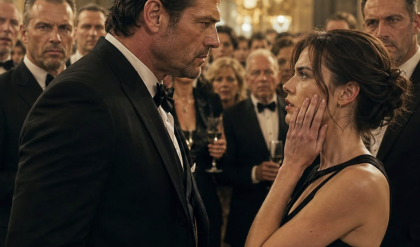
The event was at Nero, the nightclub occupying the top three floors of a Midtown tower.
For fifteen years, it had been the most coveted reservation in the city.
It was also, as anyone who paid attention understood, owned by the Contis.
The veneer was beautiful.
Celebrity clientele.
A Michelin-starred chef.
A wine list journalists wrote about like art.
Beneath the veneer, money moved.
Relationships were maintained.
The city’s power structure gathered to remind itself of its own coherence.
Sarah was given access to a dressing room she had not known existed.
Inside hung clothes fitted to measurements someone had taken or guessed with remarkable accuracy.
Evening wear at the far end.
She stood before it and felt the complicated sensation of beauty purchased as control.
She was being costumed.
The costume was exquisite.
The costume was not hers.
She chose the simplest dress.
Deep burgundy.
Long.
Elegant rather than provocative.
She wore her hair back and the small diamond earrings placed in a velvet box with her name on it.
A gift from Enzo.
Another element in the architecture of her position.
She met Enzo in the foyer at seven-thirty.
He looked smaller outside the house, or perhaps the house had always made him larger.
He examined her, then nodded once.
Approval.
Luca was already at Nero.
She understood this when they arrived because attention subtly realigned the moment the elevator opened onto the private floor.
Black marble.
Candlelight.
Power pretending to be casual.
Luca stood across the room speaking with two men who looked like they expected conversations to be worth their time.
He wore black.
He always wore black, Sarah was learning.
Not as decoration, but as refusal.
A man who used clothing to subtract himself from a room rather than add.
It did not work.
He was impossible to subtract.
There was something about his stillness that made every room organize itself around him without his asking.
He saw her arrive.
She knew because his focus shifted, not quite a look, more like a compass needle moving when north changes.
Then he returned to the conversation.
Sarah navigated the evening on Enzo’s arm.
Names came at her like a test.
Duca.
Mancini.
Ferrano.
A senator.
Two judges.
An investment banker whose handshake lasted half a second too long.
She smiled.
She said the right things.
She gave nothing away.
Near midnight, she found herself briefly alone at the bar while Enzo was absorbed in a corner conversation that excluded wives by its geometry.
She ordered water and looked at the city through floor-to-ceiling glass.
All those lighTS.
All those people living small and large lives without knowing that rooms like this shaped the world beneath them.
“You’re doing well.”
She did not turn.
She knew by the quality of the air beside her that it was Luca.
“Am I?”
“You’re remembering every name,” he said.
“Cataloging everyone in the room.”
“Occupational habit.
I grew up in a restaurant.
You learn faces.”
“A restaurant,” he said.
“My father’s.
He built it from nothing.”
She paused.
“Then lost it the same way.”
Luca was quiet.
They stood side by side at the glass.
Not close enough to be intimate.
Too close to be indifferent.
“The debt was under Voss Trattoria,” he said.
She turned.
“You researched me.”
“Of course.”
“And?”
“You are exactly who you appear to be.
A girl from Queens with a dead father, a desperate mother, and no agenda beyond getting out.”
He paused.
“Which is rarer in this world than you think.”
“Is that your way of saying you trust me?”
“It is my way of saying you are less interesting to me as a threat.”
He finally looked at her, and for one instant the directness of his gaze felt like sunlight after a long interior.
“Which is different from trust.”
“What’s the difference?”
“Trust is active.
Absence of threat is clearance.
You’ve been cleared.”
“I’ll try to contain my celebration.”
Something moved through his eyes.
Maybe the beginning of amusement.
“There’s a man at the end of the bar,” Luca said, voice dropping.
“Blue suit.
He has watched you for twenty minutes.”
“I noticed.”
“Carmine Ricci.
New Jersey logistics.
He has tried to build a relationship with my father for two years.”
“Why are you telling me this?”
“Because he will come speak to you.
Be polite.
Brief.
Tell him nothing about your family, history, or life before this house.”
“Is he dangerous?”
“Everyone here is dangerous.
The degree varies.”
A pause.
“Stay close to Rosa for the rest of the evening.”
He moved away.
Carmine Ricci approached four minutes later.
Sarah was polite.
Brief.
She told him nothing.
It happened gradually after that, the way important things usually happen.
Not in one crystallizing moment.
But by accumulation.
Detail by detail.
Until the weight became impossible to pretend away.
There was the morning Sarah ran in the walled garden behind the east wing.
She had discovered it accidentally, private and overgrown in a way that felt almost intentional.
She began running the perimeter every morning for the simple animal pleasure of movement.
One day, she turned a corner and found Luca sitting on a stone bench with coffee and a book.
He looked up.
She stopped.
For a moment, in early morning silence, they saw each other outside performance.
Not wife.
Not son.
Not threat.
Not asset.
Just two people caught in the unguarded hour before the house put its masks back on.
He returned to his book.
She resumed running.
But the moment stayed with her.
There was the afternoon in the kitchen when Rosa taught her the household recipes.
Sunday gravy that took six hours.
Bread started the night before.
Luca came through looking for something, stopped when he smelled the sauce, and stood at the stove with an expression Sarah had never seen on him.
Unguarded.
Almost grief.
“Your mother’s recipe?” she asked.
“My grandmother’s.”
Then, after a pause, “You don’t have to learn this.”
“I want to.”
He looked at her, attention shifting like a compass.
Then he took a spoon, tasted the gravy, and said, “More basil.”
He left.
She added more basil.
The small instruction stayed with her longer than it should have.
There was the night Enzo became unwell.
A bad night, the physician called it.
Oxygen for several hours.
Sarah sat outside his door wrapped in a blanket because the corridor was cold.
She had her knees drawn to her chest and was aware of how small, young, and frightened she looked.
At two in the morning, Luca came up the stairs.
He stopped when he saw her.
He said nothing.
Then he sat on the floor beside her, back against the wall.
They waited in silence.
Not uncomfortable silence.
The particular silence of two people who did not need to perform for each other in the dark.
“He has survived worse,” Luca said eventually.
“I know.”
A pause.
“Do you want him to?”
The question came out before Sarah could stop it.
Honest.
Reckless.
Luca’s body shifted, recalibrating.
“That is a dangerous question.”
“I know.”
He was quiet a long time.
“He is my father,” he said finally.
Not an answer.
But containing everything he could give.
Sarah nodded.
They sat until Rosa emerged and said Enzo was asking for Luca.
He rose and went in without looking at her.
Sarah remained in the cold corridor, thinking about the exhaustion of loving someone who had hurt you, and whether that specific exhaustion was something she and Luca Conti had in common.
The accumulation worked on both of them.
She saw it in the way he routed himself through the house.
Not avoiding her.
Almost the opposite.
A subtle gravitational adjustment of someone drawn toward what he had decided not to approach.
She would be in the library and hear him stop outside.
Pause.
Then enter for some practical reason that did not require staying as long as he stayed.
A book.
A document.
A window.
A printer.
Then conversation.
Those conversations began to matter.
They carried the electric quality of words neither person wanted to end, carving a shared space out of the air.
Luca had read everything, Sarah discovered.
Not widely.
Deeply.
The same books again and again, margins filled with his thinking.
He had studied law for two years before dropping out, not because he failed, but because he decided formal education was a performance he would no longer maintain.
He had traveled for work, not pleasure, and the work had left marks.
A scar along his forearm from Naples.
A permanent watchfulness in crowds.
The adjustment of someone who learned to read rooms because he once read the wrong room too late.
He learned her too.
The restaurant.
Her father.
The specific dignity and precariousness of Queens childhood.
Her way of moving through difficulty quietly, processing internally until the shape of her decision was complete.
He noticed that she noticed beauty with painful intensity, as if beauty were owed attention.
He watched her notice things.
She caught him watching sometimes, and he no longer looked away.
That was new.
That was dangerous.
She stopped sleeping well.
This was the body’s testimony against the mind.
Every night, she reminded herself:
She was married to Enzo Conti.
Luca was his son.
The architecture of the situation was not only complicated.
It was dangerous.
Power.
Age.
Debt.
Control.
Succession.
Everything around her had been built from choices she did not have.
None of that stopped the devastating certainty taking shape inside her.
She was falling in love with Luca.
It was the map room that changed everything.
Six weeks after her arrival, Luca opened the door to his working office and stood aside to let her in.
No explanation.
No preamble.
Sarah understood at once that this was significant.
The room she had accidentally seen before.
The maps.
The files.
The nerve center.
She stood at the threshold because crossing it felt like an agreement.
A mutual acknowledgment of something neither of them had spoken aloud.
Then she crossed.
Inside, three dark screens lined one wall.
A functional desk held organized documenTS. On the far wall, operational maps were covered in color-coded pins, marked routes, and notes in Luca’s urgent hand.
“Sit,” he said.
She sat.
He remained standing, studying her with the focused look of a man making a decision he had already made but was testing one final time.
“What I tell you does not leave this room.”
“All right.”
“I am not asking for your word,” he said.
“I am telling you the terms.”
“I understand the terms.”
He sat across from her and laid out the truth with flat clarity.
The empire.
Enzo’s declining health.
The succession question.
The council.
The families.
The patient construction of a case that would allow them to withdraw support from Enzo without triggering destabilization that would cost lives.
Sarah listened without interrupting.
When he finished, she asked, “Why are you telling me this?”
“Because you are going to be in this house for the duration.
Because you are not stupid, which means you’ve already assembled most of it.
I would rather you have the accurate version than your own.”
“And because you need something from me.”
He did not evade.
“Yes.”
“What?”
“My father speaks to you at dinner.
He tells you things he tells no one else anymore.
I want to know what he says.”
Sarah was quiet.
“You want me to spy on your father.”
“I want relevant information.”
“That is an elegant way to say yes.”
He almost smiled.
“Will you do it?”
She thought with the care the question deserved.
She was not naive.
She knew this conversation was itself manipulation.
Luca had an agenda.
Enzo had warned her of that indirectly.
The house had warned her more clearly than either of them.
“I’ll tell you what I think matters,” she said finally.
“I won’t report on him like a spy.
I won’t inventory his conversations.
But if he tells me something that affects people in this house or outside it, I’ll tell you.”
“That is less than I asked.”
“I know.
It is what I can offer.”
“Why the distinction?”
“Because he is an old man,” she said.
“He may have done terrible things.
He probably has.
But he has been genuinely kind to me.
I will not betray that kindness wholesale just because…”
“Because what?”
She met his eyes.
“Because I want you to trust me.
And I’d like to deserve it.”
The silence that followed was charged.
Not comfortable.
Not uncomfortable.
A silence doing the work of a sentence neither of them would say.
“All right,” Luca said finally.
“Your terms.”
She stood to leave.
At the door, he said her name.
She turned.
“The map in the corner,” he said.
“The one with blue pins.”
She looked.
 His Dead Foot Moved.
Then the Graves Began Speaking.
Queens.
Her neighborhood.
“That’s my neighborhood.”
“I know.”
“What are the pins?”
“The properties leveraged against your family’s debt.
Over the last three years, I have been clearing them quietly.
The people who owned those notes no longer own them.
Most have been voided.”
Sarah stood very still.
“Why?”
Luca did not answer for a long moment.
When he did, it was not an answer to the literal question.
“You should go.
It’s nearly dinner.”
She went.
In the east-wing corridor, she pressed her palms against the cool wall and breathed.
Enzo had cleared her family’s debt.
That was the price of her presence.
But Luca had been dismantling the surrounding web—the neighborhood debts, the financial traps that had made her family’s collapse possible.
Quietly.
Without asking gratitude.
Without telling her.
She did not know what to do with the knowledge except hold it carefully, as one holds something delicate that cannot yet be set down.
The fight between Luca and Enzo came at the end of the second month, on a Tuesday when a cold front turned the sky iron-gray.
Sarah did not hear it begin.
She was in the library when raised voices reached her.
One rough and old.
One controlled and hard.
The sound carried the architecture of a conflict with a long history.
She knew she was not meant to intervene.
She sat with her closed book in her lap and listened.
She learned the shape of it afterward from the house itself.
From Rosa’s economy of answers.
From the silence after, tense as the pause after a tree falls.
At dinner, Enzo was quieter than usual.
He ate without appetite.
For the first time in her presence, he looked his age.
“Luca and I disagreed,” he said near the end, as if she had asked.
“I’m sorry.”
“Don’t be.
We disagree about many things.
It is the nature of the relationship.”
He turned his wine glass without lifting it.
“He is very capable.
The most capable person I have known, and I have known many capable people.”
Sarah understood this mattered.
He was giving her something rare.
A genuine admission.
“Does he know you think that?”
Enzo made a dry sound.
“He would not believe it.”
“Why?”
“Because I spent much of his childhood telling him the opposite.”
He lifted the wine now.
“A man can be wrong, Mrs. Conti.
Even a man like me.
He can be wrong and discover it too late, when there is no corrective left except time.”
He looked toward the fire.
“And I am running low on time.”
Sarah said nothing.
Enzo, she had learned, did not want comfort.
He wanted witness.
That evening, after Enzo retired, she found Luca in the walled garden.
He stood in the far corner among unpruned rose bushes, smoking.
She had not known he smoked.
It seemed hidden and deliberate, the small act used to contain something larger.
She should have gone back inside.
She walked toward him.
He heard gravel beneath her feet and turned.
In the lamplight from the house, his face looked tired in a way it never did during the day.
The surfaces were down.
The effort of maintaining control was briefly visible.
“I didn’t know you smoked.”
“I don’t.
Except occasionally.”
“Do you want to be alone?”
“No.”
The answer surprised her.
She stood beside him while he finished the cigarette, the city glowing beyond the wall in pink-orange haze.
“He said you were right about something,” she said eventually.
Luca looked at her.
“He didn’t say what.
But he said you were capable.”
“He said that.”
“Not exactly those words.
But that was the shape of it.”
Luca looked away.
His jaw worked.
“He said it too late.”
“Maybe,” Sarah said.
“But he said it.”
“Why are you telling me this?”
“Because you should know.
Not as information.
Just because.”
He turned.
They were close.
Closer than they had ever been outside public performance.
The specific closeness of a garden at night, where darkness adjusts the rules.
She saw control in his eyes.
Beneath it, something else.
Hunger.
Not only for her.
For something his life had never supplied.
The starvation of people who learned to want nothing because wanting was always punished.
Sarah knew that hunger.
She lived inside it.
“Sarah,” he said.
Her name in his mouth had become weighted.
Careful.
Doing more work than names usually do.
“Don’t,” she whispered.
He went still.
“Don’t say whatever you are going to say next.
I think we both know we are standing close to something we cannot come back from.
We are both intelligent enough to know that.”
“And?”
“I need more time to think.”
“About?”
“Whether thinking is still useful.”
Something moved across his face.
Not amusement.
Not softness.
Something more complex and more dangerous.
He took one step back.
A careful inch of distance.
A controlled retreat.
“Go inside,” he said.
She did.
That night, she lay in bed and counted reasons.
She was married to his father.
She was here under economic coercion.
Luca had asked her for information.
His goal was to dismantle everything Enzo had built, presumably including arrangements Enzo had made, including her.
Any attachment formed here was formed inside power, constraint, calculation.
She counted eleven reasons this was impossible.
Eleven was enough.
It changed nothing.
It happened on a Wednesday in November, in the library at ten in the morning, when the house was quiet because Enzo’s physician was present.
Sarah sat in the east window seat, looking out at the walled garden where the last autumn roses had gone.
Luca was across the room with files, working in parallel silence, something that had become without naming it the best part of her day.
“You’ve stopped reading,” he said.
She looked over.
“I was thinking.”
“About?”
“Whether intelligent people in genuinely foolish situations are more or less foolish than unintelligent people in the same situations.”
“Because they know better?”
“Yes.”
“That isn’t foolishness,” Luca said.
“That is just a harder version of the same thing.”
She looked at him.
He had closed his files.
His attention was fully on her.
And Sarah thought about the garden, the eleven reasons, and two months of careful nearness.
“I have thought about this enough.”
She stood.
Crossed the room.
Every step mattered.
Six feet became four.
Four became two.
She stopped in front of him.
He had not moved.
Had not reached for her.
Only watched her come with an expression so carefully controlled it was its own confession.
“I know all the reasons this is a terrible idea,” she said.
“So do I.”
“And I’ve decided thinking is finished.”
He rose slowly, one fluid movement of a man using every ounce of physical control he had.
He stood close enough that she could feel the warmth of him.
“If I do this,” he said, voice low, “there is no simple version.”
“I know.”
“This house.
My father.”
“I know.”
“You will be in danger.”
That was the most honest thing he had said because it was the only thing he clearly did not want to say.
“I’m already in danger,” Sarah said.
“I’ve been in danger since the night I arrived.
At least this kind is…”
“What?”
She looked at him.
“Mine.
At least this is something I’m choosing.”
For a long moment, Luca looked at her with those dark, careful, hungry eyes.
Then she saw the decision.
The shift.
The lowering of the last defense.
He lifted one hand and touched her face.
Just her face.
His thumb against her cheekbone.
The gentleness undid her more completely than force ever could have.
He kissed her.
Not desperately.
Not violently.
He kissed her like a man who had waited a long time and, now that waiting was over, was in no hurry at all.
Deliberate.
Thorough.
As if learning something he intended to remember permanently.
His hand moved to the back of her head.
She placed both palms against his chest and felt his heartbeat.
Not controlled.
Rapid.
Huge.
The body’s honesty against the face’s discipline.
When they stopped, they stood forehead to forehead in the morning light, both breathing.
“Sarah,” he said.
“Don’t apologize.”
“I wasn’t going to.”
The slight fracture in his voice was the most intimate thing she had ever heard.
“What happens now?” she asked.
“We’re careful.”
“How careful?”
“Absolute.
In this house, in front of everyone—Rosa, my father, staff, anyone through those gates—nothing.
Nothing that wasn’t there before.”
“Yes.”
“Can you do that?”
She thought about the years she had spent managing her face, keeping her interior life behind her teeth.
“Yes.
Can you?”
Amusement moved through his eyes.
Full, unguarded, the first time she had seen it.
It transformed him.
“Probably not,” he said honestly.
“But I’ll try.”
She stepped back.
Picked up her book.
He picked up his files.
The library settled around them again, but the air had changed.
The room felt like after lightning.
After something that could not be undone.
She was glad it could not be undone.
They built the secret with the exhausting care secrets require.
The estate was not empty.
Nine permanent staff.
Rosa.
Security.
Three men rotating shifts, knowing the house the way soldiers know terrain.
Enzo, whose body declined but whose intellect remained sharp after sixty years of reading people who tried to deceive him.
And visitors.
More visitors now.
The succession question was drawing the families like weather.
Men came and went.
Lunches.
Dinners.
Late meetings in the study.
The house became more occupied, more watchful.
So they were careful.
In common spaces, they remained what they had always been.
Cautiously civil.
A nod in the corridor.
A brief word over coffee.
Minor acknowledgments between two people cohabiting without warmth.
Sarah performed this with the ease of someone raised to hide her interior life.
Luca performed it with the precision of a man who had practiced being one thing on the surface and something entirely other beneath.
Their time was stolen.
An hour in the garden after the ten o’clock security check.
Library mornings when Enzo was with his physician.
Once, Luca’s car in an underground garage in Midtown, engine off, windows slowly fogging while the city moved three floors above them.
They talked for two hours there.
Those conversations built something.
A shared interior world.
He told her about Naples, where his mother was from, where he spent childhood summers before she died and the summers ended.
He told her about law school, about constitutional law, about realizing power was always provisional, always dependent on those who held the balance.
He told her carefully, partially, about the six years since he took operational control.
The moral accommodations he had made.
The ones he refused.
The lines he drew.
The cost of drawing them.
She told him about her father’s restaurant in winter, tables set, kitchen alive, her father singing constantly and terribly with enormous conviction.
She told him about the year after her father died, the anxiety at four in the morning, the way fear arrived like a tide.
She told him about saying yes to her mother.
Not just the word.
The silence before it, where she felt the exact shape of everything she was giving up.
“Did you hate her for asking?” Luca asked.
“No,” Sarah said.
“I couldn’t.
She was drowning.”
“But you were too.”
“I was drowning with her.
This was the only way to stop.”
She paused.
“It sounds terrible, but there is relief in having choice removed.
I didn’t choose this house.
I didn’t choose your father.
I didn’t choose…”
“What?”
“You.”
The word landed softly in the dark car.
“I didn’t choose any of it.
Which means I also didn’t choose wrong.”
“You could leave,” Luca said.
The flatness cost him.
“When this is over, when my father’s position changes, you’ll have real choices.”
“I know.
That is not what I mean.”
“Then what?”
She looked at him in the orange city light.
“What I mean is that being here with you right now—I chose that.
That part is mine.”
He looked at her as if she had handed him something he did not know how to hold.
Then he kissed her.
Above them, the city continued.
Indifferent.
Brilliant.
They remained in the small, private dark.
Sarah was happy.
She knew it with a kind of quiet astonishment.
Inside a situation that was genuinely precarious, in a house owned by the man she was technically married to, falling in love with his son in stolen hours, she was still happy.
She knew it could not last.
Everything about this world told her it could not.
But she had read enough Marcus Aurelius to understand that what cannot last is not without value.
Temporariness is not an argument against beauty.
It is the honest condition of beautiful things.
So she held on.
To Luca.
To the secret.
To the part she had chosen.
Marco Duca arrived in December on the pretext of business dinner and stayed three days.
He was thirty-eight, handsome in the broad, confident way of men who had always been rewarded for being handsome.
He moved through the estate with ease, as if he had been there before and expected to be comfortable.
“One of the three men most likely to contest the succession,” Luca told Sarah in the garden the night before Marco’s arrival.
“Not to claim New York.
He has Boston.
But as kingmaker.
His support matters.”
“Do you want it?”
“I want his neutrality.
Support creates obligation.”
The next morning, Sarah received Marco at breakfast with pleasant neutrality.
He was charming.
That was his primary characteristic.
Warm, practiced, enveloping charm designed to establish intimacy quickly and use it.
Sarah recognized the variety.
Salesmen.
Politicians.
Her mother’s cousin who borrowed money four times and never repaid it.
Warm people bore watching more carefully than cold ones.
The cold ones were honest about their edges.
“You’re nothing like I expected,” Marco said on his second morning.
Luca was not present.
“What did you expect?”
“Someone more decorative.”
He smiled as if it were a compliment.
“More obviously acquired.”
“I think Mr. Conti’s tastes are more complex than that,” Sarah said pleasantly.
“And what are your tastes, Mrs. Conti?”
“In what sense?”
“Any sense you like.”
She looked at him with calm directness.
“I’m not sure I know you well enough to discuss my tastes, Mr. Duca.”
His smile became genuine.
“You will be interesting to know.”
“I hope you have a productive visit.”
That evening in the garden, she told Luca.
“He was feeling you out,” Luca said.
“I know.”
“For leverage.”
“He kept circling the same territory.
My life before.
My family.
How I came here.
He knows the debt story, the public version.
He wants the private one.”
Luca went very still.
“He is looking for coercion.”
“Yes.”
“If he establishes that the marriage was coercive, he can challenge legitimacy, which challenges estate distribution and succession.”
“Does that affect your position?”
“If my father dies without clean succession, yes.”
He paused, calculation moving behind his eyes.
“He came here to find you.”
“I thought so.”
The silence between them became protective.
Sarah realized this was the first time she had brought him information not because it was right or promised, but because she did not want him caught off guard.
He touched her face in the dark.
Brief.
Precise.
Risk calculated and accepted.
“He leaves in the morning,” Luca said.
“Stay away from him until he does.”
“I already decided that.”
He studied her.
“You knew what he wanted and handled it before telling me.”
“I rarely need you to tell me what to do.”
The almost-smile touched his eyes.
“Go inside.
You’re cold.”
“So are you.”
“I am always cold.”
She understood by then that this meant something different from what it appeared to mean.
“I’m used to it,” he said.
She went inside without looking back, feeling behind her the warmth of a man accustomed to cold and discovering, without vocabulary, that it was no longer entirely true.
Rosa knew.
Sarah understood not through one revealing moment but through accumulation.
The way Rosa adjusted library routes when Luca was there.
The way garden security checks happened earlier on certain nighTS.
The way she once said while folding linens, “This house has many windows.
Most of them look inward as well as out.”
Nothing else.
Just that.
Sarah thought about it for three days before going to Rosa in the kitchen.
“You know,” Sarah said.
Rosa stirred Sunday gravy.
“Know what, Mrs. Conti?”
“Rosa.”
The housekeeper set down the spoon.
“I know many things about this house.
That is my job.”
“And this?”
“Nothing.
That is also my job.”
“Why are you protecting us?”
“I am not protecting you,” Rosa said.
“I am managing the situation in the way that causes the least harm to the most people.”
“What is the difference?”
“Protection implies I have taken a side.
I have not.
I am managing household dynamics in the way I judge best for long-term stability.”
She paused.
“I have been with the Contis thirty years.
I have accommodated many things.
What I will not accommodate is unnecessary suffering.
Mr. Luca has sufficient suffering built into the structure of his life.
So do you.
I see no reason to add to it.”
Sarah looked at her for a long time.
“He doesn’t know.”
“No.”
“Should I tell him?”
“That is your decision.
But Mr. Luca’s relationship with being managed, even protectively, is complicated.
He will feel surveilled.”
Three days later, in Luca’s parked car in the Midtown garage, Sarah told him.
“Rosa knows.
She has been protecting the situation.
She has not told Enzo.”
He received this with stillness.
Then anger tightened his face.
Then, slowly, recalibration.
“How long?”
“I don’t know.
Long enough to adjust security.”
“She adjusted the security schedule.”
“Yes.”
He looked at the fogged window.
“She loves you,” Sarah said.
“That is what I understand from it.
She has watched over you for thirty years.
She sees you.
She sees us.
She chose to help.”
“She chose to know something that could get her killed.”
“She has known things about this house for thirty years that could get her killed.
One more thing does not change the math.”
He was quiet.
Then, unexpectedly, he said, “She used to walk me to school after my mother died.
For a year.
Until I told her I was too old.
She stopped.
She never made me feel bad about it.”
His voice shifted.
“I never thought about how much she has seen.”
“Maybe it’s time to.”
He reached across the car and took Sarah’s hand in the middle of the day, where anyone passing could see.
He held it with the careful pressure of someone learning that what he held mattered.
January brought a cold that settled into the estate like a permanent resident.
With it came a change in Enzo.
He did not withdraw from Sarah.
Their dinners continued.
Their careful exchange remained.
Against all odds, something like warmth had grown between the old man and the young wife he had acquired.
But he withdrew from business.
Meetings became less frequent.
Men who came through the side entrance began asking for Luca instead.
Rosa redirected them with ease that suggested the redirection had been prepared.
Enzo knew.
With the intelligence that had built and maintained an empire for forty years, he knew what was coming.
He gave Sarah things.
Not extravagantly.
Enzo was not extravagant.
Intentionally.
Her mother’s debt confirmation in writing.
Access to a bank account in Sarah’s name alone.
A book from the library.
A nineteenth-century collection of Italian poetry.
The inscription inside was not Enzo’s hand.
For my son, who loves words he pretends not to love.
Sarah held it a long time.
Then she went to find Luca.
He was in the map room.
When she appeared, he looked up and went through the rapid recalibration she knew now.
Public neutrality.
Private adjustment.
Full attention.
She held out the book.
He looked at it.
Did not move.
Then he crossed the room and took it.
His thumb brushed the inscription.
“My mother,” he said.
“I thought so.”
His face changed in small incremenTS.
No collapse.
No open grief.
But Sarah had learned to read him.
This hurt.
And mattered.
“He gave it to me,” she said.
“But I think it belongs to you.”
Luca shook his head once.
“No.
He gave it to you because he knew you would bring it to me.”
“Why would he do that?”
“Because apparently even old kings become sentimental when they see the end.”
“Luca.”
He closed the book.
“He is arranging something.”
That something revealed itself two weeks later.
The council meeting was held at Nero on a night when snow turned Manhattan white and silent.
Enzo insisted on attending.
Rosa argued.
The physician argued.
Luca argued with a controlled fury that made everyone else quieter.
Enzo won, because he was still Enzo.
Sarah wore black.
Not because anyone told her to.
Because the evening felt like mourning something that had not yet died.
At Nero, the families gathered behind closed doors.
Marco Duca was there, smiling like a man who had brought a knife and wrapped it in velvet.
The Mancinis.
Ferranos.
Ricci.
Judges without robes.
Politicians without conscience.
Luca stood behind Enzo’s chair, still as a blade.
Sarah stood near Rosa, watching every face.
Enzo spoke first.
His voice was weaker than it had been in the sitting room the night Sarah arrived, but the room leaned toward it anyway.
He acknowledged his decline.
Acknowledged operational transition.
Acknowledged Luca’s six years of control.
Then he did what no one expected.
He named Luca successor.
Not as concession.
As recognition.
“The empire survives,” Enzo said, “not because old men refuse to die, but because capable men know when to stop waiting for permission.”
The room shifted.
Marco Duca’s smile thinned.
Then Enzo turned his head slightly.
“My wife, Sarah Conti, entered my house under terms many of you have discussed privately.
I will clarify those terms.
Her family’s debt was cleared.
Her mother is protected.
Her independent assets are secured.
Upon my death, Sarah will receive what I have arranged for her—not as a contested wife, not as leverage, but as a person under my protection.”
Sarah’s breath caught.
Enzo looked at her then.
Only once.
Not tender.
Not apologetic.
But honest.
“She owes this room nothing.”
Marco Duca leaned back.
His leverage gone.
Luca did not move.
But Sarah saw the tension leave one line of his shoulder.
The vote followed.
Not unanimous.
Power rarely was.
But sufficient.
Clean enough to avoid war.
Luca Conti became what he had already been.
The true head of the Conti empire.
The old king remained seated by the fire, smaller than the myths built around him, watching the council transfer the weight of his life to the son he had damaged and trained and underestimated.
At home, near dawn, Enzo asked to speak to Luca alone.
Sarah waited in the corridor with Rosa.
The door remained closed for twenty-seven minutes.
When it opened, Luca emerged looking as if something inside him had been broken and set badly, but set.
He said nothing.
Sarah said nothing.
She only reached for his hand.
This time, he took it.
Rosa looked away, not because she did not see, but because she did.
Enzo died in February.
Not dramatically.
Not violently.
In his sleep, in the sitting room chair by the fireplace, with the wool blanket over his knees and the Italian poetry book open on the table beside him.
For three days, the house filled with people.
Condolences.
Whispers.
Calculations dressed as grief.
Sarah performed the role of widow with quiet dignity.
Luca performed the role of son and successor with cold precision.
Only once did they break.
After the funeral, after the last car left the estate, after the house went quiet in the way houses go quiet when death has finally stopped being an event and become a fact, Sarah found Luca in the library.
He stood before the shelf where Meditations lived.
The book was in his hand.
His notes from years ago.
Angry.
Urgent.
A younger man trying to survive himself.
Sarah approached slowly.
“Are you all right?”
“No.”
The honesty was immediate.
She stopped beside him.
“I don’t know what I’m supposed to feel,” he said.
“Relief.
Grief.
Anger.
Nothing.
All of them feel dishonest.”
“Then don’t decide tonight.”
“He apologized,” Luca said.
Sarah looked at him.
“In the room.
After the council.
He said he had made me strong in all the ways that cost too much.
He said he was proud of the result and ashamed of the method.”
His voice did not break.
It did not need to.
“He said it too late.”
Sarah touched his hand.
“Maybe.
But he said it.”
Luca closed his eyes.
For once, he did not retreat from comfort.
He leaned into her.
Just slightly.
It was enough.
The months after Enzo’s death did not become easy.
Power never creates ease.
It creates pressure with better furniture.
Marco Duca tested boundaries twice.
Luca answered without spectacle and with such efficiency that the third test never came.
The council adjusted to the new order.
The estate changed.
Not quickly.
Not theatrically.
But steadily.
Sarah moved through it no longer like cargo, no longer like a purchased wife whose purpose had been defined without her.
The bank account remained hers.
Her mother’s house remained safe.
The Queens debts Luca had been clearing were fully voided through legal channels polished clean enough for daylight.
Voss Trattoria reopened in spring under a new name and with Diane in the kitchen twice a week, complaining that retirement was a disease invented by lazy people.
Sarah began building something of her own.
Not charity.
Not decoration.
A fund, initially quiet, for families trapped in predatory debt before those debts reached men like Enzo.
Luca helped structure it.
Rosa found the first names.
Diane sent food to the first meeting without asking questions.
And Luca?
Luca learned, slowly and with visible effort, that sharing power did not reduce it.
He still wore black.
Still read rooms like battlegrounds.
Still frightened men who deserved to be frightened.
But in the library, in the garden, in the rooms where the truth lived, he became someone else with Sarah.
Or maybe not someone else.
Maybe simply himself, no longer starved.
One year after Sarah arrived at the estate in the rain, she stood at the same iron gate where her life had changed.
This time, the sky was clear.
The vines of metal looked less like a cage and more like an old warning she now understood how to read.
Luca stood beside her.
No guards near enough to hear.
No performance required.
“You could leave,” he said.
Sarah looked at him.
“What?”
“Everything is settled.
Your asseTS. Your mother.
Your legal status.
You are not bound here anymore.
Not to him.
Not to the old arrangement.”
His voice was even, but she knew him.
She heard the cost beneath it.
“You are giving me the choice?”
“Yes.”
“And if I leave?”
“I will not stop you.”
His face was controlled.
His hands were not.
They were clasped too tightly behind his back.
Sarah turned toward the estate.
The pale stone.
The dark windows.
The ivy.
The house that had once swallowed her like a sentence.
Then she looked at Luca.
The man who had first watched her through a wall.
The man who had mistrusted her, tested her, warned her, then trusted her with the machinery of his world.
The man who had cleared debts before she knew he cared.
The man who had kissed her like choice mattered because for both of them it had come so rarely.
“I arrived here because I had no choice,” she said.
“I know.”
“I stayed at first because I was afraid.”
“I know.”
“I loved you before I understood what staying would cost.”
His eyes changed.
“And now?”
Sarah took his hand.
“Now I choose.”
For a moment, Luca Conti, head of the most powerful family on the eastern seaboard, looked like a man who had been handed something beyond empire.
Something more dangerous.
Something more fragile.
Something no council could grant and no inheritance could secure.
He closed his fingers around hers.
“Sarah.”
Her name in his mouth still had that weight.
But now it was not a warning.
It was a vow.
They walked back through the gate together.
Not because the house owned her.
Not because debt forced her.
Not because Enzo had arranged it or the council accepted it or the Conti name required it.
Because she chose the life she would build from the wreckage of the one that had been forced upon her.
Because Luca chose to become more than the weapon his father had made.
Because love, in a house built on transactions, became the one thing neither of them could calculate into obedience.
Some stories begin with romance.
Theirs began with rain, debt, an old man’s bargain, and a young woman stepping into a house that thought it knew exactly what she was worth.
It did not.
Enzo Conti bought a wife to stabilize an empire.
What he brought into his house was a witness.
A conscience.
A quiet force.
And the one person who could look at Luca Conti, past the black suits, the maps, the bloodless calculations, the cold discipline, and say:
I know what you were made to be.
But I also see what you can still choose.
That was the real inheritance.
Not the estate.
Not the porTS.
Not the council votes or the men who lowered their eyes when Luca entered a room.
The real inheritance was the possibility that a person raised inside a machine could still become human.
And Sarah Voss, the girl who arrived with one suitcase and no choice, became the woman who proved it.
She was not purchased.
She was not conquered.
She was not a placeholder at a table designed by powerful men.
She became the choice that changed the house.
The secret that survived the storm.
The wife who was never truly the old king’s.
And the woman Luca Conti loved enough to finally step out of the cold.
Disclaimer : This content may be created by AI for entertainment purposes.
Any resemblance to real persons, events, or places is coincidental.
Family