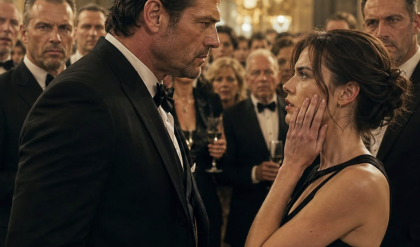
At My Brother’s Wedding, His Bride Called Me A “Sad Single Mom”—Then My 9-Year-Old Grabbed The Microphone And Exposed The Secret She Whispered Before Saying “I Do”…
PART 2
A sound moved through the ballroom like wind before a storm.Not a gasp exactly.
Not a scream.
More like two hundred people inhaling at the same time and forgetting how to exhale.
Madison stood at the edge of the dance floor, her bouquet abandoned on the sweetheart table behind her.
Her face had gone pale beneath the makeup.
For the first time since I had met her, she did not look polished.
She looked cornered.
“That is a disgusting thing to let your child say,” she snapped, turning toward me.
Let.
As if I had handed Ethan a script.
As if I had orchestrated my own humiliation and then sent my son to clean up the blood.
I couldn’t even answer.
Ethan spoke before I could.
“My mom didn’t tell me to say anything,” he said.
“I heard you.”
Madison laughed, but it came out wrong.
“Oh, really?” she said.
“And where exactly did this dramatic little performance happen?”
Ethan swallowed.
I saw his fingers tighten around the microphone stand.
He was brave, but he was still nine.
I wanted to run up there and take him into my arms.
I wanted to shield him from the knives that adults carried behind pretty smiles.
But something held me still.
Maybe it was the way he stood.
Maybe it was the fact that, for once, someone in my family was telling the truth out loud.
“I was looking for the bathroom,” Ethan said.
“Before the ceremony.
Mom was helping Uncle Nathan fix the flower on his jacket, and I went down the hallway by myself.”
Nathan’s head lifted sharply.
I remembered that moment.
The boutonniere pin had bent.
Nathan had been nervous, laughing too much, saying he couldn’t get married with a crooked flower because Madison would notice in every photo.
I had fixed it for him because that was what I did.
I fixed things for people who rarely fixed anything for me.
Ethan continued.
“I walked by a room with a mirror and dresses and makeup bags.
Madison was inside with two ladies.
I didn’t mean to listen, but I heard my name.
Then I heard my mom’s name.”
Madison’s eyes flicked toward her bridesmaids.
One of them, a tall redhead in champagne satin, looked down at the floor.
That small movement sent another ripple through the room.
Ethan’s voice grew steadier.
“She said after the wedding, she was going to make sure Uncle Nathan stopped inviting people who made them look poor.”
My cheeks burned.
“She said my mom was embarrassing,” Ethan continued.
“She said single mothers always want sympathy, and she was tired of pretending to be nice to us.”
I heard someone whisper, “Oh my God.”
My mother’s face had stiffened.
Nathan stood slowly from his chair.
“Madison,” he said, his voice low, “is that true?”
Madison lifted her chin.
“Nathan, are you serious right now?” she said.
“You’re asking me to defend myself against a child who probably misunderstood a private joke?”
Ethan turned toward Nathan.
“She also said she didn’t love you,” he said.
“She said you were safe.
She said safe men buy houses and don’t ask questions.”
The words landed harder than anything before.
Nathan went completely still.
Madison’s father, a silver-haired real estate developer named Grant Whitaker, pushed back his chair.
His expression was stone.
“Madison,” he warned.
But Madison was already unraveling.
“This is insane,” she said.
“This is my wedding.
My wedding.
And all of you are letting some bitter single mother and her kid ruin it because Claire can’t handle a joke?”
There it was.
The truth beneath the lace.
The room saw it.
My brother saw it.
And I, who had spent a year trying to convince myself Madison’s little insults were harmless, finally stopped making excuses for her.
Nathan stepped away from the table.
“You called my sister bitter?”
Madison blinked fast.
“I didn’t mean—”
“You called her embarrassing?”
“Nathan, please.”
“You said you didn’t love me?”
“I was nervous!” she cried.
“People say stupid things when they’re nervous.”
Ethan looked at her, confused.
“But you were laughing,” he said softly.
“You didn’t sound nervous.”
That broke something open.
A woman near the bar stood.
I recognized her as Lauren Mills, one of Nathan’s college friends.
She had been close to him once, before Madison slowly trimmed his circle down to people who complimented her.
“I heard it too,” Lauren said.
Madison spun toward her.
Lauren’s voice shook, but she kept going.
“I came to bring the emergency sewing kit.
The door was cracked.
I heard Madison say Nathan was ‘useful husband material.’ I heard her say Claire and Ethan made the family look like a charity case.”
My mother made a small choking sound.
Not because she was ashamed of what had been said about me.
Because now people were watching.
Madison’s bridesmaid, the redhead, covered her mouth.
Madison saw her.
“Say something, Paige,” she demanded.
“Tell them they’re twisting it.”
Paige looked up slowly.
Tears shone in her eyes.
“I told you not to talk like that,” Paige whispered.
The room exploded into whispers.
Nathan put one hand on the back of his chair as if the floor had shifted beneath him.
His wedding ring gleamed on his finger, newly placed there less than two hours earlier.
He stared at Madison like he was seeing a stranger wearing his wife’s dress.
“I asked you,” he said.
“Last night.
I asked if you were sure.”
Madison’s face changed.
The anger softened into panic.
“I am sure,” she said quickly.
“I was venting.
I was scared.
I didn’t mean any of it.”
Nathan laughed once, but there was no humor in it.
“You didn’t mean the part about loving me, or you didn’t mean to get caught?”
The ballroom fell silent.
Madison reached for him.
“Baby, don’t do this in front of everyone.”
He stepped back.
I had never seen my brother look like that.
Not angry exactly.
Shattered.
Like someone had taken the future he thought he was walking into and ripped the floorboards out one by one.
Then he turned toward me.
For the first time that night, he really looked at me.
Not past me.
Not around me.
At me.
His eyes were wet.
“Claire,” he said, and my name sounded like an apology before he even spoke the next words.
“I’m so sorry.”
I couldn’t answer.
Because if I opened my mouth, I would sob.
Ethan looked down from the stage, suddenly uncertain now that the truth had detonated.
I rushed forward then, my legs moving before my mind caught up.
I climbed the steps and wrapped him in my arms.
“You did nothing wrong,” I whispered into his hair.
“You hear me? Nothing wrong.”
He clung to me.
“I didn’t like how they laughed at you,” he said.
I closed my eyes.
The applause started with one person.
Lauren.
Then another.
Then another.
Soon the sound filled the room—not wild celebration, not joy, but something deeper.
Recognition.
Respect.
Shame arriving late but arriving at last.
My son had stood up with a crooked tie and a trembling heart and done what no adult in that room had been brave enough to do.
He told the truth.
And truth, once spoken into a live microphone, does not politely return to silence.
PART 3
The wedding did not end.
It collapsed.
There is a difference.
An ending has order.
Music fades.
Guests hug goodbye.
Someone wraps cake in foil.
The bride tosses flowers.
The groom laughs with old friends.
Cars pull away beneath warm lighTS.
A collapse is messier.
A collapse is Madison Whitaker standing in a ten-thousand-dollar gown while two hundred guests pretend not to stare.
It is my brother ripping off his boutonniere and dropping it onto the table as if the white rose had betrayed him too.
It is my mother whispering, “Nathan, think of appearances,” and Nathan turning on her with a look so cold even she shut up.
Appearances.
That word had ruled my family for as long as I could remember.
When my father left, my mother told everyone he had taken a consulting job in Atlanta.
The truth was he had moved in with a woman named Denise who sold handmade candles and believed children “blocked spiritual energy.”
When I got pregnant at twenty-two and Ethan’s father disappeared before the first ultrasound, my mother told her church friends I was “taking time to reflect.” The truth was I worked double shifts while vomiting in the employee bathroom and assembled a crib alone at seven months pregnant.
When Nathan got into financial trouble his sophomore year of college, I used my rent money to help him, then slept on a friend’s couch for three weeks.
My mother told relatives he had received “a family scholarship.”
Appearances were the altar Diane Ellis worshipped at.
And that night, her god failed her.
“Nathan,” she whispered again, gripping his sleeve, “you cannot humiliate the Whitakers.”
He looked down at her hand until she released him.
“Funny,” he said.
“You didn’t mind humiliating Claire.”
Her mouth opened.
Closed.
For once, Diane Ellis had no polished sentence ready.
Madison’s father approached Nathan.
Grant Whitaker was tall, broad-shouldered, and used to rooms obeying him.
He spoke quietly, but I was close enough to hear.
“Son, emotions are high,” he said.
“Take Madison somewhere private.
Discuss this like adulTS.”
Nathan stared at him.
“Did you know?”
Grant’s expression barely moved.
“Know what?”
“That your daughter was using me.”
Grant exhaled through his nose.
“All marriages involve practical considerations.”
Madison gasped.
“Dad.”
Nathan’s face hardened.
That single sentence did what even Ethan’s revelation had not fully done.
It confirmed that Madison’s cruelty was not a moment of nerves.
It was a family strategy.
Nathan had not married into love.
He had stepped into a contract he had never read.
I felt Ethan’s hand slip into mine.
He leaned against me, suddenly exhausted.
The DJ, poor man, stood frozen behind his equipment with one hand hovering over a laptop, as if there were a playlist titled Songs for When the Bride Gets Exposed by a Child.
No music played.
No one danced.
At the sweetheart table, Madison’s mother cried silently into a linen napkin.
Paige, the bridesmaid, sat with her shoulders shaking.
Lauren stood near the bar, arms folded, looking like she was ready to testify in court if needed.
Nathan removed his wedding ring.
The small sound it made when he placed it on the table seemed louder than the applause had been.
Madison stared at it.
“You are not doing this,” she said.
Nathan looked at her.
“I don’t know what I’m doing yet,” he said.
“But I know I’m not spending tonight in a honeymoon suite with someone who called my sister a charity case and admitted she doesn’t love me.”
“You’re going to believe them over me?” she cried.
He glanced at Ethan.
“I believe him.”
Something in my chest twisted.
For years, I had wanted Nathan to choose me.
Not over his happiness.
Not over love.
Just over cruelty.
Over silence.
Over the easy comfort of pretending he didn’t see how people treated me.
And now he had.
But it had taken my child standing on a stage to make it happen.
That truth was painful too.
A wedding coordinator in black approached Madison carefully.
“Mrs. Ellis, would you like us to move guests to the cocktail terrace?”
Madison snapped, “Don’t call me that.”
Nathan flinched.
The coordinator disappeared.
People began leaving in clusters.
Some came to me, awkward and embarrassed.
A cousin I hadn’t spoken to in six years touched my arm and said, “Claire, I’m sorry.
That was awful.”
I nodded because I didn’t know what else to do.
Another guest told Ethan he was brave.
He hid behind me.
My mother stood alone near the cake, staring at her reflection in a silver serving knife.
I wanted her to come to me.
That was the humiliating thing.
Even after everything, some childish part of me wanted my mother to cross the room, take my face in her hands, and say, “I’m sorry, baby.
I forgot who you were.
I forgot you were mine.”
But she didn’t.
She walked to Nathan.
Of course she did.
“Come home tonight,” she told him.
“We’ll sort this out.”
Nathan looked past her at me.
“Claire,” he said, “can I talk to you outside?”
Madison made a bitter sound.
“Of course.
Run to her.
Saint Claire, martyr of the discount rack.”
This time, no one laughed.
Nathan turned back slowly.
“Don’t speak about my sister again.”
His voice was quiet.
That made it stronger.
Madison’s mouth trembled.
For one second, I thought she might cry for real—not because she was sorry, but because control had slipped through her fingers in public.
Then she gathered her skirt, pushed past Paige, and stormed out through the side doors.
Her father followed.
My mother hesitated, then followed them too.
That told me everything.
Outside, the night air was cold and damp from rain earlier in the day.
The lake behind the resort reflected strings of lights from the terrace.
Music from another wedding somewhere across the property floated faintly through the darkness, cheerful and distant, as if happiness were happening to other people.
Ethan sat on a bench with Lauren, drinking water from a paper cup while I stood near the railing with Nathan.
For a while, neither of us spoke.
Then he said, “I failed you.”
I looked at him sharply.
He swallowed.
“Not just tonight.”
The wind moved through the trees.
“I heard things,” he continued.
“Madison’s commenTS. Mom’s little jokes.
I told myself you were strong.
I told myself you didn’t care.”
I laughed softly, but it broke in the middle.
“That’s what everyone tells themselves about strong people.”
He pressed his palms to his eyes.
“I don’t know how to fix this.”
“You don’t fix it tonight,” I said.
He dropped his hands and looked at me.
I was surprised by how calm my voice sounded.
“You start by not pretending it didn’t happen.”
He nodded.
Inside, through the windows, I could see workers removing champagne glasses from empty tables.
The fairy tale was being cleared away tray by tray.
Nathan looked toward Ethan.
“He saved me,” he said.
I followed his gaze.
My son sat swinging his feet above the patio stones, still wearing his crooked tie.
“Yes,” I said.
“But he shouldn’t have had to.”
Nathan closed his eyes.
And for the first time in years, my little brother had no defense.
PART 4
By midnight, Ethan and I were in my old Honda Civic in the resort parking lot, and my wedding makeup had turned into gray streaks under my eyes.
The ballroom lights glowed behind us like a world we no longer belonged to.
Guests were still leaving in slow, whispering streams.
Some looked toward my car.
Some looked away quickly.
Shame makes people strange.
It either brings them closer or teaches them to study the pavement.
Ethan had kicked off his dress shoes.
His suit jacket lay crumpled beside him.
He looked younger without it.
More like the little boy who still asked me to check under his bed during thunderstorms.
I started the engine but didn’t drive.
My hands rested on the steering wheel.
“Mom?” Ethan said from the back seat.
I looked at him in the mirror.
“Yeah, baby?”
“Are you mad at me?”
My heart split.
I turned off the engine, unbuckled my seat belt, and twisted around so he could see my whole face.
“No,” I said.
“Never.”
His eyes were shiny.
“I made the wedding bad.”
“No, sweetheart.” I climbed into the back seat with him, awkward in my dress, and pulled him close.
“You told the truth.
The truth didn’t ruin anything.
The lying did.”
He rested his head against my shoulder.
“She was mean,” he whispered.
“I know.”
“And Grandma laughed.”
I closed my eyes.
“I know.”
“Why doesn’t Grandma like us?”
That question was harder than Madison’s insult.
Harder than the laughter.
Harder than Nathan’s silence.
Because children ask simple questions that adults spend decades avoiding.
I smoothed his hair.
“I don’t think Grandma knows how to love people without making them feel small first,” I said carefully.
“But that doesn’t mean we’re small.”
He thought about that.
Then he said, “You’re not a clearance dress.”
A laugh burst out of me so suddenly it turned into a sob.
Ethan wrapped his arms around my neck.
“You’re the prettiest mom,” he said fiercely.
“And the best one.”
I cried then.
Not the silent tears I had trained myself to cry in bathrooms and parked cars and grocery aisles after checking my bank balance.
Real tears.
Messy tears.
Tears that came from a place I had been trying to keep locked for years.
Ethan patted my back like I did when he was little.
“It’s okay,” he said.
“I got you.”
That made me cry harder.
When we finally drove home, Charleston’s streets were slick from rain.
Neon signs blurred in puddles.
Ethan fell asleep before we reached the highway, his head tilted against the window.
My phone buzzed seventeen times.
Nathan.
Lauren.
Two cousins.
My mother.
I ignored all of them until I pulled into the cracked driveway of our duplex on James Island.
The porch light flickered.
The upstairs neighbor’s dog barked once.
Home looked small after the resort, but it was ours.
Every rent payment, every thrift-store lamp, every mismatched mug in the kitchen had been earned honestly.
I carried Ethan inside even though he was too big for it.
His arms looped around my neck in sleep.
I tucked him into bed, removed his tie, and placed his little shoes by the closet.
Before I left, he stirred.
“Mom?”
“I’m here.”
“Did I help Uncle Nathan?”
I sat beside him.
“I think you did.”
“Good,” he murmured.
“He looked sad.”
I kissed his forehead.
“You have a good heart, Ethan Ellis.”
“You gave it to me,” he whispered.
Then he slept.
In the kitchen, I finally checked my phone.
Nathan’s messages were frantic.
Please tell me you got home safe.
Claire, I’m sorry.
I need to talk tomorrow.
Please don’t shut me out.
My mother’s message was different.
Things got out of hand tonight.
You should have stopped Ethan before he embarrassed the family.
Call me in the morning.
I stared at that sentence for a long time.
Embarrassed the family.
Not Madison.
Not herself.
Ethan.
A child had told the truth, and my mother had identified him as the problem.
For years, I would have replied carefully.
I would have apologized for making things difficult.
I would have explained myself in paragraphs.
I would have tried to make her understand that I was hurt, that Ethan was hurt, that we mattered.
That night, I typed one sentence.
Do not contact my son until you are ready to apologize to him.
Then I blocked her.
My hand shook after I did it.
Freedom often feels like fear at first.
The next morning, sunlight came through the blinds in thin stripes across the kitchen table.
Ethan ate cereal in his pajamas, acting almost normal except for the way he kept glancing at me.
I made pancakes because it was Sunday and because pancakes were cheaper than therapy.
At 10:14 a.m., Nathan knocked on the door.
He looked terrible.
His tuxedo was gone, replaced by jeans and a wrinkled gray sweatshirt.
His eyes were red.
His face looked older than it had the day before.
Ethan opened the door before I could stop him.
“Uncle Nathan,” he said.
Nathan crouched immediately.
“Hey, buddy.”
Ethan studied him.
“Are you still married?”
Nathan flinched, then gave a sad smile.
“Technically, yes.
Emotionally, I’m standing in a burning building.”
Ethan nodded like that made sense.
“Do you want pancakes?”
Nathan looked up at me.
I sighed.
“Come in.”
He sat at my kitchen table beneath a ceiling fan that clicked on every third rotation.
It was the first time he had been inside my home in almost eight monThS.
That realization sat between us.
Ethan covered his pancakes in too much syrup and asked if he could watch cartoons in the living room.
I said yes.
He knew we needed to talk.
Nathan wrapped his hands around a coffee mug.
“I’m getting an annulment,” he said.
I blinked.
“That fast?”
“I talked to a lawyer at seven this morning.”
Of course he did.
Nathan handled pain by making lisTS.
“She said there may be grounds if we can prove fraud or misrepresentation, but it’s complicated.
I don’t even care about the legal label right now.
I just need out.”
I nodded slowly.
He stared into the coffee.
“Madison called me thirty-four times.”
“Did you answer?”
“Once.”
“What did she say?”
He laughed bitterly.
“That your jealousy infected Ethan.”
My jaw tightened.
“She said he’s disturbed,” Nathan continued.
“That single mothers raise sons who don’t respect boundaries.”
My chair scraped back before I realized I had moved.
Nathan looked up quickly.
“I told her if she ever spoke about Ethan again, all communication would go through lawyers.”
I sat back down.
Some of the anger loosened.
“Thank you,” I said.
He nodded.
Then his eyes filled.
“I should have done that a long time ago.”
Neither of us spoke.
From the living room, cartoons chirped cheerfully.
Nathan wiped his face with both hands.
“Mom called me,” he said.
“I’m sure.”
“She thinks we should all apologize to the Whitakers.”
I laughed.
Not because it was funny.
Because it was exactly what I expected.
Nathan looked ashamed.
“I told her no.”
That was new.
I folded my hands around my mug.
“What did she say?”
“That you’ve always had a way of making men choose you out of pity.”
The words hit, but not the way they once would have.
I was tired of bleeding for every insult.
Nathan looked miserable.
“Claire, I’m sorry.”
“You don’t have to repeat everything she says.”
“I know.
I just…” He looked toward the living room.
“I need you to understand what I’m finally seeing.”
I did understand.
He was not only leaving Madison.
He was waking up inside our family.
And waking up hurTS.
PART 5
The story should have ended there.
A cruel bride exposed.
A brother apologizing.
A mother blocked.
A brave child eating pancakes while adults sorted through wreckage.
But public humiliation has a long tail.
By Monday morning, half of Charleston seemed to know.
Someone had recorded Ethan at the microphone.
Of course they had.
In the age of smartphones, no disaster stays private unless it happens in a room full of saints, and wedding receptions are not famous for producing saints after an open bar.
The video appeared first in a private family group chat.
Then someone’s cousin posted a blurred version online with the caption: Kid exposes bride at wedding after she insults his single mom aunt.
By lunchtime, it was everywhere.
 During the Explosion, She Never Flinched—The Mafia Boss Realized Who She Really Was Too Late
Madison’s face was not blurred.
Mine was.
Ethan’s was, thank God.
But people recognized us anyway.
My manager at the diner pulled me aside before my shift.
“Claire,” she said gently, “are you okay?”
I almost said yes automatically.
Then I stopped.
“No,” I said.
“But I’m working on it.”
She hugged me.
That surprised me so much I nearly dropped the tray in my hand.
Customers whispered that day.
Some left bigger tips than usual.
One older woman squeezed my hand and said, “Your boy is a good man already.”
I smiled until my cheeks hurt.
By Tuesday, Madison released a statement through her father’s company.
It was three paragraphs of polished poison.
She claimed she had been “misrepresented during a private emotional moment,” that “a child’s misunderstanding had been weaponized by an adult with longstanding resentment,” and that she hoped Nathan would “step away from toxic family influence.”
Toxic family influence.
That meant me.
Nathan called me ten minutes after the statement went up.
“Do not respond,” he said.
“I wasn’t planning to.”
“I mean it.
Grant wants a fight.
Madison wants sympathy.
Don’t give them either.”
I looked across the diner at a table of teenagers watching the video on a phone.
“What do you want?”
He was quiet.
Then he said, “The truth.”
The truth arrived from an unexpected place.
Paige, the redheaded bridesmaid, came to my duplex Wednesday night.
She stood on my porch holding a manila envelope and crying so hard she could barely speak.
“I should have said something sooner,” she said.
I let her in.
Ethan was at a friend’s house.
Nathan arrived twenty minutes later after I called him.
Paige sat at my kitchen table, the same place Nathan had sat days before, and removed three printed screenshots, a flash drive, and a folded piece of hotel stationery from the envelope.
Madison had not merely made cruel commenTS.
She had planned.
There were messages between Madison and Paige from weeks before the wedding.
I can survive Nathan for a few years if the house is in both names.
His sister is a problem.
Too sentimental.
Too much baggage.
Once I’m pregnant, he won’t leave.
His mom is easy.
Compliment her pearls and she turns into putty.
Nathan read the messages without blinking.
His face drained of color.
Paige cried harder.
“I thought she was joking at first,” she said.
“Then she kept saying things.
About money.
About your house.
About how Grant said marrying into your family would help with the zoning dispute because Nathan had connections at City Hall.”
Nathan worked as a civil engineer for the county.
Suddenly, the room felt colder.
“What zoning dispute?” he asked.
Paige pulled out the folded hotel stationery.
It was a list in Madison’s handwriting.
Names.
Dates.
Notes.
Nathan—county permits, useful contacts, family assets modest but reputation clean.
Claire—weak point, single mom, emotional leverage.
Diane—status-driven, controllable.
I stared at the paper.
Weak point.
That was what I had been to Madison.
Not a person.
Not a sister.
Not a mother.
A pressure point.
Nathan stood so abruptly his chair hit the wall.
“I need air.”
He went outside.
I followed.
He was on the porch, gripping the railing, breathing like he might be sick.
“I was a mark,” he said.
I stood beside him.
“Yes.”
He laughed once, broken.
“She studied us.”
“Yes.”
His voice dropped.
“And Mom helped her.”
I didn’t answer.
Because that was the part neither of us wanted to say.
Diane had given Madison the map.
Every insecurity.
Every old wound.
Every family weakness.
My mother had not created Madison’s cruelty, but she had fed it enough information to sharpen the blade.
Nathan looked at me.
“How did we become people who let Mom decide who matters?”
The question hung between us.
I thought about our childhood house.
Diane at the kitchen table, bills spread out, anger simmering under perfume.
I thought about being twelve years old and learning to make dinner so Nathan wouldn’t bother her.
I thought about the way she praised him for surviving the same home I had managed for everyone.
“I think,” I said slowly, “we were trained young.”
He nodded, eyes wet.
The next morning, Nathan’s lawyer filed papers.
Not just for annulment.
For an injunction preventing Madison and her family from contacting him directly.
By Friday, Grant Whitaker’s zoning dispute appeared in the local business journal.
Someone leaked emails suggesting his company had tried to pressure county employees through personal relationships.
Nathan was not named as a wrongdoer.
Madison was.
The wedding video became part of a bigger story, but I kept Ethan away from it as much as I could.
I turned off commenTS. I told his school he was not to be interviewed, photographed, or questioned.
Nathan paid for a consultation with a child therapist, not because Ethan was broken, but because brave children still need safe places to set down heavy things.
When I told Ethan he might talk to someone about what happened, he frowned.
“Am I in trouble?”
“No.”
“Is Uncle Nathan?”
“No.”
“Is Madison?”
I paused.
“She’s facing consequences.”
He considered that.
“Good,” he said, then returned to his cereal.
Children understand justice more cleanly than adulTS.
Two weeks after the wedding, my mother came to my diner.
I saw her through the window before she entered.
Perfect beige coat.
Pearl earrings.
Hair sprayed into submission.
She looked less like a woman coming to apologize and more like a woman arriving for a negotiation.
I was refilling coffee at table six when she sat in my section without waiting to be seated.
“Claire,” she said.
I kept my voice professional.
“What can I get you?”
Her lips tightened.
“Don’t be childish.”
I looked at her then.
Really looked.
At the woman I had spent my life trying to please.
At the mother whose approval had dangled in front of me like food in front of a starving person.
At the person who had insulted me into a live microphone, then blamed my child for the fallout.
Something inside me went quiet.
Not numb.
Peaceful.
“You can apologize,” I said.
She blinked.
“Excuse me?”
“To me first.
Then to Ethan.”
Her eyes hardened.
“I will not apologize to a child for speaking out of turn.”
“Then you can leave my section.”
Her face flushed.
A few customers turned.
For once, I did not shrink.
Diane stood slowly.
“You think this little burst of attention makes you strong?”
“No,” I said.
“Raising Ethan did that.”
She had no answer.
She left without ordering.
And for the first time in my life, watching my mother walk away did not feel like abandonment.
It felt like space.
PART 6
Three months later, Nathan moved into the apartment above my garage.
Technically, it was not a real apartment when he first saw it.
It was a storage space filled with Christmas bins, Ethan’s old toys, a broken treadmill, and a suspicious smell near the window unit.
But Nathan needed somewhere quiet, and I needed help with rent, so we made it work.
He painted the walls pale blue.
Ethan helped assemble shelves and declared himself “assistant landlord.” Nathan bought a small couch, a coffee maker, and three plants he immediately began overwatering.
It was strange at first.
Not bad.
Just strange.
For years, Nathan had existed in my life mostly through holiday obligations and rushed phone calls.
Now he came downstairs on Tuesday nights with groceries.
He helped Ethan with math homework.
He fixed the porch step I had been avoiding for eight monThS. Sometimes, after Ethan went to bed, we sat at the kitchen table and talked about our childhood like two survivors comparing maps of the same storm.
“I used to think you were Mom’s favorite,” he admitted one night.
I nearly choked on my tea.
“Me?”
“You always knew what to do,” he said.
“You cooked.
You handled bills.
You calmed her down.”
“Nathan, that wasn’t favoritism.
That was labor.”
He stared at me.
Then he whispered, “I’m sorry.”
He said it often in those monThS.
Not in a way that begged forgiveness.
In a way that built something.
Madison fought the annulment at first.
Then more messages surfaced.
Paige testified in a deposition.
Lauren provided a written statement.
Grant Whitaker’s company came under investigation for permit interference, and Madison’s appetite for public battle disappeared quickly.
The marriage was annulled six months after the wedding.
Nathan did not celebrate.
He took Ethan and me to the beach at Sullivan’s Island.
We ate fried shrimp from paper baskets and watched Ethan chase waves in rolled-up jeans.
At sunset, Nathan handed me an envelope.
“What is this?” I asked.
“Open it.”
Inside was a check.
I stared at the number.
“Absolutely not.”
“Claire—”
“No.”
“It’s not charity.”
“It looks like a lot of zeros for not charity.”
He smiled faintly.
“It’s repayment.”
“For what?”
“College.
Rent.
Groceries.
Car repairs.
Every time you saved me and I was too young or too selfish to understand what it cost you.”
My throat tightened.
“Nathan, I didn’t keep receipTS.”
“I did some math.”
“Of course you did.”
He looked embarrassed.
“You don’t have to cash it.
But I need to acknowledge it.”
I looked at the check again.
For years, I had told myself helping family was supposed to be invisible.
That love didn’t ask to be named.
But unnamed sacrifices have a way of disappearing until everyone assumes they were free.
I folded the check and placed it back in the envelope.
“I’ll think about it,” I said.
He nodded.
I cashed it the next week.
Not all of it went to bills.
Some went into a savings account for Ethan.
Some paid off the credit card I had used for dental work.
And some bought me something I had not allowed myself in years.
A writing class.
Every Thursday night, I drove downtown to a community arts center and sat in a room with twelve strangers who wanted to tell the truth beautifully.
The first night, the instructor asked us to write about a moment that divided life into before and after.
I wrote about a microphone.
I wrote about laughter.
I wrote about my son’s small hands gripping a stand taller than he was.
When I read it aloud, my voice shook.
Nobody laughed.
After class, an older man named Harold told me, “That boy of yours gave you a doorway.
Make sure you walk through it.”
So I did.
I wrote more.
During lunch breaks.
After Ethan slept.
On rainy Sunday mornings while Nathan took him to basketball practice.
I wrote about single motherhood without turning myself into a tragedy.
I wrote about family without pretending blood made people safe.
I wrote about shame and how it survives best in silence.
A year after the wedding, a regional magazine published my essay.
The title was simple: The Night My Son Spoke.
I didn’t name Madison.
I didn’t name my mother.
I didn’t need to.
The essay went farther than I expected.
Women emailed me from Ohio, Arizona, Maine, Texas.
Single mothers.
Daughters.
Sisters.
People who had swallowed insults at holiday tables and smiled until their faces hurt.
They told me Ethan made them cry.
They told me they wished someone had stood up for them.
I printed some of the kindest messages and kept them in a folder.
Not because I needed strangers to prove my worth.
Because sometimes healing comes from realizing your private pain was never yours alone.
Ethan turned ten that spring.
For his birthday, Nathan rented a small pavilion at the park.
There were cupcakes, water balloons, and a ridiculous superhero cake that leaned slightly to the left.
Lauren came.
Paige came too, nervous at first, but Ethan hugged her like she was family because children are better than adults at recognizing genuine remorse.
My mother did not come.
She sent a card with fifty dollars and no apology.
I placed the money in Ethan’s savings account and threw the card away.
That evening, after the party, Ethan and I sat on the porch steps eating leftover cupcakes.
“Mom?” he said.
“Yeah?”
“Do you think Grandma will ever say sorry?”
I watched lightning bugs flicker over the lawn.
“I don’t know.”
He nodded.
“Would you forgive her?”
I thought about lying.
Saying yes because mothers are supposed to teach softness.
Saying of course because forgiveness sounds prettier than boundaries.
Instead, I told the truth.
“I would listen,” I said.
“But forgiving someone doesn’t mean letting them hurt you again.”
Ethan considered that.
“Good,” he said.
“Because I don’t want her to make you cry anymore.”
I put my arm around him.
“She doesn’t get that power now.”
He leaned against me.
“Because of me?”
I kissed his hair.
“Because of us.”
PART 7
Two years after the wedding, Nathan got married again.
This time, there were no crystal chandeliers.
No two-hundred-person guest list.
No five-tier cake.
No Whitakers.
He married a pediatric nurse named Rebecca Hale in the backyard of a restored farmhouse outside Asheville, North Carolina, under an arch Nathan built himself because apparently emotional growth had turned him into the kind of man who owned a circular saw.
Rebecca was nothing like Madison.
She laughed with her whole face.
She wore simple pearl earrings borrowed from her grandmother and a dress she found in a small bridal shop on sale.
When she met Ethan, she knelt to his level and asked him about his favorite books instead of calling him handsome in that empty adult way.
Most importantly, she loved Nathan when no one was watching.
I knew because I saw it in small things.
The way she saved him the corner brownie because he liked edges.
The way she touched his arm when he went quiet in crowded rooms.
The way she asked me about my writing and actually listened to the answer.
Two days before the wedding, Rebecca pulled me aside while we were folding napkins.
“I want to ask you something,” she said.
My body tensed from old habit.
She noticed.
“It’s good,” she said gently.
“I promise.”
I smiled.
“Okay.”
She took a breath.
“Nathan told me you practically raised him.”
I looked down at the napkin in my hands.
“He exaggerates.”
“No,” she said.
“I don’t think he does.”
I swallowed.
Rebecca touched my wrist.
“Would you walk him down the aisle with me?”
I stared at her.
“What?”
“His mother won’t be there,” she said.
“And he says the person who got him here is you.”
For a moment, I couldn’t speak.
Diane had not been invited.
Nathan made that decision himself.
He had met her for coffee six months earlier and asked if she was ready to apologize to Ethan.
She told him he was letting me “rewrite family history.”
He stood up, paid the bill, and walked out.
That was the last time either of us saw her.
I had imagined that moment would feel victorious.
It didn’t.
It felt sad.
But clean.
On Nathan’s wedding day, Ethan wore a gray suit and carried the rings.
He was twelve now, taller, leaner, with the same serious eyes that had once looked across a ballroom and refused to accept cruelty as normal.
Before the ceremony, Nathan stood beside me behind the farmhouse, adjusting his cuffs.
“You okay?” I asked.
He laughed nervously.
“Weddings and I have a complicated relationship.”
“Fair.”
He looked toward the chairs where guests were gathering.
“I keep thinking about that night.”
“So do I.”
His eyes found Ethan, who was showing the rings to Rebecca’s little niece.
“I used to feel ashamed when I remembered it,” Nathan said.
“Now I think it saved my life.”
I nodded.
“It saved more than yours.”
He looked at me.
“You built a life after it.”
“So did you.”
Music began.
Rebecca appeared at the end of the aisle, glowing in late-afternoon sunlight.
Guests stood.
Nathan inhaled sharply.
“You ready?” I asked.
He held out his arm.
“With you? Yeah.”
So I walked my brother down the aisle.
Not as his mother.
Not as his backup plan.
As his sister.
As the girl who had packed his lunches when nobody else remembered.
As the young woman who had mailed him money she couldn’t spare.
As the single mother he had once failed to defend and had spent years learning how to honor.
At the front, Rebecca took his hands.
The ceremony was short and beautiful.
Ethan delivered the rings without dropping them, though he later admitted his palms were sweaty.
Nathan cried during his vows.
Rebecca cried too.
I cried quietly and did not care who saw.
At the reception, there was a microphone.
When I saw it, my stomach tightened.
Nathan noticed.
He leaned close.
“No surprise speeches from children tonight.”
I laughed.
But later, after dinner, Ethan asked for the microphone.
My heart nearly left my body.
“Ethan,” I whispered, “what are you doing?”
He grinned.
“Relax, Mom.”
He stood beneath string lights in the farmhouse yard, no longer the tiny boy in a crooked tie, but still my brave son.
“I promise I’m not exposing anyone tonight,” he said.
Everyone laughed warmly.
Nathan covered his face.
Ethan continued.
“A few years ago, I gave a speech at a wedding that was not very fun.”
More laughter, softer now.
“But tonight is different.
Tonight I just want to say that Uncle Nathan taught me something important.
Grown-ups can mess up really badly, but if they tell the truth and try to make it right, they can become better.”
Nathan wiped his eyes.
Ethan turned toward Rebecca.
“And Aunt Rebecca, you’re already better than his first choice.”
The yard exploded.
Rebecca laughed so hard she bent forward.
Nathan pointed at Ethan.
“That’s fair.”
Ethan smiled, then looked at me.
“And my mom taught me that being strong doesn’t mean letting people be mean to you.
It means knowing when to walk away, and knowing who deserves to walk with you.”
I pressed a hand to my heart.
Ethan lifted his glass of lemonade.
“So, to Uncle Nathan and Aunt Rebecca.
May your house have good snacks, honest people, and no live microphones unless someone checks them first.”
The toast brought down the backyard.
Later that night, after the music started, Nathan asked me to dance.
I almost said no because I still felt awkward dancing in public, but he held out his hand and gave me the same pleading look he used when he was seven and wanted the last cookie.
So I danced with my brother under the lighTS.
Ethan danced nearby with Rebecca’s niece, both of them laughing like nothing in the world had ever been broken.
Maybe that is what healing looks like.
Not pretending the damage never happened.
Not forcing every person back into the picture.
But building new rooms inside your life where the old cruelty cannot enter.
My writing career grew slowly after that.
A small publisher bought a collection of my essays.
I dedicated the book to Ethan: For the boy who spoke when the room went silent.
At the launch event, Nathan sat in the front row with Rebecca.
Lauren came.
Paige came.
My diner manager came with flowers.
Ethan, embarrassed by all the attention, tried to hide near the refreshment table until I called him up.
“This book exists because of many things,” I told the audience.
“Pain.
Work.
Therapy.
Rent paymenTS. Bad coffee.
Good friends.
But mostly, it exists because one night, my son reminded me that truth does not need to be tall to stand up.”
Ethan blushed so red everyone laughed.
Afterward, he hugged me and whispered, “You made it sound cooler than it was.”
“No,” I said.
“I made it sound exactly as brave as it was.”
Years have passed now.
Ethan is in high school.
Nathan and Rebecca have a daughter who thinks I am the best aunt in the world because I let her put stickers on my laptop.
Madison moved to Florida, according to someone who thought I wanted to know.
I didn’t.
Grant Whitaker’s company never fully recovered from the investigation.
Diane sends Christmas cards sometimes.
I don’t open them.
People ask if I’m angry.
Sometimes.
But anger is no longer my home.
It is a visitor.
It comes, it tells me where I was hurt, and then it leaves when I listen.
What remains is something stronger.
A small kitchen table where my brother learned to apologize.
A porch where my son and I rebuilt our peace.
A life where I no longer audition for people committed to misunderstanding me.
And the memory of a ballroom full of people laughing until a nine-year-old boy walked to a microphone and changed the ending.
For years, I thought that night was the worst humiliation of my life.
I was wrong.
It was the night the mask came off.
It was the night my brother saw the truth.
It was the night my mother lost the power to define me.
It was the night my son gave me back my name.
I am not a clearance dress.
I am not a cautionary tale.
I am not the broken zipper in someone else’s perfect family portrait.
I am Claire Ellis.
I am a mother.
I am a sister.
I am a woman who survived the laughter and learned to speak louder than shame.
And if you ever find yourself sitting in a room where people who should love you are laughing at your pain, remember this:
Sometimes the smallest voice in the room is the one that finally tells the truth.
THE END