During the Explosion, She Never Flinched—The Mafia Boss Realized Who She Really Was Too Late
THE WAITRESS DIDN’T FLINCH WHEN THE BOMB WENT OFF—THEN CHICAGO’S MOST FEARED MAN REALIZED SHE HAD SAVED HIS LIFE ON PURPOSE
The car bomb turned a four-hundred-dollar lunch into smoke, screaming, and flying glass.
Everyone dove for cover—except the young waitress in the red apron, who calmly finished pouring Valentino Milani’s wine.
By midnight, he knew the truth: she was not a waitress at all, and the people hunting her were about to turn Chicago into a battlefield.
PART 1 — THE WOMAN WHO NEVER STOPPED POURING
The explosion came at 1:12 in the afternoon, exactly when Daphne Angelo tilted the bottle.
One second, The Gilded Cage was all polished mahogany, white tablecloths, crystal glasses, and the low murmur of Chicago’s powerful pretending they were civilized.
The next, the street outside became white fire.
The front windows did not shatter.
They vanished.
Glass flew through the restaurant in bright, deadly sheeTS. A senator’s wife screamed from beneath a table.
A hedge fund manager crawled across the floor with blood on his collar.
The chandelier above the bar swung hard enough to rain crystal over the shattered marble.
Valentino Milani dropped low by instinct.
At thirty-four, he was called a real-estate mogul by newspapers and Il Martello by men who knew better.
The Hammer.
He owned buildings, unions, debt, judges’ secrets, and enough of the Chicago waterfront that even the lake seemed to know his name.
His hand went to the pistol at his ankle.
His men moved at once.
Rico by the bar.
Two soldiers near the valet entrance.
Another by the kitchen.
They scanned for the second strike, because a professional attack never trusted the first explosion to finish the job.
But Valentino stopped looking at the doors.
He was looking at the waitress.
Daphne Angelo stood beside table twelve, the wine bottle still angled over his glass.
Her dark-blonde hair remained pinned in a neat bun.
Her red apron was dusted with ash.
A cut of light from the blast flickered across her pale face, but her expression had not changed.
Not shock.
Not fear.
Not even confusion.
A shard of glass spun toward her cheek.
She moved her head two inches.
The glass missed, struck the wall behind her, and stuck there vibrating like a thrown knife.
The Cabernet filled Valentino’s glass to the same perfect line a sommelier would have admired under quiet lighting.
Then she set the bottle down with a soft, controlled clink.
“Compliments of the house, sir,” she said.
Her voice was calm enough to make the room colder.
Then she brushed glass from her apron and walked toward the kitchen, stepping around bodies, broken chairs, and screaming guests as if chaos were only an inconvenient spill.
Valentino stared after her.
Rico reached him, breath short, gun drawn.
“Boss, we need to move.”
Valentino did not move.
“The waitress,” he said.
Rico blinked through the smoke.
“What?”
“The one in the red apron.
Who is she?”
Rico looked toward the kitchen doors.
“I’ll check, but we have a bomb scene, police inbound, and—”
“Now.”
Rico swallowed his argument.
“Yes, boss.”
Sirens wailed in the distance.
Smoke rolled across the ceiling.
Somewhere near the front, a man sobbed into his own hands.
Valentino stood slowly, eyes fixed on the kitchen door.
He replayed her movement in his mind.
She had not frozen.
She had not been lucky.
She had adjusted the wine bottle and silver tray at the exact angle needed to deflect the shard that would have struck his throat.
She had saved him.
And she had made it look like service.
By nightfall, Valentino sat in the security office beneath the restaurant, watching four angles of footage on a wall of monitors.
Chen, his head of security, slowed the video frame by frame.
Daphne’s pulse, visible in her neck, stayed steady before the blast.
Steady after it.
“Sixty-two beats per minute,” Chen whispered.
“That’s impossible.”
“No,” Valentino said.
“It’s training.”
They watched the glass trajectory again.
The tray lifted.
The shard changed direction.
Valentino leaned forward.
“She saw it coming.”
Chen pulled her employment file.
Daphne Angelo.
Twenty-six.
Service jobs in Seattle, Portland, Denver.
Clean background.
Sparse social media.
Tax history beginning only three years earlier.
Before that, nothing.
No childhood.
No school.
No family.
No real past.
Valentino smiled slowly at the frozen image of her face mid-pour.
“Find her,” he said.
Six thousand miles away, in a quiet Berlin office, a man known only as the Architect received the same grainy footage through an encrypted server.
A woman in a red apron.
Smoke behind her.
Calm eyes.
The facial match returned 94.1%.
The Architect removed his glasses and smiled.
After three years, Viper had made her first mistake.
PART 2 — VIPER AT TABLE TWELVE
The Private Dinner
The Gilded Cage closed on Tuesdays.
The public website called it “private dining availability.”
In reality, it meant Valentino Milani wanted the building empty, and Chicago had learned to arrange itself around his preferences.
Daphne arrived at 7:58 p.m.
Same uniform.
Black slacks.
White shirt.
Red apron.
Hair pinned back.
No jewelry except a small silver watch.
She looked like a woman reporting for work, not a woman walking into a room controlled by the most dangerous man in the city.
Two armed guards searched her at the entrance.
They found nothing.
Of course they found nothing.
People only found what Daphne chose to carry.
Valentino waited at table twelve with candles burning across the restored dining room.
The windows had already been replaced.
The broken marble polished.
The blood erased.
Money had a way of making violence look imaginary by morning.
“Miss Angelo,” he said.
“Thank you for coming.”
“I was told it wasn’t optional.”
“Smart girl.”
She sat across from him because he gestured toward the chair, not because she accepted his authority.
Her hands rested visibly on the table.
Relaxed.
Still.
A server’s hands.
A surgeon’s hands.
A killer’s hands, perhaps.
Valentino reached beneath the table and placed a gun on the white tablecloth.
A Glock.
Unloaded.
Daphne knew before she touched it.
“Who are you?” he asked.
“I’m a waitress.”
“Waitresses scream when bombs go off.”
“I was in shock.”
“Shock raises heart rate.”
Her expression did not change.
He set his phone on the table and played the audio Chen had extracted from the staff room the day before.
A locker door.
Footsteps.
Then the unmistakable sequence of a firearm being stripped and reassembled in seconds.
Daphne’s eyes flicked to the phone.
One tiny movement.
Enough.
“One of my men left his weapon in the staff room,” Valentino said.
“You took it apart and rebuilt it in fourteen seconds.”
“He shouldn’t leave weapons unsecured.”
Valentino laughed once, soft and genuine.
It surprised him.
“I agree.”
Daphne reached for the gun on the table.
His hand moved slightly toward his jacket.
She noticed.
He noticed her noticing.
She checked the chamber, removed the empty magazine, confirmed what she already knew, then slid the weapon back to him.
“You brought an unloaded gun to frighten me,” she said.
“That means you are testing me, or you are afraid of me.”
“Which one?”
“Both.”
His smile sharpened.
There it was.
Not confession.
Contact.
“You want the truth?” she asked.
“I insist on it.”
“I was very good at a very bad job.
I left that job three years ago.
I became Daphne Angelo because quiet lives require quiet names.”
“What was the job?”
“The kind people like you pay other people to deny exisTS.”
Valentino leaned back.
“Military?”
“No.”
“Government?”
“Worse.”
“Who are you hiding from?”
Daphne looked past him toward the dark windows.
“People who make you look like a saint.”
For the first time, Rico, standing near the bar, stopped pretending not to listen.
Valentino studied her.
The flat voice.
The controlled breathing.
The woman who had walked through smoke and broken glass without letting her hand tremble.
“You work for me starting tomorrow,” he said.
“No.”
“I’ll triple your salary.”
“No.”
“I wasn’t negotiating.”
Daphne stood.
“Men who say that usually are.”
Something passed between them.
Not trust.
Not liking.
Recognition.
Valentino rose too.
“People like you don’t survive in my city without protection.”
“People like me survive because protection becomes a cage.”
“Then call it employment.”
“No.”
He walked closer, stopping just outside her striking range.
Good, she thought.
He was learning quickly.
“Eight tomorrow morning,” he said.
“My office.”
“I’m not coming.”
“You will.”
“Why?”
He looked at the restored windows.
“Because whoever built that bomb was not aiming at my restaurant.
They were aiming at me.
You saw the shard before my own men did.
I want to know what else you see.”
Daphne held his gaze for a long second.
Then she turned and left.
At 8:00 the next morning, she was in his office.
The First Shot
Valentino’s office occupied the top floor of a limestone tower overlooking the river.
It smelled of espresso, leather, rain, and decisions other people regretted.
He spent the morning on calls, moving assets, interrogating lieutenants, asking questions so quietly that men on the other end began apologizing before understanding what they had done.
Daphne stood near the window and said nothing.
Rico hated her immediately.
Valentino found that useful.
Distrust had kept Rico alive.
“We have a meeting tonight,” Valentino said, signing a document.
“South Docks.
Warehouse Seven.”
“That is not security work,” Daphne said.
“It is if someone tries to kill me.”
“You’re testing me.”
“Yes.”
Rico stepped forward.
“Boss, this is insane.
She could be the setup.”
“Then we’ll learn something.”
The meeting at the docks took place under a sky the color of wet steel.
Rusted warehouses stood along the river, their windows broken, their loading bays dark.
Valentino arrived with three SUVs and eight men, a modest show of force by his standards.
The Khrenov brothers waited inside with their own security.
Arms dealers pretending to be investors.
Investors pretending not to know the difference.
Daphne stayed two steps behind Valentino’s left shoulder.
Her eyes moved constantly: rafters, roofline, broken windows, skylight, dock doors, reflection in oil puddles, the suspicious stillness of the building across the alley.
There.
North window.
Third floor.
A blink of glass where no glass should move.
She keyed her earpiece.
“Scope.
North building.
Third floor.
Center window.”
Rico’s voice crackled.
“Negative.
Cleared.”
“Not cleared.”
Valentino did not turn from the Khrenovs.
“You’re certain?”
“Yes.”
The reflection shifted.
Daphne did not wait for permission.
She grabbed Valentino by the shoulder and dragged him sideways just as the shot split the air.
A round tore through the space where his head had been and buried itself in a steel container behind him.
The warehouse erupted.
Men shouted in Russian, English, Italian.
Valentino’s soldiers formed a perimeter.
The Khrenovs scattered.
Rico cursed into his comms.
Daphne was already gone.
By the time Valentino reached the alley, she was coming down from the adjacent building with a warm shell casing in her hand and a look on her face he had not seen before.
Fear.
Not of the sniper.
Of the mark carved into the windowsill.
A viper coiled around a dagger.
Valentino held out a phone his men had found in the sniper’s nest.
The screen showed a photograph taken through a scope.
Daphne’s face.
Centered.
Targeted.
“They weren’t shooting at me,” Valentino said.
“No,” Daphne answered.
“They were sending you a message.”
She closed her fist around the casing.
“Everyone near me dies.”
Valentino stepped closer.
“Who are they?”
“The Syndicate.”
The name meant nothing to Rico.
It meant something to Valentino.
He had heard whispers from men who handled things governments did not admit needing handled.
A broker network.
Assassins.
Extractions.
Destabilization.
No headquarters.
No flag.
No conscience.
Only contracts and consequences.
“You worked for them,” Valentino said.
“I escaped them.”
His eyes narrowed.
“No one escapes an organization like that.”
Daphne looked toward the dark window.
“I did.”
“Then why are they still hunting you?”
“Because I was never supposed to survive the last job.”
Dinner Above the City
The second attempt came three nights later.
Valentino insisted on dinner at his penthouse because he wanted answers and preferred interrogations with wine.
Daphne sat at the far end of a marble table, untouched osso buco in front of her.
Outside the floor-to-ceiling windows, Chicago glittered beneath a hard winter sky.
Rico and two guards stood by the elevator pretending they were not listening.
“The Syndicate recruited me when I was sixteen,” Daphne said.
Valentino’s expression did not shift, but something in his eyes cooled.
“Recruited.”
“Useful word for theft.
I was alone.
Angry.
Good with patterns.
They called it training.
It was conditioning.
Weapons.
Languages.
Surveillance.
Disguise.
Patience.
How to become invisible in rooms where everyone thinks they are paying attention.”
“Your codename?”
She looked at him.
“Viper.”
Rico muttered something under his breath.
Daphne ignored him.
“My last contract was Vienna.
High-value target.
No exit plan.
I realized too late that the job was designed to eliminate the target and me.
I disappeared before they could close the file.”
“And for three years you poured wine.”
“I slept,” she said quietly.
“For a while, that felt like victory.”
That answer struck Valentino harder than he expected.
He lifted his glass.
The crystal exploded.
The shot came through the window with a sharp crack, then another.
Daphne moved before anyone else understood the first glass had broken.
She struck Valentino in the chest with the blunt end of a dinner knife, knocking him backward out of the chair as the second round tore through the space his head had occupied.
Rico killed the lighTS.
The penthouse dropped into darkness, lit only by the city below.
Daphne pressed Valentino behind cover, her palm hard against his chest.
“Two shooters,” she whispered.
“Different angles.
They expected you to stand.”
“You threw a knife at me.”
“I saved your life.”
“A warning would have been polite.”
“Polite gets people killed.”
Another round shattered the far window.
The guards shouted.
Rico barked commands.
Valentino reached for Daphne’s wrist as she moved toward the kitchen exit.
“Don’t.”
She looked down at his hand.
“Let go.”
“You are not bulletproof.”
“Neither are you.”
She pulled free.
Seven minutes later, she returned through the front door with a cut on her cheek and blood on her sleeve that was not hers.
Rico raised his weapon.
Valentino lifted a hand.
“Stand down.”
Daphne walked to Valentino, breathing hard but not panicked.
“It’s done.”
“Both?”
“Both.”
“With what? You left unarmed.”
She gave him the faintest smile.
“I improvised.”
Valentino looked at her then, truly looked.
Not as a waitress.
Not as an asset.
Not as a mystery.
As a person carved out of violence and still standing.
“You are the most dangerous woman I’ve ever met.”
“I am not your weapon.”
“No,” he said.
“You’re worse.”
She narrowed her eyes.
“What does that mean?”
“You’re the first person in years who can keep me alive without needing to obey me.”
That silenced her.
For a moment, the penthouse held only wind through broken glass and the distant sound of sirens below.
The Gala Where Hiding Ended
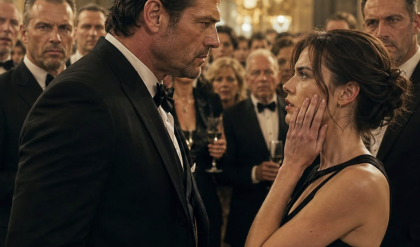
The Marone Foundation gala was Chicago’s annual performance of conscience.
Criminal families in tuxedos.
Politicians in diamonds.
Judges who pretended not to remember certain envelopes.
Philanthropy bright enough to bleach old stains, at least for one evening.
Valentino attended every year.
This year, he brought Daphne.
She descended the Blackstone Hotel staircase in midnight-blue silk that moved like water.
Valentino’s stylist had chosen it.
Daphne hated everything about it: the attention, the exposed shoulders, the slit in the skirt, the way every eye in the ballroom became a possible sightline.
Valentino met her at the foot of the stairs.
“You look like you’re walking to your execution.”
“I might be.”
“Then we’ll die beautifully.”
“That is not comforting.”
“I am new to comforting.”
He offered his arm.
She took it because refusing would draw more attention.
For ninety minutes, they performed.
Valentino smiled.
Donors laughed.
A judge squeezed his shoulder too familiarly.
Rival bosses offered compliments that were really warnings.
Daphne stood beside him, saying little, seeing everything.
At 10:47 p.m., she noticed a man near the service entrance.
Black tuxedo.
Empty champagne glass.
Perfect posture.
Eyes on her, not Valentino.
She knew the posture.
She had worn it.
“We need to leave,” she said.
Valentino was speaking to a hospital trustee.
“Now?”
The lights went out.
Not a failure.
A decision.
Three seconds of darkness.
Then suppressed gunfire.
The ballroom became a herd.
Guests screamed, fell, shoved, crawled.
Diamonds flashed under emergency lighTS. Chairs overturned.
Someone prayed in a language Daphne did not know.
She pushed Valentino toward Rico.
“Kitchen exit.
Now.”
“And you?”
“Handling it.”
She vanished before he could stop her.
In the service hall, four men dressed as waiters moved with professional precision.
Daphne recognized the lead one.
“Marcus,” she said.
He turned.
His face changed.
“Viper.”
Not Daphne.
Never Daphne.
Viper.
For ten seconds, she became the woman she had tried to bury.
The fight was fast, brutal, and unseen by most of the ballroom.
A weapon knocked upward.
A body slammed into a wall.
A chandelier bulb shattered.
Two men fell before they understood she had closed the distance.
The fourth ran because he was smart enough to survive as messenger.
Daphne let him.
When she returned to the ballroom, her dress was torn, her hair half loose, and her skin marked with blood not entirely her own.
The remaining guests saw her emerge from the dark hallway like something war had taught to walk elegantly.
Someone’s phone flashed.
By morning, the photo was everywhere in the underworld.
Daphne Angelo.
Viper.
Alive.
Beside Valentino Milani.
The secret was dead.
The Vineyard
Valentino took her to Wisconsin at dawn.
No convoy.
No spectacle.
A black Range Rover cutting through gray morning toward a vineyard he never sold wine from.
Rows of pinot noir stretched across frozen hills, their winter vines bare and twisted like old hands.
The estate house was stone and timber, beautiful in the way fortified places pretend not to be afraid.
“Sleep,” Valentino said when they entered.
Daphne did not.
Three hours later, he found her in the driveway loading a backpack into Rico’s sedan.
“You’re leaving.”
“Yes.”
“No.”
“They’re coming for me.
Every minute I stay makes you a target.”
Valentino walked closer.
“You keep calling it protection.
I call it running.”
Her jaw tightened.
“I ran for three years and survived.”
“Barely.”
“That still counTS.”
“Not as living.”
That hit.
She looked toward the vines.
“Everyone I get close to dies.”
“I’ve heard variations.”
“You haven’t heard mine.”
She said the names then.
A handler in Prague.
A spotter in Johannesburg.
A logistics officer in Istanbul.
A doctor who removed a tracker from beneath her ribs and was dead two weeks later.
Every person who helped her became leverage.
Then warning.
Then body.
Her voice did not break until the last name.
Valentino listened without interrupting.
Then he unbuttoned his shirt.
Daphne stared at him.
“What are you doing?”
“Answering.”
His torso held its own history: bullet scars, a knife mark along the ribs, old burns near one shoulder, a phoenix tattoo rising through damage instead of hiding it.
“My uncle tried to kill me when I was twenty-five,” he said.
“Half my own family wanted me dead before I learned to make them more afraid of losing me than killing me.
Death has followed me since I was sixteen.”
“You chose your life.”
“I inherited it first.
Chose parts later.”
“That’s different.”
“Yes.
Your cage had different bars.
It was still a cage.”
She turned away.
He did not touch her.
That mattered.
“You can leave,” he said.
“I won’t chain you.
I won’t follow unless you ask.
But understand this before you go: the Syndicate found you while you were alone.
Hiding made you smaller, not safer.”
Her hand tightened around the backpack strap.
“And staying makes me what?”
“Visible.”
“Visible gets people killed.”
“Visible also lets people stand beside you.”
The vineyard was silent around them.
Dawn turned the frost silver.
Daphne looked at the phoenix tattoo, at the scars integrated into its wings.
“Demons run together,” she said softly, remembering something he had said after the penthouse attack.
Valentino’s mouth curved faintly.
“If necessary.”
She dropped the backpack.
“Fine.”
“Fine?”
“I stay.
But I am not your weapon.”
“No.”
“I am not your possession.”
“No.”
“I make my own calls in the field.”
“Within reason.”
She stared.
He sighed.
“I am learning.”
She picked up the backpack and carried it back into the house.
That morning, somewhere beneath the frozen vineyard, war stopped being something chasing Daphne.
It became something she chose to face.
Financial War
The Syndicate did not strike next with bulleTS.
It struck with numbers.
By 9:00 a.m., Valentino’s offshore accounts froze.
By 10:15, two shell trusts locked.
By noon, every bank tied to Milani Enterprises flagged internal review.
At 12:03, the bounty went live on dark channels: five million for Valentino Milani, ten million for Viper.
Alive or dead.
Rico read the alert with a pale face.
Valentino poured coffee.
“We’re broke,” Rico said.
“Temporarily inconvenienced.”
“There is a fifteen-million-dollar bounty on your head.”
“Daphne’s worth twice as much.”
Daphne, cleaning a weapon at the dining table, looked up.
“Focus.”
Valentino smiled into his coffee.
Rico looked like he wanted to resign from the entire species.
By dusk, vehicles appeared near the property line.
Not Syndicate professionals at first.
Bounty chasers.
Street mercenaries.
Desperate men who thought money made them brave.
Daphne watched them through binoculars from the upstairs window.
“They are not disciplined.”
“Good news?”
“No.
Stupid men die loudly and attract better men.”
Valentino’s expression sobered.
“What do we do?”
“We hold.
Then we move.
The Architect expects us to panic, run, or defend forever.
We do none of that.”
“Who is he?”
Daphne lowered the binoculars.
“Marcus Renfield.
My final handler.
The man who built Viper out of a girl and tried to erase the girl when the weapon became inconvenient.”
For the first time, Valentino heard something beneath her controlled voice that was not fear.
Grief.
“He taught you everything?”
“No,” she said.
“He taught me how to kill.
He never understood the rest of me survived.”
The vineyard came under siege that night.
The details became rumor later: headlights between vines, short bursts of gunfire, men stumbling through darkness, private security moving with terrifying discipline after Daphne reorganized them.
What mattered was simple.
By morning, the bounty hunters were gone.
Some fled.
Some were arrested after Valentino anonymously tipped authorities about armed trespassers.
Some were carried away by their friends.
Rico had a bandaged arm.
One of Valentino’s men had a broken collarbone.
Daphne stood at the window watching the sunrise turn the vineyard red-gold.
Valentino came to stand beside her.
“They will keep coming.”
“Yes.”
“So we stop waiting.”
She looked at him.
“We find the Architect.”
The Bank That Wasn’t Empty
Daphne found him by studying absence.
Traffic cameras around an abandoned bank on West Adams showed too little foot traffic at the wrong hours.
Delivery vans with fake routing numbers.
Utility usage in a building supposedly empty since 2019.
Cell signals that appeared, vanished, and never repeated.
“The old Chicago Mercantile Trust,” she said, spreading photos across the vineyard’s basement table.
Rico frowned.
“It’s abandoned.”
“No.
It’s theater.”
Valentino studied the building plans.
“Fortified?”
“Likely.”
“How many inside?”
“Enough.”
Rico crossed his arms.
“We don’t have enough men for a direct assault.”
“We’re not doing one.”
Valentino looked at her.
“What are we doing?”
“Taking his money, his servers, and his myth.”
Mira Conti, Valentino’s legal fixer, appeared on a secure video call from Chicago.
She had a voice like polished steel and no patience for bloodshed when paperwork could bleed a man slower.
“The bank building is under investigation by federal financial crimes,” she said.
“Thanks to an anonymous packet of evidence I absolutely did not receive from any of you.”
Daphne glanced at Valentino.
He looked innocent badly.
Mira continued.
“If the Architect is operating there, we need servers intact.
People alive enough to talk.
Documents not burned, shredded, or covered in anyone’s dramatic fingerprinTS.”
Rico muttered, “Lawyers ruin everything.”
“Only the sloppy things,” Mira said.
The operation happened at midnight.
Not a massacre.
A trap.
Valentino’s people cut off exits, not lives.
Federal agents arrived through a parallel warrant based on Mira’s evidence.
Daphne entered only after the alarms were disabled and the primary guards surrendered or fled.
The Syndicate professionals inside fought hard but briefly once they realized the building had been sealed from outside and its accounts frozen from within.
The Architect was not there.
Of course he was not.
On the main operations floor, a laptop opened to a live video call.
 She Slapped the “Poor Country Woman” at the Wedding Table—Not Knowing the Papers in Her Hands Would Freeze the Entire Ballroom
Marcus Renfield appeared on the screen.
Gray hair.
Wire glasses.
Calm professor’s face.
Dead eyes.
“Viper,” he said.
“You always were my best work.”
Daphne stepped close to the camera.
“I was never yours.”
He smiled.
“You are standing in an empty nest.
Did you think I would wait for you?”
“No,” she said.
“I thought you would run.”
His smile faded slightly.
Behind her, agents boxed servers.
Rico collected paper files.
Mira, on the phone, began naming seized accounTS.
Daphne leaned closer.
“You just lost your escrow.
Your contractors.
Your banking routes.
Your safe names.
Every hunter coming for me tomorrow will be wondering if you can still pay.”
The Architect’s mouth tightened.
“You underestimate loyalty.”
“No,” Daphne said.
“I understand payroll.”
Valentino laughed once behind her.
She closed the laptop slowly instead of shooting it.
That restraint mattered.
The Architect was no longer a ghost.
He was an old man whose empire had suddenly become traceable.
What Valentino Wanted
They returned to the vineyard before dawn.
Daphne expected celebration.
There was none.
Only exhaustion.
Rico slept in a chair with one hand still near his weapon.
Mira sent a message consisting only of case numbers and the sentence: Try not to commit new crimes before breakfast.
Valentino stood alone in the kitchen, pouring coffee he did not drink.
“You wanted him dead,” Daphne said.
He did not deny it.
“Yes.”
“And now?”
“Still.”
She nodded.
Honesty mattered more than good answers.
“But you let the agents take the servers.”
“Yes.”
“Why?”
Valentino turned.
“Because if I kill him, he becomes your nightmare forever.
If the record kills him, he becomes a file.”
Daphne absorbed that.
Somewhere between the restaurant and the bank, the Hammer had learned the difference between revenge and ending.
It made him more dangerous.
It also made him safer to stand beside.
“That sounded almost wise,” she said.
“Do not tell Rico.”
“I won’t.”
He looked at her cut cheek, the dark circles beneath her eyes, the way her hands trembled only when she thought no one saw.
“Sleep,” he said.
“Stop telling me to sleep.”
“Eat, then.”
“Better.”
He made toast badly.
She ate it anyway.
The Architect’s Last Move
Marcus Renfield made his final mistake three weeks later.
He tried to buy protection from a cartel representative in Pilsen using stolen Milani routes, Syndicate client lists, and one promise: he could deliver Viper.
Valentino’s network heard within hours.
Not because his empire was larger than the Syndicate’s had been.
Because local men understood Valentino’s consequences better than Renfield’s promises.
The meeting was set at a motel off I-94.
Daphne listened to the intercepted call in silence.
“He’s desperate,” Rico said.
“No,” Daphne said.
“He is used to making other people desperate.
He doesn’t recognize the smell on himself.”
Mira arranged law enforcement coordination because she had become extremely committed to ruining everyone’s revenge fantasies.
Valentino was not pleased.
Daphne surprised him by agreeing.
“He trained me to disappear bodies,” she said.
“I want him photographed, booked, named, and archived.”
Valentino studied her.
“You sure?”
“No.”
That was the truest answer.
“Do it anyway,” she said.
The motel room smelled of old smoke, damp carpet, and failure.
Renfield sat at a small table with a laptop and a pistol within reach.
He had shaved his beard.
Changed his clothes.
A man trying to look less like himself and failing because power leaves posture behind even after money leaves.
Daphne entered first.
Not like Viper.
Like Daphne.
Federal agents covered the exiTS. Valentino waited in the hall because she asked him to.
That mattered too.
Renfield looked up.
For a second, something like pride crossed his face.
“My girl.”
Daphne’s expression did not move.
“No.”
He smiled.
“You came alone.”
“No.”
His eyes flicked toward the door.
Daphne stepped closer.
“You taught me to kill loose ends.
You taught me that attachment was liability.
You taught me that fear could be refined into obedience.”
Renfield’s hand moved toward the pistol.
She was faster.
The gun skidded across the floor before he finished reaching.
Agents entered.
Renfield froze, stunned less by arrest than by her refusal to end him privately.
“You’re handing me to them?” he said.
“I’m handing you to records.”
His face twisted.
“You think law will hold me?”
“No,” Daphne said.
“Evidence will.”
Valentino appeared in the doorway then.
Renfield looked from him to Daphne.
“You replaced the Syndicate with a mafia king.”
Daphne shook her head.
“I stopped mistaking isolation for freedom.”
Renfield laughed bitterly.
“He will use you.”
Valentino’s voice came low from the door.
“She decides that.
Not you.
Not me.”
For the first time, the Architect had no useful answer.
Agents cuffed him.
When they led him past Daphne, he whispered, “You were perfect.”
She looked at him.
“No.
That was the first thing you never understood.”
The Trial of Shadows
The prosecution took nine monThS.
Syndicate cases did not move quickly because shadows have lawyers, shell companies, dead witnesses, encrypted accounts, and governments that dislike admitting what they once outsourced.
But the bank servers survived.
The escrow records survived.
Client lists survived.
Payment trails survived.
Renfield’s own voice survived in files he had believed were too secure to betray him.
Daphne testified under her legal name first.
Daphne Angelo.
Then under seal, she acknowledged the name the Syndicate had given her.
Viper.
She did not describe methods.
She described systems.
How children were recruited through poverty, grief, anger, disappearance.
How identities were created and erased.
How contracts became leverage.
How the organization made violence look like paperwork and then made people like her carry the moral weight alone.
The courtroom was closed for parts of it.
Valentino sat outside during those sessions because she did not need him there.
He understood.
That was new.
When she emerged after the first day, pale and shaking, he stood but did not approach until she nodded.
Then he placed a paper cup of coffee in her hand.
“Bad?”
“Necessary.”
He nodded.
Renfield’s defense tried to paint her as unstable, violent, unreliable, an assassin seeking immunity by inventing hierarchy.
The prosecutors played his own recordings.
His calm instructions.
His payment approvals.
His coded messages after the Gilded Cage bombing.
His order after the gala photo went public:
Bring Viper home or burn everyone beside her.
The jury listened.
Records do that.
They make denial stand under light.
Renfield was convicted on conspiracy, international contracting offenses, financial crimes, identity trafficking, obstruction, and attempted murder tied to the restaurant attack, the penthouse shooting, and the bounty system.
No one cheered.
Daphne preferred that.
Cheering would have made it feel like entertainment.
When the verdict came, she closed her eyes.
Not free.
Not yet.
But no longer hunted by a ghost.
The Gilded Cage Reopens
Six weeks after the verdict, The Gilded Cage reopened.
Again.
New windows, reinforced but elegant.
New velvet curtains.
New chandeliers.
New security that looked like hospitality until one knew where to look.
The floor had been replaced, the bar restored, the wine cellar expanded.
Chicago came because Chicago loved survival when it was expensive.
Valentino sat at table twelve.
His usual position.
Back to the wall.
Sightlines to both entrances and the kitchen.
Some habits were architecture now.
Across from him sat Daphne in a black dress with a narrow silver bracelet on her wrist.
No diamonds.
She had returned the first bracelet Valentino bought because it was “too loud.” He was learning.
The new waiter approached nervously.
“Mr. Milani.
Miss Angelo.
May I start you with something to drink?”
Valentino looked at Daphne.
She smiled.
“Bring the 2005 Château Margaux.”
The waiter nodded too quickly.
“And breathe,” she added.
He froze.
She leaned back.
“You’ll spill if you hold your breath.”
The boy exhaled.
Valentino watched her with amusement.
“You are particular.”
“I was a waitress.”
“You were never a waitress.”
“I was an excellent waitress.”
“You were a terrifying waitress.”
“That too.”
The wine arrived.
The young waiter presented the label.
His hand trembled slightly, but he managed the cork cleanly and poured with care.
Daphne lifted the glass.
Swirled.
Inhaled.
“Good.”
The waiter nearly melted with relief.
When he left, Valentino raised his glass.
“To not hiding.”
She tapped hers against it.
“To choosing when to be seen.”
They drank.
Outside, Chicago glittered beyond the glass like a city pretending it had never been afraid.
The Woman at the Staff Door
Later that night, Daphne went to the kitchen.
Not because she needed to.
Because the rhythm of service still soothed her.
Steam rose from pans.
Cooks shouted orders.
Plates moved under heat lamps.
The dishwasher hissed.
The air smelled of garlic, butter, wine, and urgency.
A new waitress stood near the staff door, crying silently into a napkin.
Daphne stopped.
The girl looked up, startled.
“I’m sorry.
I’ll get back out there.”
“What happened?”
“Nothing.”
Daphne waited.
The girl wiped her face.
“A man at table six grabbed my wrist.
I didn’t want to make a scene.”
Daphne looked through the kitchen window toward table six.
A man in a navy suit laughed too loudly beside a city councilman.
“Name?”
The waitress blinked.
“Mine?”
“His.”
“I don’t know.”
“Then we’ll learn.”
Daphne walked into the dining room.
Valentino saw her from table twelve and stood halfway.
She lifted one finger.
Not yet.
He sat back down.
Progress.
At table six, Daphne leaned beside the man in the navy suit and spoke softly enough that only he heard.
“If you touch staff again, you will leave through the service entrance without your public reputation attached.”
His face flushed.
“Excuse me?”
Daphne smiled.
The smile did not reach her eyes.
“I was very clear.”
He looked past her toward Valentino.
Valentino raised his glass in silent acknowledgment.
The man went pale.
Daphne returned to the kitchen.
The waitress stared.
“You didn’t have to do that.”
“Yes,” Daphne said.
“I did.”
Something in the girl’s face shifted.
Not gratitude exactly.
Relief that did not yet trust itself.
Daphne knew that feeling.
What He Built for Her
Valentino created a security fund in the name of the restaurant.
He called it an employee protection initiative because Daphne refused anything dramatic.
It covered legal support, emergency housing, medical care, and relocation assistance for service workers, informants, and people escaping coercive networks.
Mira drafted the paperwork.
“Independent board,” Daphne insisted.
Valentino looked offended.
“I can be trustworthy.”
“You can be generous.
Different thing.”
Mira pointed her pen at him.
“She’s correct.”
Rico, now openly fond of Daphne though he denied it under oath, became the fund’s first security advisor.
He complained constantly and approved every expense with terrifying speed.
The Gilded Cage changed.
Not publicly.
Publicly, it remained exclusive, expensive, impossible to book.
Privately, its back corridors became a way station for people who needed to disappear legally: witnesses, threatened staff, women with bruised wrists, young men trying to leave crews before initiation became blood, families hiding from debts that should never have existed.
Valentino did not advertise it.
Daphne preferred results over reputation.
One evening, she found him watching a mother and teenage son leave through the kitchen exit with new documents, safe transport, and a future no one would ever connect to table twelve.
“You like this,” she said.
He slipped his hands into his pockeTS.
“I like winning.”
“This isn’t winning.”
“No?”
“No.
This is repairing.”
He considered that.
“Do I like repairing?”
“You’re asking me?”
“I’m new to it.”
She smiled.
“Yes, Valentino.
I think you do.”
The Question of Love
They did not become gentle people.
That would have been dishonest.
Daphne still woke at the smallest sound.
Valentino still entered rooms by assessing threats before beauty.
Rico still argued with everyone.
Mira still sent emails at 3:00 a.m.
beginning with Since apparently none of you can behave unattended.
But something had changed.
Daphne no longer sat facing every exit.
Only most of them.
Valentino no longer assumed silence meant obedience.
Only sometimes, and Daphne corrected him.
One night, after closing, they sat alone at table twelve.
Rain blurred the windows.
The restaurant smelled of extinguished candles and polished wood.
Valentino poured wine himself.
Badly.
Daphne watched the uneven line in the glass.
“That is terrible technique.”
“I am diversifying my weaknesses.”
“You have many.”
“I am aware.”
She laughed.
He looked at her the way he had looked at her after the first bomb, but the question in his face had changed.
Not who are you?
Now will you stay?
She hated that she understood without him asking.
“I don’t know how to do this,” she said.
“Stay?”
“Love.”
The word sat between them, dangerous because it had no weapon and no cover.
Valentino’s voice lowered.
“Neither do I.”
“That is not comforting.”
“I know.”
“What do you want from me?”
He answered carefully because he had learned the weight of that question.
“Nothing you don’t choose.”
She studied him.
“Good answer.”
“True answer.”
“Better.”
He reached across the table, palm up.
No grab.
No demand.
She looked at his hand for a long moment.
Then placed hers in it.
Not forever.
Not a promise sealed with violins and moonlight.
A choice for that minute.
For Daphne, that was more intimate than any vow.
The Old Name
Renfield’s sentencing happened in winter.
Daphne attended because she needed to see the system name him publicly.
Valentino sat behind her.
Not touching.
Close enough.
Renfield stood thinner than before, gray hair combed neatly, suit plain.
He looked like a disappointed professor forced to attend a ceremony beneath his dignity.
The judge read the sentence.
Long years.
Asset forfeiture.
Restitution.
Records sealed where needed but preserved where possible.
Renfield asked to address the court.
He looked at Daphne.
“I created Viper,” he said.
The courtroom quieted.
Daphne stood before the prosecutor could stop her.
“No,” she said.
The judge paused.
Valentino went still.
Daphne continued, voice clear.
“You found a girl who wanted to survive and taught her violence.
You did not create me.
You failed to erase the parts of me you could not use.”
Renfield’s face changed.
Anger.
Finally.
Good.
The judge allowed the statement into the record.
That mattered to Daphne more than she expected.
Afterward, outside the courthouse, snow fell lightly over the steps.
Reporters shouted.
Cameras flashed.
Valentino guided no one.
Daphne walked on her own.
At the curb, she stopped.
“What is it?” he asked.
“My real name was not Daphne.”
He waited.
The city seemed to quiet around them.
“It was Elena Ward.”
He heard the gift beneath the information.
Not a confession.
Trust.
“Do you want me to use it?”
She thought about that.
“No.
Daphne is the one who chose herself.
Elena is the one who survived long enough to become her.”
Valentino nodded.
“Then Daphne.”
She looked at him.
“For now.”
Rico’s Toast
A year after the Gilded Cage bombing, Valentino hosted a private dinner for the staff.
No donors.
No politicians.
No rival families.
Just cooks, servers, bartenders, cleaners, security, drivers, administrators, and the people who kept the restaurant alive when the powerful used it as theater.
Daphne hated speeches.
Rico loved them secretly.
He stood at the end of the room with a glass of sparkling water because Daphne had threatened to remove his wine if he got sentimental and armed.
“To the Cage,” Rico said.
A cook shouted, “Which time?”
Laughter broke across the room.
Rico rolled his eyes.
“To the third reopening, then.
May it be the last one caused by explosions.”
More laughter.
Then he looked toward Daphne.
“And to Miss Angelo, who taught half of us that security is not the man with the biggest gun.
It is the person who notices the waitress crying, the exit blocked, the guest lying, the boy too scared to ask for help.”
Daphne looked down.
Valentino watched her carefully.
Rico lifted his glass.
“To the woman who never stopped pouring.”
The room raised glasses.
Daphne muttered, “I hate all of you.”
Rico smiled.
“We know.”
That night, after the staff left, Daphne stood alone near the restored front windows.
She touched the glass where the first blast had entered her new life and destroyed the hiding place she had mistaken for peace.
Valentino came up beside her.
“Regrets?”
She took her time answering.
“Yes.”
He looked at her.
She continued.
“I regret the people who died before I knew how to stop running.
I regret the girl Renfield found.
I regret that the world makes monsters useful before it asks who made them.”
He was silent.
“But you?”
She turned toward him.
“No.
I don’t regret you.”
The answer hit him visibly.
Good, she thought.
Let him feel something without turning it into strategy.
The Final Pour
Years later, people still talked about the footage.
Not the bomb.
The pour.
A young waitress in a red apron standing in smoke, glass flying around her, wine flowing dark and perfect into Valentino Milani’s glass.
The video became myth.
People used it to make Daphne sound fearless.
They were wrong.
Fear had been there.
Buried deep.
Compartmentalized.
Translated by training into motion instead of panic.
She had not been fearless.
She had been practiced at surviving fear without letting it decide her hands.
That was different.
Important.
On the fifth anniversary of the bombing, The Gilded Cage held no public event.
Daphne refused.
Valentino, who had learned that refusing Daphne was expensive emotionally, agreed.
Instead, they closed early.
At midnight, the staff gathered in the dining room.
The young waitress from the table-six incident—now assistant manager—opened a bottle of wine with steady hands.
Rico stood by the bar pretending not to be moved.
Mira arrived late with legal documents and a cake she insisted she had not baked.
Valentino sat at table twelve.
Daphne stood beside him with the bottle.
“Absolutely not,” he said.
“What?”
“You are not reenacting trauma with Cabernet.”
“I am pouring wine.”
“You weaponize symbolism.”
“Says the man with a phoenix tattoo.”
Mira called from the bar, “He has you there.”
Daphne poured anyway.
This time, no bomb.
No shattering glass.
No screaming patrons.
Only candlelight, rain against reinforced windows, and people who knew enough about the past not to make it decorative.
The wine reached exactly the perfect line.
Valentino lifted the glass.
“To quiet hands,” he said.
Daphne looked at him.
“To loud records.”
They drank.
Outside, Chicago moved in cold blue light.
Sirens somewhere far away.
Traffic along the river.
Snow beginning to fall over rooftops and alleys and the old streets where men still thought power meant fear.
Inside, a restaurant once built as a front had become something stranger.
A fortress.
A refuge.
A place where danger sat at table twelve and sometimes paid medical bills, moved witnesses, protected waitresses, and reminded powerful men to keep their hands to themselves.
Daphne placed the bottle on the table.
Soft clink.
The same sound from the day everything exploded.
Valentino reached for her hand.
She let him take it.
Not because she belonged to him.
Because she had chosen to remain beside him after learning exactly what that meant.
The Hammer and the Viper.
People called them monsters.
Maybe they were.
But some monsters learn whom not to devour.
Some monsters turn their teeth toward the people who hunt the vulnerable.
Some monsters stop running, stand together, and build doors where cages used to be.
In the kitchen, a new trainee practiced carrying a tray.
Her hands shook.
The assistant manager corrected her gently.
“Grip here.
Keep your wrist loose.
Breathe before you move.”
The trainee nodded.
She had no idea that the woman at table twelve had once stood where she stood.
No idea that empires could be altered by the steadiness of one hand holding a bottle.
No idea that the most dangerous person in the room was not always the one with a weapon.
Sometimes it was the one who saw the explosion coming, changed the angle, saved a life, and never spilled a drop.
Daphne smiled.
Not the performance smile.
The real one.
Then she looked out at the city that had tried to turn her into either a ghost or a weapon and had failed at both.
She was not hiding anymore.
She was not owned.
She was not Viper unless she chose to be.
She was Daphne Angelo.
The woman who had survived every name they gave her.
The woman who poured the wine.
The woman who stayed.
And somewhere beyond the glass, in all the dark places where old men still sold death through clean paperwork, the Syndicate’s survivors learned to lower their voices when Chicago was mentioned.
Not because they feared Valentino Milani.
Not only.
Because they had seen the footage.
And they knew the truth.
If the waitress did not flinch when the world exploded, imagine what she would do when she finally looked back.