Roman Valente Walked Into My Emergency Room Covered In Blood, And Everyone Forgot How To Breathe
PART 1 — THE MAN WITH BLOOD ON HIS HANDS
**Roman Valente walked through the emergency room doors covered in blood, and every lie I had told myself for four months fell silent.**
For one breath, the hospital vanished.
The monitors, the rolling gurneys, the ringing phones, the sour bite of disinfectant, even the shouting nurses faded into a white, stunned roar.
There was only Roman.
His dark hair was rain-wet and pushed back from a face too handsome for mercy, too familiar for forgiveness.
Blood streaked the cuff of his white shirt, soaked the front of his charcoal suit, and dried in dark crescents beneath his fingernails.
He was not alone.
Two paramedics rushed a man beside him on a stretcher, one pumping air into the man’s lungs while another pressed both hands against a wound in his chest.
“Trauma One!” Dr. Keller shouted.
Roman followed them, moving like a man who had forgotten pain existed.Preview
Then his eyes found mine.
**Recognition struck him with the force of a bullet.**
“Riley,” he said.
My name left his mouth softly, impossibly, as if the past had walked into the room beside him.
I gripped the handle of my cleaning cart so hard my glove tore.
For a moment, I wanted to run.
For another, worse moment, I wanted him to cross the floor, gather me into those bloodstained arms, and tell me that every cruel thing I believed had been wrong.
Instead, I stepped back.
“Nurse Morgan,” Jen said sharply behind me.
“Move the cart.”
Roman’s gaze dropped.
Not to my face.
Not to the floor.
To the small curve beneath my oversized scrub top.
I saw the exact second he understood.
His face changed, not with triumph, not with anger, but with something close to terror.
“How far along are you?” he asked.
The question was quiet.
It still cut through the emergency room like glass.
I lifted my chin.
“Get out of the trauma bay, Mr. Valente.”
His jaw tightened.
“Riley.”
“Your friend is dying,” I said, and the coldness in my voice surprised even me.
“Go be useful.”
That landed.
Roman turned and followed Dr. Keller into Trauma One, but before the swinging doors closed, he looked back.
**That look said he had seen the secret I had burned, buried, and carried beneath my ribs.**
I forced myself into Trauma Two.
The room smelled of old blood and new bleach.
I cleaned mechanically, wiping red from stainless steel, stripping sheets, tying biohazard bags, pretending my hands were steady.
But my mind had split open.
Roman had come back.
Roman had seen.
Roman knew.
I told myself he knew nothing.
A man could look at a pregnant woman and suspect many things.
But Roman Valente had done the math in one glance because men like him were trained to calculate damage.
The father of my child was across the hall, and the woman he was supposed to marry was probably already on her way.
I almost laughed then.
It came out as a gag.
I pressed one palm against my mouth and leaned over the sink until the nausea passed.
When I straightened, I saw my reflection in the metal cabinet.
Pale face.
Hollow eyes.
A woman pretending not to break.
A woman who had burned an ultrasound photo in a chipped coffee mug because she could not bear to see a little gray flutter of life and think of Roman’s hands on another woman’s waist.
I was still staring when the doors behind me opened.
Roman stepped inside.
His sleeves were rolled up now, the blood washed from his hands but not from the fabric at his chest.
There was a shallow cut near his collarbone, taped carelessly, already bleeding through.
“You’re injured,” I said before I could stop myself.
His mouth twisted.
“You noticed.”
“I notice blood.
It’s my job.”
“And the rest?”
“The rest is none of my concern.”
He shut the door behind him.
The click sounded indecently loud.
“You’re pregnant,” he said.
I reached for the trash liner.
“Congratulations on your eyesight.”
“Is it mine?”
I faced him then.
The cruelty I had practiced for months rose like a shield.
“Does it matter?”
His face went still.
“Yes.”
“Why?” I asked.
“So your fiancée can decide whether to buy silence with a check or a threat?”
Pain crossed his features, quick but real.
“Victoria is not my fiancée by choice.”
I laughed once, brittle and humorless.
“Strange.
The magazines made it look very mutual.”
“The magazines were given a story.”
“And you were given a woman with a famous father, a perfect smile, and enough diamonds to blind God.”
Roman took a step toward me.
I took one back.
“Do not,” I whispered.
He stopped.
His eyes lowered to my stomach again.
Something inside me clenched with a protectiveness so fierce it frightened me.
“I called the number from the hotel,” he said.
“I never gave you my number.”
“You wrote it on the back of a receipt.”
I froze.
No memory came.
Only the rain, the bar, his voice saying Neruda as if poetry were a door.
Only my grief opening too easily.
“I left it in your book,” he said.
“The little blue one.
You were reading it when I met you.”
My throat went dry.
“That book disappeared.”
“I came back to the room before noon,” he said.
“You were gone.
Your bag was gone.
The book was gone.
My note was gone too.”
“You left.”
“My father had a heart attack.”
The anger in me faltered.
Roman’s face had hardened around the words, but grief lived beneath them.
“He died that afternoon,” he said.
I looked away.
A horrible part of me wanted to believe him.
A wiser part remembered the tabloid cover.
“And two weeks later,” I said, “you were engaged.”
“My family was cornered before my father was buried.”
The door opened before I could answer.
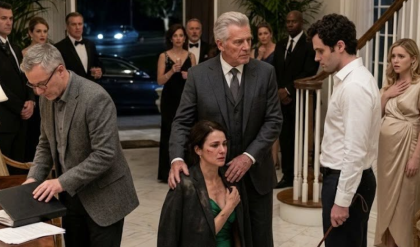
Victoria Morrison entered like perfume over smoke.
She was tall, blonde, immaculate, dressed in winter white with diamonds circling one wrist.
Her eyes swept from Roman to me, then to my stomach.
For half a second, her perfect face cracked.
Then she smiled.
“There you are,” she said to Roman.
“My father is here.”
Roman did not move.
Victoria’s gaze rested on me again.
“How brave of you, nurse,” she said softly.
“Working in your condition.”
The words were polite.
The threat was not.
I pulled my scrub top lower.
Roman saw it.
His expression darkened.
“Victoria,” he said, warning her.
She lifted one elegant brow.
“Careful, Roman.
People are watching.”
Then Senator James Morrison appeared in the doorway.
He was exactly as television had trained America to love him.
Silver hair.
Warm smile.
Patriot’s pin.
Eyes like a locked cellar.
He looked at Roman first, then Victoria, then me.
The smile stayed.
But the blood left his face.
For a heartbeat, the senator stared at me as though he had seen a ghost wearing hospital scrubs.
Then he said one word.
“Morgan?”
My name sounded different in his mouth.
Not recognition.
Not curiosity.
Fear.
I did not know it then, but that was the moment the story stopped being about a broken heart.
**That was the moment I learned my unborn child was not the only secret buried inside me.**
PART 2 — THE WOMAN WITH DIAMONDS ON HER WRIST
Senator Morrison recovered faster than any honest man would have.
His smile warmed again, practiced and paternal.
“I knew a Morgan once,” he said.
“A fine family name.”
Roman’s body shifted slightly, placing himself between the senator and me.
The movement was so natural I almost missed it.
Victoria did not.
Her eyes narrowed, then softened into something that looked almost like pity.
“Daddy,” she said, “Dr. Keller needs an update on Mr. Alvarez.”
Alvarez.
The bleeding man.
The one Roman had carried in with terror hidden under command.
The senator glanced at the closed trauma doors.
“Of course,” he said.
“We must all pray.”
He put a hand on Victoria’s shoulder, but she stiffened under it.
The gesture lasted less than a second.
Still, I saw it.
So did Roman.
When the senator left, Victoria remained.
She looked at me with that polished smile, but her voice dropped low.
“You should ask to be reassigned tonight.”
I folded my arms over my stomach.
“Is that a suggestion or an order?”
“A courtesy.”
“I don’t take courtesies from women who threaten nurses.”
Her smile disappeared.
“You think I’m the threat?”
Roman said her name again, softer this time.
Victoria turned on him.
“You brought him here.”
“I brought Mateo where he might live.”Preview
“You brought her into this.”
He looked at me.
“No,” he said.
“She was already in it.”
My skin went cold.
“What does that mean?”
Before either of them could answer, Dr. Keller stepped out of Trauma One.
His surgical cap was crooked, his gloves red.
“Mr. Valente,” he said, “your friend is alive, but barely.
The bullet clipped the lung and nicked the pericardium.
We’re taking him up.”
Roman closed his eyes briefly.
“Did he say anything?”
Dr. Keller hesitated.
“He kept repeating a name.”
Every nerve in me seemed to listen.
“What name?” Roman asked.
Dr. Keller looked at me.
“Morgan.”
The hallway tilted.
I reached for the wall.
Roman moved, but I slapped his hand away.
“No,” I whispered.
“No, don’t touch me.”
Dr. Keller glanced between us.
“Riley, sit down.”
“I’m fine.”
“You’re gray.”
“I said I’m fine.”
But I was not fine.
A wounded man I had never met had crossed the city bleeding and said my name.
A senator had looked at me as if my face had crawled out of a grave.
Roman Valente, the man I had spent months trying to hate, was staring at me with grief, guilt, and something worse.
Knowledge.
I turned and walked away.
Not far.
Only to the small chapel at the end of the corridor, where families went to bargain with God under stained glass and fluorescent bulbs.
I sat in the last pew, folded my hands, and tried not to shake.
Roman found me three minutes later.
Of course he did.
Men like Roman found doors, secrets, weaknesses.
He stood at the back for a long time.
When he finally spoke, his voice was stripped clean.
“Mateo Alvarez was a private investigator.”
I did not turn.
“Yours?”
“Yes.”
“What was he investigating?”
“The Morrison family.”
My laugh came out small.
“Your future in-laws?”
“I told you.
I never chose that engagement.”
“But you wore it well.”
He walked down the aisle slowly.
“I wore it because my father’s company was being gutted by people who knew exactly which debts could ruin us and which scandals could bury my mother.”
“That sounds tragic for the billionaire.”
“It was not money they threatened.”
I turned then.
His face was pale, his bandage red.
“They threatened my sister’s children,” he said.
Something in me quieted.
Roman sat one pew away, leaving space between us like a peace offering.
“After my father died, Senator Morrison’s people produced documents tying Valente Properties to illegal zoning paymenTS. My father may have signed them.
He may not have.
I still don’t know.
Morrison offered a solution.”
“Marry his daughter.”
“Appear engaged to her,” he said.
“Support his redevelopment bill.
Help him look bipartisan, successful, untouchable.”
“And Victoria?”
Roman looked toward the chapel doors.
“Victoria has been trapped longer than I have.”
That surprised me.
“She threatened me.”
“She warned you.”
I wanted to reject that.
I wanted the world simple.
Roman had wronged me.
Victoria was cruel.
The senator was powerful.
I was unlucky.
But nothing about the night had stayed simple.
“What does this have to do with me?” I asked.
Roman reached into the inside pocket of his ruined jacket.
He removed a plastic evidence sleeve and laid it carefully on the pew between us.
Inside was a photograph, creased down the middle.
I knew the woman in it.
My mother, Ellen Morgan.
She was younger than I remembered, standing in a hospital hallway with her nurse’s badge clipped to her collar.
Beside her was my father, Daniel Morgan, smiling cautiously at the camera.
In my mother’s arms was a baby wrapped in a yellow blanket.
On the back of the photograph, written in blue ink, were three words.
**Keep her hidden.**
I stopped breathing.
Roman did not touch me.
That restraint nearly broke me.
“Mateo found this in a sealed file connected to St.
Catherine’s maternity ward,” he said.
“My mother worked here.”
“I know.”
“She died when I was twelve.”
“I know that too.”
“My parents died in a car accident.”
Roman’s silence was terrible.
I stood too quickly.
“No.”
“Riley.”
“No,” I said again, louder.
“You don’t get to walk back into my life with blood on your clothes and turn my dead parents into one of your political mysteries.”
“I wish I were wrong.”
“You don’t know anything about them.”
“I know your father’s brake line was cut.”
The chapel went airless.
His words did not shout.
They did not need to.
They simply fell between us and shattered twelve years of grief.
I remembered rain on a November road.
Two police officers at my aunt’s kitchen table.
The smell of burnt coffee.
The way my aunt Ruth had held me too tightly and said, “Accidents happen, sweetheart.”
Accidents happen.
Accidents happen.
Accidents happen.
I gripped the pew until my fingers hurt.
“Why would anyone kill my parents?”
Roman looked down at the photograph.
“Because they were hiding a child.”
My hand moved to my belly.
He saw it.
His voice softened.
“Not yours.”
My eyes filled before I could stop them.
“Then whose?”
The chapel doors opened.
Victoria stood there, diamonds gleaming under the fluorescent light.
Her face had lost every trace of society polish.
For the first time, she looked tired.
Older.
Almost human.
“Yours,” she said.
I stared at her.
“What?”
Victoria came inside and closed the door behind her.
The diamonds on her wrist made a faint, cold sound.
“The child they were hiding,” she said, “was you.”
The pew beneath me might as well have vanished.
Roman rose.
“Victoria, not here.”
“She deserves the truth,” Victoria said.
“Before my father turns her into another obituary.”
My heart pounded so hard I felt it in my throat.
“Your father?”
Victoria looked straight at me.
“Senator James Morrison is not just afraid of you, Riley.”
She swallowed.
“He is afraid because you are his daughter
PART 3 — THE NAME BURIED UNDER ASHES
There are truths so large they do not enter the mind all at once.
They arrive like winter through a cracked window, first as a chill, then as numbness, then as the knowledge that everything warm has been leaving for a long time.
I sat in the chapel with one hand over my unborn child and listened to Victoria Morrison tell me I was her father’s blood.
No.
Not her father.
Mine.
The word refused to fit.
“My parents were Daniel and Ellen Morgan,” I said.
Victoria nodded.
“They were the only parents you ever had.”
“Then stop talking.”
“I can’t.”
“You can.”
“She can’t,” Roman said quietly.
“Not anymore.”
I turned on him.
“And you knew?”
“Not that night.”
“Do not mention that night.”
His face tightened.
“All right.”
Victoria sat in the pew across from me.
Up close, her perfection looked expensive but fragile, like porcelain glued after a fall.
“My mother married James Morrison when I was six,” she said.
“He adopted me for the cameras.
A widowed war hero marrying a schoolteacher with a daughter.
It made voters cry.”
“So you’re not his biological daughter.”
“No.”
I laughed, though nothing was funny.
“Then the tabloids were wrong twice.”
“The tabloids are rarely asked to be right,” Victoria said.
Her calmness made me want to slap her.
She saw it and did not flinch.
“My stepfather had an affair twenty-nine years ago with a young campaign aide named Celia Hart.
She became pregnant.
He was already building his career on family values, faith, and a wife who was useful to him.”
“What happened to Celia?”
Victoria looked down.
“She died after giving birth.”
My heart seemed to pause.
“At St.
Catherine’s?”
“Yes.”
Roman’s voice was gentle.
“Your mother, Ellen Morgan, was the maternity nurse on duty.”
I shook my head slowly.
“My mother would have told me.”
“She tried,” Victoria said.
“There was a box.”
A memory flashed.
My mother kneeling by the hallway closet.
My father saying, “Not yet, Ellie.”
My mother crying into a scarf she never wore.
“There was no box,” I whispered.
“There was,” Roman said.
“Mateo was trying to find it.”
“Why?”
Victoria removed her diamond bracelet.
Her wrist beneath it was marked with a thin red groove.
For the first time, I understood.
Those diamonds were not jewelry.
They were a shackle.
“My stepfather believed the baby died with Celia,” she said.
“For years.
Then your parents began asking questions after you turned twelve.
They wanted to tell you who you were.
They contacted a lawyer.
The lawyer contacted the wrong person.”
I could not breathe.
“Three days later,” Roman said, “your parents were dead.”
The chapel blurred.
I pressed both hands to my mouth.
My baby shifted inside me for the first time.
Not a flutter.
Not imagination.
A small, impossible brush of life against grief.
**In the middle of learning I had been born from violence and protected by love, my child moved as if to remind me that I was still alive.**
I broke then.
Not elegantly.
Not with a single tear sliding down my cheek like women in movies.
I bent forward and sobbed into my hands while Roman stood helplessly near the pew, every instinct in him straining against the distance I demanded.
Finally, I whispered, “Why now?”
Victoria answered.
“Because Senator Morrison is announcing his presidential exploratory committee in six weeks.”
Roman’s mouth tightened.
“A living illegitimate daughter whose adoptive parents died under suspicious circumstances would end him.”
“So he tried to kill Mateo.”
“He tried to retrieve what Mateo found,” Roman said.
“The photograph?”
Victoria looked at the chapel door.
“More than that.”
Roman reached into his pocket again and took out a small silver locket.
It was dented, blackened on one edge, as if it had survived a fire.
I knew it.
My mother wore it in nearly every photograph I had of her.
My aunt Ruth told me it had been lost in the crash.
Roman placed it in my palm.
My fingers trembled around it.
Inside was a tiny folded paper.
The paper was brittle with age, covered in my mother’s handwriting.
**Her name is Riley because she fought to breathe.
If anything happens to us, tell her she was wanted, tell her she was loved, and tell her James Morrison must never know where she is.**
I read it once.
Then again.
Then the words became water.
Roman sat beside me then, not touching until I leaned, only a fraction, toward him.
He took that fraction as if it were a holy gift.
His hand covered mine.
The contact nearly undid me.
I remembered his hands in the hotel room.
I remembered his laugh when I spilled wine on his cuff.
I remembered him reading poetry badly on purpose until I smiled through the worst day of my year.
“Did you know who I was when we met?” I asked.
“No.”
His answer came instantly.
“Do not lie to me now.”
“I didn’t know,” he said.
“I knew only that you looked sad in a way I understood.”
“Because your father was dying.”
“Because I already knew he was being destroyed.”
The anger returned, weaker but sharp.
“And the engagement?”
“I should have found you before the announcement,” he said.
“I should have put a notice in every newspaper, hired every investigator, torn the city apart.
But my father died, my mother collapsed, my sister’s children were threatened, and I made one compromise after another until I no longer recognized my own life.”
“That is not an apology.”
“No,” he said.
“It is the shame underneath one.”
The chapel fell quiet.
Victoria stood.
“I’ll keep watch.”
When she left, Roman and I remained in the dim light.
For the first time, neither of us was performing.
He looked exhausted.
I probably looked worse.
“The baby is yours,” I said.
The words were not soft.
They were not romantic.
They were a door unlocked with shaking hands.
Roman’s face changed in a way I will remember until the day I die.
He closed his eyes first, as though the joy hurt.
Then he opened them, and they were wet.
“Riley.”
“I wasn’t going to tell you.”
“I know.”
“I hated you.”
“I know.”
“I loved you too,” I whispered, and hated myself for it.
He made a sound like a man struck through the chest.
“I came back to that hotel room,” he said.
“I swear to you, I came back.”
“I burned the ultrasound picture.”
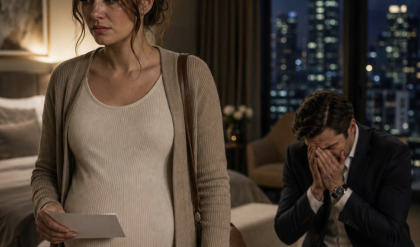
 Pregnant Wife Silently Ends Her Marriage and Vanishes—Her Millionaire Husband Cries Too Late
The confession escaped me before I could weigh it.
His expression broke.
“Why?”
“Because it looked like hope.”
For a long time, he said nothing.
Then he reached for my hand, slowly enough that I could refuse.
I did not refuse.
“Then we will make another,” he said.
“When you are ready.”
I wanted to tell him that hope was not something you remade.
It was something that grew back crooked after fire.
But before I could speak, my phone buzzed.
A message from an unknown number appeared on the screen.
There was a photograph attached.
My apartment door, hanging open.
On my kitchen table sat the chipped mug where I had burned the ultrasound picture.
Beside it was a fresh white envelope.
The message contained five words.
**Your mother’s box is ours.**
PART 4 — THE BRACELET THAT WAS NOT JEWELRY
Roman did not ask permission to come with me.
I did not have the strength to argue.
By the time we reached my apartment, the police were already downstairs, though no one had called them from my phone.
That told me everything.
Senator Morrison had eyes before we had witnesses.
My doorframe was splintered.
The cheap brass lock hung twisted like a broken tooth.
Inside, the apartment looked the way grief feels.
Drawers yanked open.
Cushions slashed.
Books scattered across the floor.
The framed photograph of my parents lay facedown, glass cracked through my mother’s smile.
I stepped over a pile of winter sweaters and went straight to the kitchen.
The chipped mug was there.
So was the white envelope.
Roman picked it up with a handkerchief.
Inside was a single black-and-white photograph.
Me, age twelve, standing at my parents’ graves.
Behind a tree in the background stood Senator Morrison.
Watching.
My knees weakened.
Roman caught my elbow.
This time, I let him.
“He was there,” I whispered.
Roman’s voice was low and lethal.
“He has been near your life longer than we knew.”
The officer in the doorway cleared his throat.
“Ma’am, you’ll need to come down and make a report.”
Roman looked at him.
“She’s not going anywhere with you until your badge number is verified.”
The man flushed.
“Sir?”
Roman took one step forward.
“You arrived before anyone called.
That makes you either very efficient or very compromised.”
The officer’s hand twitched near his belt.
Roman smiled without warmth.
“Choose your next movement carefully.”
A second voice came from the hall.
“He’s with Morrison.”
Victoria entered in a dark coat, her hair pinned beneath a scarf, her face stripped of makeup.
The officer cursed and ran.
Roman moved to follow, but Victoria grabbed his arm.
“No.
That’s what they want.”
She looked at me.
“Pack what matters.”
A strange laugh rose in me.
“What matters is gone.”
“No,” Victoria said.
“You are still here.”
I stared at her.
There was no polish in her now.
No senator’s daughter.
No blonde woman from the magazine cover.
Just a frightened woman who had spent her life near a monster and learned to speak softly around teeth.
I packed a small bag.
Two sweaters.
Prenatal vitamins.
My parents’ cracked photograph.
The locket.
A tiny pair of yellow booties I had bought from a thrift store and hidden behind flour because I had been too afraid to admit I wanted them.
When I came out, Roman was holding the booties.
His thumb rested on the soft yarn as if he had found a relic.
“I didn’t know if I was allowed to buy anything,” I said.
He looked up.
“Allowed by whom?”
“Life.”
He folded the booties carefully and placed them in my bag.
“Life has already taken enough from you.”
Victoria drove us herself.
Roman sat beside me in the back seat, his phone vibrating constantly.
He ignored every call until his sister’s name appeared.
He answered at once.
“Lucia?”
I heard a woman crying.
Roman’s face hardened, then emptied.
“When?”
Silence.
“We’re coming.”
He ended the call.
“What happened?” I asked.
“My mother’s house was searched.”
“Was she hurt?”
“No.
But the children were there.”
Victoria gripped the steering wheel.
“My God.”
Roman leaned forward.
“You said you had a plan.”
“I had a theory,” Victoria said.
“Now I have desperation.”
She drove us not to Roman’s estate, as I expected, but to an old Catholic retreat house north of the city, closed for winter and owned by a friend of her mother’s.
The building smelled of dust, beeswax, and pine.
Snow pressed against the dark windows.
For one quiet hour, no one found us.
Then Victoria placed her diamond bracelet on the kitchen table.
It glittered under the yellow light.
“I need you both to understand something,” she said.
“My stepfather gave me this when I was sixteen.”
Roman stared at it.
“I thought it was a tracker.”
“It is.”
She touched a hidden clasp.
The bracelet opened in two sections.
Inside, tucked where diamonds met platinum, was a narrow data drive.
“It is also where I have been hiding copies of his files for eleven years.”
I stared at her.
“You had proof all this time?”
“Pieces,” she said.
“Never enough.
Names without signatures.
Payments without context.
Photos without dates.
But Mateo found the missing thread.”
“My mother’s box,” I said.
Victoria nodded.
“Ellen Morgan kept birth records, letters from Celia Hart, and a cassette tape.”
Roman frowned.
“A tape?”
“My stepfather has always loved the sound of his own voice,” Victoria said.
“Celia recorded him when she realized he was going to abandon her.”
The kitchen seemed to shrink around us.
“What did he say?” I asked.
Victoria looked almost sorry.
“That if the baby became a problem, both mother and child would disappear.”
Roman’s hands curled into fisTS.
“My parents heard that tape,” I said.
“Yes.”
“And now he has it.”
“Maybe,” Victoria said.
“Or maybe he wants us to think he does.”
I did not understand until she looked at me with sudden intensity.
“Riley, did your aunt ever give you anything after your parents died? Anything odd? A book, a recipe box, an old handbag?”
I thought of my aunt Ruth, stern and religious, always afraid of drawers, attics, and questions.
She had raised me after my parents died, but never with ease.
She loved me like someone guarding a candle in a storm.
“She gave me my mother’s Bible,” I said slowly.
Victoria leaned forward.
“Where is it?”
“At my apartment.”
Roman swore softly.
“No,” I said.
“Not out in the open.
Aunt Ruth told me never to keep it near windows or water, which made no sense.
I hid it in the hospital locker because my apartment ceiling leaked.”
For the first time that night, Victoria smiled.
It was not warm.
It was victorious.
“Then your mother was smarter than all of us.”
We returned to St.
Catherine’s before dawn.
The hospital looked different when you entered as prey.
Every guard could be bought.
Every camera could be watched.
Every elevator might open onto a gun.
Roman kept close enough for me to feel his heat.
In the locker room, my hands shook so badly I dropped the key twice.
The Bible was wrapped in an old pillowcase beneath spare shoes.
Its leather cover was cracked.
My mother’s name was written inside.
Between the pages of Psalms, there was an envelope.
Inside was not a cassette tape.
It was a birth certificate.
My birth certificate.
My mother’s name was Celia Hart.
My father’s name was James Alistair Morrison.
Across the bottom, in Ellen Morgan’s handwriting, were the words:
**He will deny her blood.
Make the blood speak.**
Roman went still.
Victoria covered her mouth.
I stared at the sentence until the meaning settled.
“The blood speak,” I whispered.
Victoria nodded slowly.
“DNA.”
Roman looked at my stomach.
“No.”
I understood before he finished.
To prove who I was, we needed living blood.
Mine would be challenged.
Records would disappear.
Witnesses would die.
But my baby carried both my blood and Roman Valente’s, and no senator could erase a child tested under court order with the eyes of the nation watching.
My unborn baby had become evidence.
I pressed both arms around my stomach.
“No,” I said.
“He is not using my child.”
Roman stepped closer.
“Neither are we.”
Victoria’s voice broke.
“Riley, without proof, he wins.”
I looked at her.
“And with proof?”
She did not lie.
“With proof, he will do anything to stop you.”
That was when my phone rang.
Unknown number.
Roman reached for it, but I answered first.
Senator Morrison’s voice filled my ear, warm as poison.
“My dear,” he said, “you have something that belongs to me.”
I looked at Roman.
“No,” I said.
His pause was almost tender.
“Then perhaps Roman has not told you the last secret.”
My blood turned cold.
Roman’s face sharpened.
“What secret?”
The senator laughed softly.
“Ask him why he was really at that hotel bar.”
PART 5 — THE SECRET AT THE ALTAR
The most dangerous lies are not the ones that are false.
They are the ones with enough truth inside them to make love doubt itself.
I ended the call without speaking.
Roman reached for me.
I stepped back.
“Why were you at that hotel bar?”
His face changed.
Not guilt exactly.
Fear.
That was worse.
“Riley.”
I shook my head.
“No.
Not my name.
The truth.”
Victoria looked between us.
“Roman?”
He turned away, ran both hands through his hair, and for the first time since he had entered my life covered in blood, he looked young.
Not powerful.
Not untouchable.
Just a man who had carried one secret too many.
“I was meeting Mateo,” he said.
My chest tightened.
“At the hotel?”
“Yes.”
“The night we met?”
“Yes.”
The room fell silent around that single word.
Roman stepped toward me, then stopped himself.
“Mateo believed a nurse connected to the old maternity records might still be alive.
He had a name, but not yours.
Not then.
We were supposed to meet in that bar because Morrison’s people watched my office.”
I could hear my own breathing.
“You were investigating my life when you bought me a drink.”
“I didn’t know it was your life.”
“But you knew there was a woman somewhere.
A child hidden.
A dead mother.
A nurse.
A scandal.”
“Yes.”
The word hurt because it was honest.
“You quoted poetry to me while hunting a ghost,” I said.
His eyes shone.
“I quoted poetry because you were sitting alone with a book and a grief I recognized.”
“I was not a clue.”
“No,” he said fiercely.
“You were never a clue.”
I wanted to believe him.
I wanted to hate him.
The baby moved again, small and insistent, as if tired of adults making war over the past.
Victoria spoke quietly.
“Riley, Morrison told you that because he wants you divided.”
I turned on her.
“And you want me united with him because it helps your plan.”
Her face flinched.
“Yes,” she said.
“And because I know what it is to be loved badly by powerful men who call it protection.”
That stopped me.
Victoria looked at the bracelet on the table.
“My mother died in a fall down the stairs when I was seventeen,” she said.
“The official report called it an accident.
I learned then that accidents happen often around James Morrison.”
Roman closed his eyes.
“I’m sorry.”
“I don’t want sorry,” Victoria said.
“I want him buried alive in the truth.”
She turned to me.
“The charity gala is tomorrow night.
He will announce the engagement date, the campaign committee, and his family-values platform.
Every camera in the state will be there.”
I understood slowly.
“You want me to walk in.”
“Yes.”
“Pregnant.”
“Yes.”
“With proof that I am his daughter.”
“Yes.”
Roman said, “Absolutely not.”
I looked at him.
For once, his command did not anger me.
It frightened me because I wanted to obey it.
I wanted him to take me somewhere safe.
I wanted a clean room, a warm blanket, an ordinary future where my child’s first cry was not evidence.
But my parents had died because they protected me.
Celia Hart had died because she carried me.
Aunt Ruth had spent her life afraid because she raised me.
And my baby was growing in a world where men like Senator Morrison could cut brake lines, buy officers, and still smile on television.
“No,” I said.
Roman’s eyes met mine.
“No?”
“I am done hiding.”
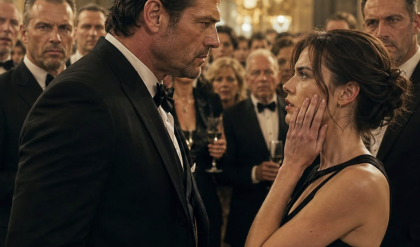
The gala took place at the Morrison Cultural Center, a marble palace built with money that should have repaired schools, clinics, and bridges.
Women in silk drifted beneath chandeliers.
Men in tuxedos shook hands as if laundering sins through skin.
Cameras flashed when Roman entered with Victoria.
I watched from a service corridor in a plain black maternity dress Victoria had found for me.
It was the first garment I had worn that did not try to hide the baby.
My stomach curved openly beneath the fabric.
**For the first time, I did not look like a woman carrying shame.**
I looked like a woman carrying a verdict.
Roman saw me across the room.
His expression changed so quickly that Victoria had to touch his arm to keep the performance intact.
Senator Morrison stood at the podium, radiant beneath the lighTS.
“My friends,” he began, “tonight is about family, service, and the future.”
Victoria’s bracelet glittered on her wrist.
Inside it, the drive transmitted everything to three newsrooms, one federal prosecutor, and Lucia Valente’s lawyer husband, who was waiting with an emergency injunction and enough caffeine to kill a horse.
That was the plan.
Plans, I had learned, were prayers written by people who had not yet met disaster.
Halfway through the senator’s speech, two security men moved toward my corridor.
Roman saw them.
So did Victoria.
She stepped to the microphone before her stepfather could stop her.
“Daddy,” she said brightly, “tell them about Riley.”
The room stilled.
Senator Morrison’s smile did not move.
“Who?”
Victoria pointed.
Every camera turned.
Light hit me like weather.
I walked forward.
My legs trembled, but I kept my hand on my stomach and my eyes on the man who had haunted my entire life without ever raising me.
Whispers rippled through the ballroom.
Roman left Victoria’s side.
The senator’s voice sharpened under the polish.
“Mr. Valente, control yourself.”
Roman stopped.
Not because the senator ordered him.
Because I lifted my hand.
This was mine.
I reached the foot of the stage.
“My name is Riley Morgan,” I said.
The microphones caught it.
“My parents were Daniel and Ellen Morgan.
They were killed when I was twelve.
Tonight, I learned they died protecting me from you.”
The senator laughed gently.
It was masterful.
Pitying.
Concerned.
“Ladies and gentlemen, this young woman is clearly distressed.”
I removed the birth certificate from my bag.
Victoria’s bracelet caught the camera zoom.
“My birth mother was Celia Hart.”
The senator’s smile twitched.
“My father is listed as James Alistair Morrison.”
Gasps broke across the room.
The senator leaned toward the microphone.
“Forgery is a serious crime, Ms.
Morgan.”
“So is murder,” I said.
The room erupted.
Security moved.
Roman moved faster.
A man grabbed my arm, and Roman hit him so hard he dropped without a sound.
Victoria took the microphone again.
“Federal prosecutors have copies of financial records, police payments, witness intimidation files, and medical records from St.
Catherine’s maternity ward.”
The senator turned on her.
“You stupid, ungrateful girl.”
For the first time, America heard his real voice.
The cameras loved it.
Victoria smiled sadly.
“There you are.”
He realized then.
His eyes dropped to the bracelet.
His face twisted.
“You wired me?”
“You trained me,” she said.
The senator lunged for her, but Roman reached the stage first.
Then everything happened in pieces.
A shout.
A flash of metal.
A gun where no gun should have been.
Roman turning toward me.
Victoria screaming.
The senator’s hand shaking as he aimed not at me, but at my stomach.
**He was not trying to kill his daughter.**
**He was trying to erase his grandchild.**
The shot cracked through the ballroom.
Roman slammed into me.
We fell together, marble cold beneath my back, his body heavy over mine.
For a second, I thought I had been hit.
Then I felt warmth spreading across my hands.
Roman’s blood.
“No,” I said.
His face was above mine, pale with pain.
“Are you hurt?”
“You idiot,” I sobbed.
“You got shot and you’re asking me?”
“Answer me.”
“No.
No, I’m not hurt.”
His breath trembled.
“Good.”
Around us, men tackled the senator.
Victoria knelt beside us, screaming for a doctor.
I pressed both hands to Roman’s side.
“Stay with me.”
He tried to smile.
“I came back to the hotel.”
“I know.”
“I would have come back every day.”
“I know.”
“I love you.”
“I know,” I said, crying so hard I could barely see him.
“And you are not allowed to make that a goodbye.”
He lived.
Barely, stubbornly, Roman lived.
The bullet missed his heart by less than an inch, which Dr. Keller later called luck.
Victoria called it divine sarcasm.
The senator was arrested before sunrise.
By noon, every network in America was playing the footage of him calling Victoria ungrateful, lunging for her, and firing at his pregnant biological daughter.
The DNA test came two weeks later.
There was no room left for denial.
**James Morrison was my father.**
The tabloids called me the secret daughter.
The prosecutors called me a witness.
The public called me brave.
I called myself tired.
Roman recovered in a private room at St.
Catherine’s, complaining so much about the pudding that the nurses threatened to sedate him for the good of morale.
I returned to work only to resign.
Not because I was afraid.
Because I had spent years cleaning up rooms where powerful men left blood behind, and I wanted my child to know a mother who chose more than survival.
Victoria visited often.
At first, we sat in awkward silence.
Then she brought tea.
Then she brought the files.
Then, one afternoon, she brought a small wooden box recovered from a storage unit rented under Aunt Ruth’s maiden name.
Inside were letters from Ellen Morgan.
Photographs of Celia Hart.
A cassette tape.
And an ultrasound picture.
Not mine.
Celia’s.
On the back, in Ellen’s handwriting, were the words:
**This baby is not his shame.
She is our miracle.**
I held it for a long time.
Then I understood the twist life had saved for the end.
For months, I thought I had burned the only picture of my child because pain had made me cruel.
But my mother had once held a picture of me in the same gray blur of hope and decided I was worth risking everything.
The love I thought I had destroyed had been waiting for me in another woman’s hands all along.
Three months later, on a spring morning bright enough to forgive winter, my son was born.
Roman cried before the baby did.
I named him Daniel, after the father who chose me.
His middle name was Hart, after the mother who carried me.
When the nurse placed him in my arms, I looked at Roman, then Victoria, then the tiny face blinking angrily at the world.
“He looks furious,” Victoria whispered.
Roman nodded solemnly.
“He gets that from his mother.”
I laughed then.
Really laughed.
The sound startled my son, and he opened his mouth to protest life with impressive outrage.
Roman leaned over us, still pale, still healing, utterly ruined by love.
“Riley,” he said, “will you marry me?”
I looked at the man who had found me in grief, lost me to lies, returned covered in blood, and stood between my child and a bullet.
Then I looked at my son.
Then at the window, where morning poured over us without asking permission.
“Yes,” I said.
Not because the past had been made clean.
It had not.
Not because every wound had closed.
Some never would.
I said yes because love is not the absence of fire.
**Love is what remains in your hands when the ashes cool.**
And for the first time in my life, I was not hiding what I carried.
I was holding him up to the light.