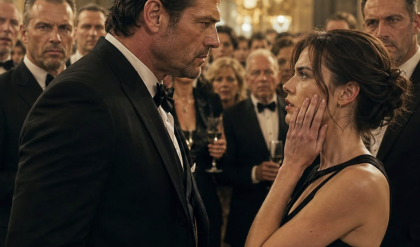
He Offered a Homeless Nurse Any Price to Sleep Beside Him… Until the Sound Beside His Bed Exposed the Doctor Who Destroyed Her
This time he did smile, faint and humorless.
Then, with the rain roaring around them and his expensive black car waiting at the curb, Lincoln Frost repeated the sentence that would change both their lives.
“I meant what I said.
Sit beside me until morning.
I’ll pay any price.”
Delilah stood.
“Why?”
He looked past her into the rain-dark street, and for one second the most feared man in Hadley looked unbearably human.
“Because I haven’t slept in three years,” he said.
“And tonight, if I’m alone when the dark comes, I think something inside me is going to break.”
Delilah did not answer.
There were offers that trapped you because they sounded cruel.
This one trapped her because it sounded wounded.
The car was warm enough to hurt.
Delilah sat pressed against the door, her damp suitcase at her feet, while Lincoln rested his head against the window and kept his eyes closed.
He did not sleep.
His fingers tapped against his knee with the steady, restless rhythm of a man fighting himself.
The driver, a broad man with a shaved head and watchful eyes, said nothing.
Hadley slid past the glass in ribbons of wet neon and gold.
When they reached Frost Tower, Delilah almost laughed from disbelief.
The building rose over downtown like it had been planted there by men who believed clouds were property.
A private elevator carried them to the top floor, where the doors opened onto a penthouse so vast and silent that Delilah’s wet shoes seemed to insult it.
There were marble floors, floor-to-ceiling windows, dark wood shelves, and furniture chosen by someone with impeccable taste and no interest in comfort.
No family pictures.
No crooked mug by the sink.
No jacket tossed over a chair.
No evidence that anyone lived there except a man who did not know how to belong anywhere.
The driver stepped beside her.
“Boone Merrick,” he said.
“I handle security.”
“Delilah Hartwell,” she said before she could stop herself.
Lincoln glanced back, and she saw that he had noticed the gift of her name.
Boone’s eyes swept her face with open suspicion.
“Mr. Frost doesn’t usually bring strangers upstairs.”
“I didn’t ask to be brought.”
“No,” Lincoln said.
“She didn’t.”
A second man appeared at the end of the hall.
Younger than Boone, leaner, polished in a navy suit, with a neat smile that arrived on his mouth a second before it reached his eyes.
“Mr. Frost,” he said.
“Rough night?”
Lincoln removed his wet coat.
“Nothing that concerns you, Graham.”
The younger man’s smile held.
“Of course.”
As Lincoln turned away, Delilah caught the briefest flash in Graham’s eyes.
It was gone quickly, a cold spark buried under manners.
He stepped into a shadowed corner and checked his phone, his back angled away from the room.
Delilah looked at him a beat too long.
Boone noticed.
“Your room is this way, Miss Hartwell.”
“I thought he wanted me to sit beside him.”
“He does,” Lincoln said from the doorway of the study.
“But not if you’re shaking so hard your teeth crack.”
A guest room had been prepared within minutes.
Dry clothes lay folded on the bed, plain and new.
Delilah changed, though she kept her mother’s stopwatch in her pocket and her medical bag beside her feet.
She told herself she would rest for five minutes.
Instead, she listened.
For hours, footsteps moved beyond the wall.
Back and forth.
Back and forth.
Not hurried.
Not calm.
The pacing of a trapped animal that had learned the cage was inside its own ribs.
At two in the morning, Delilah gave up pretending this was not her concern.
She opened the door and followed the sound to a study lit by one brass lamp.
Lincoln stood by the window with a glass of whiskey in his hand.
The liquor had not been touched.
“You should lie down,” she said.
He did not turn.
“Lying down is the problem.”
“Your arm needs rest.”
“My arm is the least damaged part of me.”
The honesty startled her.
He looked over his shoulder.
His face, in the low light, seemed older than it had in the rain.
“I’ve paid neurologists, sleep specialists, psychiatrists, men who speak at conferences and women with waiting lists longer than most prison sentences.
They wired me to machines.
They wrote prescriptions.
They told me to reduce stress.” His mouth twisted.
“Reduce stress.
As if I could step outside my life and hang it up like a coat.”
Delilah moved to the chair across from him.
“Medicine can force unconsciousness.
It can’t always create safety.”
His eyes sharpened.
“Safety?”
“People sleep when the body believes someone is keeping watch.
Some people lose that belief.”
For a long time, he said nothing.
Then he sat.
Not because she ordered him to.
Because, perhaps, he wanted someone else to decide something for once.
Delilah checked his bandage, cleaned it again, and placed fresh gauze over the wound.
When she finished, the silence felt too large.
Without thinking, she reached into her pocket and took out the old stopwatch.
She set it on the table between them.
Tick.
Tick.
Tick.
It was a small sound.
Ordinary.
Almost silly inside that enormous room above the city.
But Delilah had grown up with that sound.
Her mother had used the watch beside hospital beds, in free clinics, in kitchens where elderly neighbors could not afford an ambulance.
“A heartbeat tells the truth,” her mother used to say.
“People lie because they’re scared.
Bodies don’t.”
The ticking filled the study.
Lincoln stared at the watch.
“What is that?”
“My mother’s.”
“Why did you bring it out?”
“I don’t know.”
But she did know.
Some part of her had offered him the only steady thing she had left.
Lincoln leaned back slowly.
His fingers, which had been tapping against the chair arm, stopped.
His jaw loosened.
His breathing, ragged at first, began to settle around the quiet rhythm on the table.
Tick.
Tick.
Tick.
Delilah did not move.
Twenty minutes passed.
Then thirty.
Then the impossible happened.
Lincoln Frost fell asleep.
Not drugged.
Not collapsed.
Not unconscious from blood loss.
Asleep.
The most feared man in Hadley sat in a chair with his wounded arm bandaged and his head tilted toward the sound of an old nurse’s stopwatch, sleeping like someone who had finally heard a door lock between him and his nightmares.
Delilah sat with him until dawn.
When sunlight entered the room, Lincoln opened his eyes.
For one moment he looked disoriented.
Then he saw the window, the pale morning, the watch, and Delilah in the chair across from him.
Astonishment moved across his face so nakedly that she looked away to protect him from being seen.
“You stayed,” he said.
“You paid me to.”
“I haven’t paid you anything.”
“Then I made a bad business decision.”
A soft breath left him.
It might have been a laugh if he had remembered how.
That morning, over coffee she was afraid to spill on a counter that looked more expensive than surgery equipment, Lincoln made his second offer.
“Stay.”
Delilah set down her mug.
“No.”
“You haven’t heard the terms.”
“I heard the word stay.
That was enough.”
“Your own room.
A lock.
A salary higher than Mercy General ever paid you.
Boone will arrange anything your niece needs.”
Her blood ran cold.
“My niece?”
Lincoln’s face did not change.
“Boone looked into you.”
“You had me investigated?”
“I let a stranger into my home.”
“You mean you let a desperate woman into your home, then made sure you knew exactly how desperate she was.”
He accepted the accusation without flinching.
“Yes.”
Delilah stood so quickly the chair legs scraped the floor.
“Then you know I’m easy to buy.”
“No,” Lincoln said quietly.
“I know you refused money when you needed it most.
That makes you the opposite of easy to buy.”
She hated that the answer slowed her anger.
He continued, “You need shelter.
Your niece needs stability.
I need to sleep.
We can help each other.”
“I am not your companion.”
“No.”
“I am not your possession.”
“No.”
“I am your nurse.
I keep my own room.
You never enter without permission.
I don’t ask what you do outside this house, and you don’t bring it to my door.
If I leave, I leave freely.”
Lincoln held her gaze.
Then he nodded.
“Agreed.”
“And one more thing.”
“Name it.”
“My niece, Naomi, doesn’t come near this place unless I decide it’s safe.”
For the first time, something like respect warmed his eyes.
“Agreed.”
So Delilah stayed.
At first, she told herself it was temporary.
A practical arrangement.
A roof, a salary, and a way to keep Naomi in her small Catholic school across town without pulling her out mid-semester.
Naomi was eight years old, all elbows and curiosity, with her late mother’s dimples and Delilah’s entire heart wrapped around her finger.
Delilah kept her worlds separate.
By day, she visited Naomi at the apartment of Mrs. Bell, the retired school secretary who had helped care for the child since Delilah’s sister died.
By evening, she returned to Frost Tower, checked Lincoln’s bandages, measured his blood pressure, and sat beside him with the stopwatch ticking softly on the table.
She began testing the pattern.
One night, she left the watch in her pocket.
Lincoln paced until nearly dawn.
The next night, she placed it beside the bed.
He slept within an hour.
It was not Delilah’s voice.
Not the room.
Not exhaustion.
It was the ticking.
The sound did what money, medicine, and power had failed to do.
It told some wounded part of him that a heart was still beating nearby.
She did not understand why until the night he woke screaming one name.
“Daniel!”
He bolted upright, drenched in sweat, his eyes wide but seeing something that was not the room.
Delilah did not touch him.
She had learned long ago that waking terror could mistake comfort for attack.
Instead, she pushed the stopwatch closer.
Tick.
Tick.
Tick.
Lincoln’s breathing hitched.
His gaze lowered to the watch.
Slowly, painfully, he returned.
“I’m sorry,” he said, his voice already rebuilding its walls.
“You don’t have to apologize for pain.”
His eyes flicked to hers.
She did not ask who Daniel was.
That was why, weeks later, he told her.
It happened after Naomi came to live with Delilah in the tower.
Lincoln had discovered her existence the way he discovered everything, through Boone.
Delilah had been furious until he said only, “A child should be with the person who loves her most.
This building is big enough.”
Naomi arrived on a Saturday morning with a pink backpack, two missing front teeth, and absolutely no fear of wealth.
She ran to the window, pressed both palms against the glass, and shouted, “Aunt Dee, we’re in the sky!”
Lincoln stood in the doorway as if facing a problem no weapon could solve.
Naomi turned to him.
“You’re huge.”
Lincoln blinked.
“I suppose.”
“Do you know how to play treasure hunt?”
“I’m afraid not.”
“That’s okay.
I teach beginners.”
Delilah watched in disbelief as Naomi took Lincoln Frost by two fingers and led him around his own penthouse, ordering him to look behind books, under cushions, and once inside a decorative vase for a pebble she had hidden in her sock.
By afternoon, Naomi had drawn him a picture.
It showed a tall man with black hair standing beside a house.
Above him, she had drawn a bright yellow sun.
Lincoln studied the page.
“Why the sun?”
Naomi shrugged.
“Because you look sad.
My mom said sad people need sunshine more than anybody.”
The room went very still.
Lincoln held the drawing as if it were made of glass.
That night, after Naomi had fallen asleep with a stuffed rabbit tucked under her chin, Lincoln sat with Delilah in the study.
The stopwatch ticked between them.
Naomi’s drawing had already been placed on his desk.
“Daniel was my brother,” Lincoln said.
Delilah looked up but did not speak.
“He was six years younger.
Our mother disappeared when I was fourteen.
Our father was dead before that.
I raised him.” He looked toward the window.
“Or I tried.”
The city glittered below them, cold and endless.
“I did things I’m not proud of so Daniel could eat.
Then I did worse things so he could live somewhere warm.
By the time I understood what I was becoming, people were afraid of me, and fear had become useful.” His jaw tightened.
“I told myself it was all for him.”
“What was he like?”
The question seemed to hurt him.
“Kind,” Lincoln said.
“That was the worst part.
He grew up kind anyway.
He would bring food to people I told him not to trust.
He remembered birthdays.
He cried at old movies and pretended he had allergies.”
Delilah smiled faintly.
Lincoln did not.
“Three years ago, men came for me at my house.
They came at night.
Daniel was staying over because he said I worked too much and needed real breakfast in the morning.” He swallowed once.
“I woke up too late.”
Delilah’s hand closed around the arm of her chair.
“I held him on the floor,” Lincoln said.
“I put my hand on his chest and counted.
I told myself that as long as I could feel his heart, he was still here.
I counted every beat.
Every weak, slowing beat.”
His voice broke on the last word.
He covered his eyes with one hand.
The man who could frighten rooms into silence sat bent under a grief no empire could carry for him.
“And then there wasn’t another beat,” he whispered.
Delilah understood then.
Why darkness was not darkness to him.
Why sleep was not sleep.
Why closing his eyes meant letting go.
The stopwatch was not a cure.
It was a promise.
A steady heartbeat that did not slow, did not fade, did not leave him counting toward silence.
Delilah reached across the table and placed her hand over his.
“This was my mother’s,” she said.
Lincoln lowered his hand.
“She was a nurse.
She raised me alone.
I grew up doing homework in hospital waiting rooms.
She taught me to count a pulse before I could properly multiply.
She used to say a heartbeat never lies.”
Her fingers touched the worn metal of the watch.
“She got sick fast.
Faster than anyone expected.
I had spent years helping save strangers, but when it was my mother in the bed, I couldn’t save her.
I sat beside her with this watch and counted her heartbeat as it slowed.”
Lincoln’s eyes changed.
Not pity.
Recognition.
Two people from opposite worlds, both haunted by the same unbearable memory: the moment love was not enough to keep a heart beating.
“So that’s why you carry it,” he said.
Delilah nodded.
“As long as it ticks, I feel like a piece of her is still with me.”
Lincoln looked at the watch for a long time.
“Then we’re both living by the sound of a heart that no longer beaTS.”
Nothing romantic happened then.
No kiss.
No dramatic confession.
Only silence.
Only understanding.
And somehow that was more dangerous than either one.
The danger returned wearing a white coat.
Lincoln had rules in his world, and Delilah learned them by watching what he would not tolerate.
He ran illegal gambling rooms, controlled docks, collected debts, and owned politicians who smiled too much at charity dinners.
But he had a hard line against anything that harmed children, families, or the sick.
So when counterfeit medication began appearing in small pharmacies and low-income clinics across Hadley, Lincoln treated it like an invasion.
“These people are already suffering,” he said, reading Boone’s report.
“Whoever is doing this is selling death to people praying for relief.”
The investigation took weeks.
Money moved through shell clinics.
Prescriptions pointed to false suppliers.
Patients worsened after taking drugs that should have helped them.
Then Boone placed a photograph on Lincoln’s desk.
Dr. Wallace Pike.
Delilah entered carrying tea at that exact moment.
The cup slipped from her fingers and shattered on the floor.
Lincoln stood.
“Delilah?”
She stared at the photograph.
The room seemed to tilt.
“That’s him,” she said.
“Pike?”
“That’s the doctor who destroyed my life.”
 THE SCALPEL SHE REMEMBERED
Lincoln’s face went perfectly still.
Delilah told him everything.
The patient at Mercy General.
The wrong medication.
The chart Pike altered after the death.
The committee hearing.
The copies she had hidden before security escorted her out.
The way Pike had looked at her with gentle disappointment while telling the board she had been under emotional strain from her mother’s death.
“I thought it was arrogance,” she said, her voice shaking.
“I thought he made a deadly mistake and ruined me to protect his reputation.”
Lincoln looked down at the file.
“No,” he said, and his voice became terrifyingly soft.
“He ruined you because you saw the edge of his business.”
The truth settled over her like ice.
The patient had not died because of a simple error.
The patient had died because Wallace Pike was pushing counterfeit drugs, and Delilah had been the first person close enough to notice.
Lincoln lifted his eyes.
“He will answer for it.”
Delilah should have felt relieved.
Instead, she felt fear.
Because men like Pike did not wait politely for justice.
Two days later, a silver Mercedes pulled up beside Delilah outside a grocery store in River West.
The window lowered.
Wallace Pike smiled at her from the back seat.
“Miss Hartwell,” he said warmly.
“I was hoping we could speak like adulTS.”
She should have walked away.
But for months, his shadow had followed her through every ruined part of her life.
So Delilah opened the door and got in.
Pike did not waste time.
“I know you kept documents,” he said.
“Copies of charts, dosage records, internal notes.
You were always thorough.
That was why you were such a useful nurse before grief made you reckless.”
Delilah’s hands tightened in her lap.
He placed a folder beside her.
“Sign the statement.
Admit you misunderstood the records under emotional stress.
In return, your mother’s remaining medical debt disappears.
Mercy General reinstates you with an apology.
Your niece receives a private school fund.
You get your life back.”
For one terrible second, temptation filled the car.
Naomi in a better school.
No debt.
No locked doors.
No fear of being recognized as the disgraced nurse from Mercy General.
Pike offered her a pen.
Delilah looked at it.
Then she thought of her mother’s watch.
A heartbeat never lies.
She pushed the folder back.
“No.”
Pike’s smile held, but something poisonous appeared underneath it.
“You are protecting a criminal over your own future.”
“I’m protecting the patients you’re killing.”
“You have no idea what kind of man Lincoln Frost is.”
“I know exactly what kind of man you are.”
His eyes hardened.
“You had nothing when this began,” he said softly.
“After this, you will have less.”
Delilah opened the car door.
“I may have nothing,” she said, stepping out, “but I still know who I am.
That’s more than you can say.”
By the time she returned to Frost Tower, Lincoln already knew something was wrong.
Not because she told him.
Because Graham Mallory was missing.
Boone had spent weeks tracing leaks.
Pike’s people had moved too cleanly, avoiding Lincoln’s men by minutes, shifting product before raids, changing routes as if someone inside Frost Tower was whispering in their ear.
That night, Boone placed phone records on Lincoln’s desk.
Graham.
The polished young man with the courteous smile.
The man Lincoln had lifted from nothing, trained, trusted, and seated at his own table.
When Graham was brought into the study, he tried to smile.
Then he saw the evidence.
The smile died.
Lincoln looked at him for a long time.
“I gave you a life.”
Graham’s face twisted.
“You gave me a leash.”
“I trusted you.”
“You trusted me to stand behind you.
To answer phones.
To clean up your messes.
Pike offered me something better.”
“He offered you poison money.”
“He offered me my own name.”
Lincoln’s expression did not change, but Delilah, standing near the doorway, saw the wound land.
Not in his pride.
In the lonely place Daniel had left behind.
“You were never my shadow,” Lincoln said quietly.
“You were the one who decided standing beside me meant standing beneath me.”
Graham laughed once, bitter and frightened.
“That’s easy to say from the throne.”
Lincoln signaled to Boone.
“Get him out of my house.”
Graham’s eyes widened.
“Lincoln—”
“My brother used to sit at that table,” Lincoln said, his voice dropping.
“You sat there too.
And you sold sick people to a man who fills medicine bottles with lies.”
Boone took Graham by the arm.
When the door closed, Lincoln remained standing with his back to the room.
“You see?” he said.
“This is what I am.
This is what my world does.
You were right to want Naomi away from it.”
Delilah stepped forward and set the stopwatch on the desk.
Tick.
Tick.
Tick.
“You’re not alone,” she said.
Lincoln turned toward her.
“Not anymore.”
Pike struck before dawn.
Naomi was safe at Mrs. Bell’s house outside the city, spending the weekend with a golden retriever named Pancake and a backyard full of chalk drawings.
Delilah had kissed her goodnight through the phone.
Lincoln had stood nearby pretending not to listen, then smiled faintly when Naomi shouted, “Tell Mr. Frost I found a real worm and it’s disgusting but brave.”
They were coming back from Mrs. Bell’s when the ambush happened.
Two SUVs blocked the street near the old meatpacking warehouses.
Another pulled behind them.
The night erupted into headlights, screeching tires, and gunfire.
“Down!” Boone shouted from the front seat.
Lincoln shoved Delilah to the floor and covered her with his body.
She smelled rain on his coat and metal in the air.
Glass burst.
The driver cursed.
Boone fired back with terrifying calm.
Delilah’s world narrowed to Lincoln’s heartbeat against her cheek and his voice above her.
“Stay down.”
“But—”
“Delilah.
Stay down.”
He shielded her through the whole attack.
Even when the car lurched forward and slammed through a gap between the SUvs.
Even when Boone shouted that they were clear.
Even when Delilah pushed herself up and saw the blood spreading under Lincoln’s hand.
For one second, she could not breathe.
“Lincoln.”
He tried to smile.
“You’re all right?”
“You’re bleeding.”
“I’ve had worse.”
She almost sobbed because she remembered him saying the same foolish thing the night they met.
Boone turned in the front seat, his face pale.
“We can’t go to Mercy.
Pike’s got people watching hospitals.”
“Then drive somewhere hidden,” Delilah ordered.
Boone looked at her.
“Now!”
He drove to an abandoned textile warehouse near the river, a property Lincoln owned under another name.
The building was cold, dark, and smelled of dust and old rain.
Delilah spread her coat on the concrete and made Lincoln lie down.
Her hands moved before fear could catch them.
She cut his shirt open.
The bullet had torn through his side, deep enough to bleed badly but not so deep that hope was gone.
She packed gauze, applied pressure, checked his pulse, ordered Boone to bring more light, clean water, towels, anything.
Lincoln’s face drained of color.
“Stay awake,” she said.
“Look at me.”
His eyelids lowered.
“No.
Lincoln Frost, you do not get to close your eyes on me.”
A faint breath moved through him.
“Bossy.”
“You have no idea.”
His pulse fluttered under her fingers.
Weak.
Too weak.
Delilah reached into her bag and pulled out the stopwatch.
Tick.
Tick.
Tick.
The sound filled the warehouse.
And suddenly she understood Lincoln’s nightmare not as a story, but as a living thing inside her own body.
She was the one counting now.
She was the one with her hand on a fading heartbeat, terrified that if she missed one beat, the person she loved would leave the world.
Her tears fell, but her hands stayed firm.
“You listen to me,” she whispered, leaning close.
“I did not drag you back from three years of darkness so you could leave me in a warehouse.
Naomi needs you.
I need you.
And you promised me freedom, remember? Well, I’m using it.
I am freely telling you that you are not allowed to die.”
The stopwatch ticked beside his ear.
His pulse trembled.
Then steadied.
Delilah worked until the bleeding slowed.
She worked until Boone, silent and shaken, looked at her with something close to reverence.
She worked until Lincoln’s breathing became even enough for her to believe he might survive the ride to a safe house.
When they moved him, she did not let go of his hand.
For two days, Lincoln drifted between fever and sleep.
Delilah stayed beside him through every hour.
She changed his bandages, cooled his skin, counted his pulse, and kept the stopwatch near his pillow.
She told him ordinary things because ordinary things felt like prayers: Naomi wanted a bicycle, Mrs. Bell’s dog had eaten a sock, the sunrise over Hadley looked almost kind from the safe house window.
On the third morning, Lincoln opened his eyes.
Delilah was holding his hand.
He looked at her, then at the pale light behind her.
His voice was rough, barely more than breath.
“You’re still here.”
The words broke her.
“Yes,” she whispered.
“I’m still here.”
He stared as if he needed to memorize the proof.
For three years, he had woken expecting absence.
This time, someone had stayed.
Delilah pressed his hand to her cheek.
“I’m not going anywhere.”
Lincoln closed his eyes again, but this time there was no fear in it.
Only peace.
They brought Wallace Pike down without killing him.
That mattered to Delilah.
Lincoln had wanted blood.
She could see it in the cold stillness of his face whenever Pike’s name was mentioned.
But Delilah had spent too many years trying to save lives to let revenge become the final word of her own story.
So they used evidence.
Her copied Mercy General records.
The forged prescriptions.
The counterfeit supply routes Boone had traced.
The shell clinic paymenTS. Graham’s recorded calls.
Testimony from frightened pharmacists and grieving families who had finally learned why their loved ones had worsened after taking medicine that should have helped them.
The file did not go to one person.
It went everywhere at once.
Federal prosecutors.
State medical boards.
Investigative reporters.
Hospital insurers.
Families of victims.
Every door Pike could normally close was forced open at the same time.
By the end of the week, Dr. Wallace Pike was no longer smiling on hospital brochures.
He was led out of his downtown office past cameras, stripped of the white coat he had used like a saint’s robe, and exposed as a man who had sold suffering to the desperate.
Mercy General issued a public statement clearing Delilah Hartwell.
The apology was formal, careful, and far too late.
Still, Delilah cried when she read it.
Not because Mercy had admitted she was right.
Because the patient who died was no longer just a buried mistake.
Their death had become the crack that opened a wall of lies and saved others from being harmed.
Her mother would have understood that kind of justice.
Months passed.
Lincoln changed slowly, not into a harmless man and not into a saint.
Delilah was too honest to pretend love erased a person’s past.
But he began cutting away pieces of the empire that had once kept him alive and now kept him chained.
He closed the gambling rooms that preyed on addicTS. He turned warehouse money into legitimate freight contracTS. He put Boone in charge of a foundation that quietly paid medical bills for families who had been crushed by hospitals, interest, and shame.
“Daniel would laugh at me,” Lincoln said one night, watching workers carry boxes into a free clinic funded under a name no one connected to him.
“No,” Delilah said.
“He would brag about you.”
Lincoln looked away, but not before she saw his eyes shine.
Naomi adored him without fear.
She made him attend school plays, judge sidewalk chalk contests, and once forced him to wear a paper crown that said King of Pancakes.
Boone took a picture.
Lincoln threatened to fire him.
Naomi threatened to stop speaking to both of them.
The picture remained.
The penthouse changed too.
Not all at once.
A blue mug appeared near the sink.
Naomi’s drawings took over the refrigerator.
Delilah left books on tables, cardigans on chairs, and once, by accident, a grocery list on Lincoln’s desk that included coffee, bandages, strawberries, and glitter glue.
He kept it.
“Why?” she asked.
He looked almost embarrassed.
“It looks like someone lives here.”
One autumn morning, sunlight poured through the tall windows, turning the whole penthouse gold.
Naomi sat at the kitchen island eating pancakes with too much syrup, explaining to Boone why worms were misunderstood heroes.
Boone listened gravely, as he listened to all Naomi’s briefings.
Delilah carried coffee toward the bedroom.
Lincoln was still asleep.
The man who had once paced through nights like a prisoner now slept deeply, one arm across the blanket, his face peaceful in the morning light.
On the table beside him, her mother’s stopwatch ticked on.
It was no longer the only thing keeping him safe.
It was simply part of the room now, like the sunlight, the coffee, the laughter drifting from the kitchen.
Delilah set the mug down.
Lincoln opened his eyes slowly.
No panic.
No terror.
Only a quiet smile when he saw her.
“Good morning,” he said.
“Good morning.”
From the kitchen, Naomi shouted, “Mr. Frost, Boone says worms don’t have bones, and I think that’s suspicious!”
Lincoln closed his eyes for one more second, and Delilah laughed softly.
“What?” she asked.
He reached for her hand.
“I used to think peace would feel like silence,” he said.
“Turns out it sounds like pancakes, a suspicious worm, and that watch.”
Delilah sat beside him.
For a while, neither of them moved.
They had both once believed love meant holding on so tightly that death could not enter.
They had learned the cruel truth that no human hand could hold back every loss.
But they had also learned something gentler afterward.
Sometimes love was not saving someone from every darkness.
Sometimes it was sitting beside them until morning.
Sometimes it was counting the heartbeat that remained.
Sometimes it was staying.
And in that home high above Hadley, where a poor nurse had once arrived soaked, frightened, and carrying everything she owned in one broken suitcase, Delilah Hartwell finally understood that the smallest kindness on the darkest night can return in ways too large for the heart to measure.
Lincoln Frost had offered her any price to sit beside him.
In the end, what saved them both was the one thing neither of them could buy.
A safe place to belong.
THE END