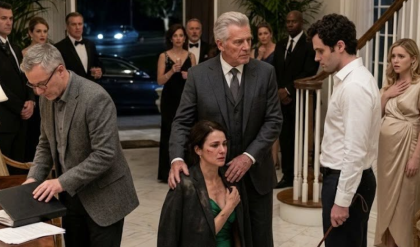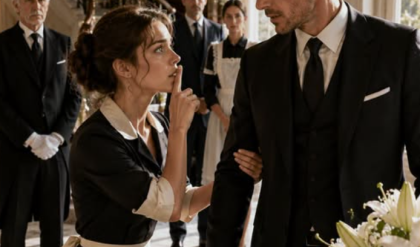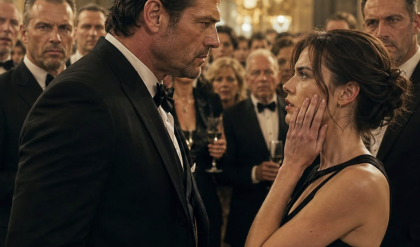
He brought his mistress into the morning show green room and told the producer I was too unstable to appear on live television.
Before America ever heard his practiced grief, the room would learn he had broken the one agreement he thought would keep me silent.
But that was not the most dangerous secret waiting inside my purse.
My name is Victoria Sinclair Whitmore, and the day Harrison underestimated me was the day he destroyed himself.
I was already in the makeup chair when they walked in.
Harrison Whitmore III.
My husband.
And Brielle Sloane, wearing pale blue cashmere, soft blond waves, and his hand resting comfortably on the small of her back.
For one second, nobody spoke.
The makeup artist froze with the powder brush near my cheek.
The producer, Lena Bryant, stood by the door with her headset around her neck, suddenly looking like she wished she had chosen a different career.
Harrison did not look at me first.
He looked at the mirror.
At himself.
At Brielle beside him.
As if he was checking whether they looked pitiful enough for America.
Then he finally said, “Victoria.
I didn’t know you were coming.”
I smiled at him through the mirror.
“I’m your wife,” I said.
“It felt appropriate.”
Brielle lowered herself onto the cream sofa like she belonged there.
Then she opened a folder.
A highlighted script.
Pink lines.
Soft answers.
Healing.
Second chances.
Love that did not arrive politely.
She whispered one sentence under her breath, practicing for the cameras.
“I never wanted to hurt anyone…”
The room went cold.
Not because she sounded guilty.
Because she sounded rehearsed.
Harrison turned to Lena.
His voice dropped.
Gentle.
Careful.
Cruel.
“I’m concerned,” he said.
“Victoria has been under significant emotional stress.
I can’t risk her embarrassing herself on live television.”
There it was.
His favorite weapon.
Not crazy.
Fragile.
Fragile sounded kind.
Fragile made people lower their voices while they took away your microphone.
Lena looked at me.
Then at Harrison.
Then at Brielle’s folder.
I felt humiliation rise in my throat like heat.
But I did not cry.
I did not defend myself.
I did not ask him how he could do this after seven years of marriage.
I simply reached into my purse.
Harrison’s face changed.
Only a little.
But I knew him.
I knew every small shift in that beautiful, lying face.
I pulled out a cream envelope sealed with my attorney’s embossed mark and held it out to Lena.
“What is this?” she asked.
I looked at Harrison.
Then at the woman wearing my bracelet.
“The NDA he broke,” I said, “the moment he entered this room with her.”
The air stopped moving.
Brielle’s lips parted.
Harrison’s tan faded under the studio lighTS.
Lena opened the envelope.
Her eyes moved quickly across the page.
Then slower.
Then she stopped.
Like a woman who had just found a bomb hidden under a wedding cake.
Harrison stepped forward.
“Lena—”
“No,” she said.
His smile tightened.
“This is a misunderstanding.”
Lena looked up.
Her face had gone pale.
“This segment is canceled.”
Brielle stood.
“But we were told—”
“You were told by a man in breach of a legal agreement on network property,” Lena said.
I rose slowly from the makeup chair.
Not because I was weak.
Because timing was the only luxury he had never been able to steal from me.
I passed Brielle and stopped beside her wrist.
The diamond tennis bracelet glittered beneath the green room lighTS.
My bracelet.
The one that had disappeared from my dressing room eight months earlier.
I leaned close and said softly, “You should take that off.”
Her face drained.
“Why?”
I looked at Harrison.
Then back at her.
“Because it belongs to evidence now.”
For the first time that morning, Harrison stared at me like he had no idea who I was.
He was right.
The woman he had brought here to humiliate was gone.
And the producer had just found the first page of what I had been carrying.
The Whitmores owned towers, resorts, senior living communities, and enough political donations to make everyone call them civic-minded.
Their crown jewel was Whitmore House, a limestone mansion on Fifth Avenue overlooking Central Park.
I replaced stiff brocade with cream linen, opened the curtains, filled rooms with books, flowers, music, and children from our literacy program.
Harrison liked the photographs, but he did not like that people began calling the house mine.
In the car afterward, he told me not to confuse decorating with legacy.
Then he squeezed my knee too hard and said he knew I would remember.
Softly.
Where bruises did not show.
Flowers I ordered were canceled, guests I invited vanished from lists, and my credit card failed at Bergdorf Goodman because he wanted me to call him for help.
I used my own.
That offended him most, because I made independence look like contempt, and he made dependence look like love.
Instead, I became quiet.
Not broken, just quiet, and that frightened him.
He told people I barely left the house, refused help, and was obsessed with Brielle.
But Brielle was only a symptom.
Harrison had ordered white roses for Brielle every Monday, billed through the Whitmore Foundation’s donor relations budget.
The delivery address belonged to Blue Harbor Wellness LLC, Brielle’s company.
A private jeweler on Madison Avenue called to say a blond woman had brought in the Paris bracelet I had bought for myself.
She said it was a gift from her fiancé.
Not because of the bracelet.
Because I was still married to him.
When it ended, he said Harrison was escalating.
I said he was careless, and Elias answered that carelessness was escalation in men used to protection.
Elias found payments routed from Whitmore Foundation vendors to Blue Harbor Wellness.
Martin found trust amendments Harrison had made after my mother’s death, with my signature on two documents I had never signed.
Almost affectionate.
He knew the slope of my V, the long cross on my T, and the way I lifted the end of my R when signing quickly.
Sometimes it arrives as ink.
My mother’s Arden Trust owned preferred debt tied to several Whitmore properties through acquisitions made years before my marriage.
One was the Nantucket resort where Harrison proposed, one was a Midtown tower, and the third was Whitmore House.
My trust owned the senior note on my husband’s family home.
Elias said if Whitmore Holdings breached its covenants, the trust could accelerate.
He had already put it in reach.
Harrison was in the dining room with his mother, Margaret, who weaponized concern like a family heirloom.
She told me I looked thin, and I told her she looked observant.
I turned and saw the man I had loved, beautiful, furious, and frightened beneath the polish.
I told him I was not going to embarrass him.
“Then what are you doing?”
“I’m learning the house.”
That was the sweetest part.
No gold bars, no spinning locks, no movie-style security traps.
It looked like a private bank with better lighting, colder air, and enough silence to bury a family empire.
She told me never to let anyone shame me for understanding money.
Back then, I thought she meant accounts, but now I understood she meant exiTS.
Forged documenTS. Foundation transfers.
Property covenanTS. And the morning show talking points that proved exactly how he planned to destroy me.
He would not call me dangerous; he would call me wounded.
He would not call Brielle his mistress; he would call her a partner in healing.
She planned when to pause, when to look at Harrison, and when to say she prayed I found peace.
I folded the paper neatly because if I stared at it too long, I might forget discipline.
He did not shame me for it.
He only said honesty made anger easier to aim.
Martin sent legal preservation notices to Harrison’s attorneys, the foundation board, and financial institutions.
Elias reviewed the Whitmore property covenants, because the forged signatures gave us leverage, the suspicious transfers gave us pressure, and the debt gave us power.
Harrison smiled at red carpeTS. Brielle posted soft sunrise meditations.
Anonymous sources kept calling me fragile, isolated, and unstable.
On page 143, she described a grieving woman who confused compassion for betrayal.
She did not use my name, but she did not need to.
He read the marked pages and confirmed publication could violate the agreement.
For the first time, I wondered if fighting them would turn me into the bitter woman they claimed I already was.
Then, quietly, he told me about Anna, his dead wife.
In that moment, I realized his coldness was not cruelty, but grief frozen around a wound.
He smiled like poison and told me not to make a scene.
I told him I had never made one; he only kept arranging rooms.
I clipped it, placed it in the file, and marked it as evidence of public narrative escalation.
Martin laughed.
Elias only said, “Good.”
Brielle’s publisher received a legal notice.
The Whitmore Foundation board received a confidential audit summary.
The Arden Trust notified Whitmore Holdings of covenant breaches.
I answered on the eighteenth.
When he demanded to know what I was doing, I told him I was learning the house.
We sat in the old library while documents spread across the desk like weapons.
Elias told me the NDA was the switchblade, and we would not open it unless Harrison did.
Elias said he would not.
Men like Harrison would rather risk prison than obscurity.
Rain hit the windows, and for the first time, the house felt less like a museum and more like something waking up.
He told me not to let revenge become the only room I had left.
I wanted to say revenge was all I had.
Instead, I asked him to help me keep the lights on somewhere else.
He said he could do that.
PART 4
Harrison’s morning show interview was not a conversation.
It was a declaration of war dressed in studio lighTS. His publicist leaked the news three days before the appearance, promising America a story about love, healing, and surviving public judgment.
I read the headline inside my mother’s old apartment on Riverside Drive.
I had left Whitmore House, but not because I had lost.
Leaving was strategy, not defeat, and that apartment was the safest place I still owned outright.
Elias arrived with coffee and worse news.
Harrison’s team had told the producer that I had agreed to the segment.
But the consent email came from a fake address, one letter different from my publicist’s real domain.
I stared at Elias.
The fraud was not clever.
It was desperate.
Then Harrison texted, asking me not to make Friday harder than it had to be.
Another message followed.
He said I had always feared being seen clearly.
Then he said he hoped I would forgive him for choosing peace.
Peace.
The arrogance of that word nearly made me break the phone.
Instead, I typed back only three words: Bring the bracelet.
By Wednesday, everything was moving.
Martin filed sealed motions in arbitration.
The foundation’s independent counsel scheduled an emergency board session for Friday morning, and the Arden Trust prepared notices tied to Whitmore property breaches.
A federal investigator received evidence of charitable funds routed to shell vendors.
Brielle’s publisher delayed her memoir indefinitely.
Then Brielle posted a tearful video, claiming powerful people were trying to silence women who spoke their truth.
I watched it once and sent it to Martin.
He replied that she was very committed to helping us.
Even her performance had become useful.
Thursday night, Harrison came to my mother’s apartment.
He walked in wearing a camel coat, perfect hair, and frightened eyes.
When he saw Elias at my dining table, his first question was what that man was doing there.
I told him Elias was working.
Harrison tried to turn the room into a performance about dignity.
But Elias did not move, and I did not shrink.
Harrison asked me to call everything off.
The audit, the threats, the lawyers, all of it.
He offered money, the Paris apartment, the Nantucket house, and permanent comfort.
I smiled because men like Harrison always offered comfort once they realized you wanted justice.
I told him I wanted him to cancel Friday.
No interview, no Brielle, no discussion of me, our marriage, or anyone’s instability.
For one moment, relief crossed his face.
Then suspicion replaced it.
He asked if I was afraid of what people would hear.
I told him no.
I was giving him one last chance to stop them from hearing everything else.
His eyes hardened, and the husband disappeared.
Only the opponent remained.
He mocked me for hiding behind hired men.
I stood and told him I had hidden behind him for seven years.
I was done hiding.
At the door, he gave me his final insult.
He said I had been nothing before his name.
I looked at him with genuine surprise, because he truly believed that.
After my father’s hotels, my mother’s trust, my money, my silence, and my life spent warming his dead house, he still thought his name had made me.
So I told him the truth.
His name was the least valuable thing I ever wore.
He slammed the door and left angry.
Elias said that was worse, because angry men with cameras nearby make mistakes.
By morning, Harrison proved him right.
At 6:18, his publicist confirmed the interview was moving forward.
At 6:41, Brielle posted two coffee cups in a black SUV with the caption about choosing grace.
At 7:03, Lena Bryant’s assistant accidentally forwarded me the green room schedule.
At 7:22, I dressed in winter white, my mother’s pearls, and no wedding ring.
Then I walked into the network building carrying the end of Harrison Whitmore’s performance.
## PART 5: THE HOUSE FINALLY CHOSE
Lena Bryant closed the envelope carefully.
No one spoke.
The studio lights buzzed overhead, filling the silence with a low electric hum that suddenly sounded louder than breathing.
She looked at Harrison.
“I need you to answer one question.”
His smile returned.
Controlled.
Confident.
“What question?”
“Did you sign this agreement?”
He hesitated.
Only half a second.
But it was enough.
“Yes.”
“And did you understand that bringing Ms.
Sloane into any media appearance concerning your marriage without written consent constituted a material breach?”
His jaw tightened.
“It isn’t that simple.”
Lena folded the agreement.
“It is exactly that simple.”
She removed her headset.
“The interview is canceled.”
Brielle stood so quickly that the script slipped from her hands.
Pages scattered across the floor.
One landed at my feet.
The highlighted sentence stared back at me.
*’I only wanted everyone to heal.’*
I bent down, picked it up, folded it once, and handed it back to her.
“You rehearsed compassion,” I said quietly.
“You never practiced honesty.”
She couldn’t meet my eyes.
Security arrived moments later.
Not for me.
For Harrison.
Network counsel had already instructed the staff to preserve every security recording from that morning.
Every hallway.
Every elevator.
Every minute inside the green room.
Because legal departments love one thing more than ratings.
Evidence.
—
At exactly 10:17 a.m., the first domino fell.
The Whitmore Foundation Board voted to suspend Harrison as chairman pending an independent investigation.
At 11:42, federal investigators executed document preservation orders.
By noon, financial journalists were asking why charitable funds had paid wellness invoices connected to Harrison’s girlfriend.
At one o’clock, Brielle’s publisher officially terminated her book contract.
By three, Harrison’s public relations firm resigned.
Not because they suddenly discovered integrity.
Because they had discovered invoices.
—
Whitmore House felt strangely empty that evening.
The portraits still stared down from the walls.
The fireplaces still burned.
But for the first time in decades, nobody believed the family controlled the room.
Margaret Whitmore requested a private meeting.
She poured tea herself.
No servanTS.
No audience.
Only us.
“I underestimated you,” she admitted.
I looked at the woman who had spent seven years mistaking silence for weakness.
“No,” I answered.
“You underestimated my mother.”
She frowned.
“My mother built exits into every agreement she ever signed.”
I placed one final folder on the table.
“The Arden Trust now controls the senior debt.”
Margaret closed her eyes.
She already understood.
Whitmore Holdings had violated multiple loan covenanTS.
The family could refinance.
Sell asseTS.
Or surrender control.
For the first time in fifty years…
The Whitmores would have to ask permission.
—
Harrison called me that night.
Not screaming.
Not threatening.
Crying.
“I’ve lost everything.”
His voice sounded smaller than I remembered.
“I know.”
“Please…”
“I loved you.”
I closed my eyes.
There had been a time when hearing those words would have broken me.
 PART 2 Weston Rhodes stood at the front gate long after Brooke disappeared into the snow.
Now they only sounded late.
“You loved being admired,” I answered.
“You loved winning.”
“You loved control.”
“But love?”
I looked around the library I had once filled with flowers.
“You never learned that part.”
Silence.
Then he whispered,
“What happens now?”
I looked out the window toward Central Park.
“Now…”
“You become accountable.”
I ended the call.
—
The divorce took nine monThS.
It made headlines.
Then stopped making headlines.
Because scandals fade.
Documents do not.
The forged signatures held.
The financial transfers held.
The recordings held.
Every lie Harrison told eventually found paperwork waiting for it.
He accepted a settlement without trial.
Not because he wanted peace.
Because discovery would have destroyed what remained of the Whitmore name.
He walked away with money.
No leadership.
No foundation.
No legacy.
Only the surname he had always believed could save him.
It couldn’t.
—
Brielle disappeared quietly.
Years later I heard she taught meditation in a small coastal town under her maiden name.
I wished her neither happiness nor misery.
Only truth.
Sometimes that is punishment enough.
—
Elias declined every television interview.
When journalists called him the attorney who defeated the Whitmores, he corrected them.
“I represented a woman.”
“She defeated them herself.”
That sentence meant more to me than every headline combined.
—
Whitmore House was eventually sold.
Not because I forced the sale.
Because the family could no longer afford pretending it belonged to them.
The closing took twenty-three minutes.
Seven generations ended with four signatures.
I attended only long enough to hand the keys to the new owners.
A young couple.
Two teachers.
Their little daughter ran across the marble foyer laughing.
She asked if she could paint her bedroom yellow.
Her mother apologized.
I smiled.
“It’s your house.”
“Paint every room.”
The little girl disappeared upstairs before anyone could stop her.
For the first time…
The house sounded alive.
—
A year later I reopened my mother’s literacy foundation.
Not inside a mansion.
Not beneath chandeliers.
Inside an old brick building overlooking the Hudson.
Children filled the rooms every afternoon.
Books replaced portraiTS.
Music replaced silence.
People often asked whether I missed Whitmore House.
I always answered honestly.
“No.”
Because I finally understood something.
Home is not the place you spend years trying to earn.
It is the place where no one asks you to.
One autumn afternoon, I found my mother’s handwritten note tucked inside an old ledger.
Only one sentence.
*”The strongest women never inherit freedom.*
*They build it.”*
I framed it above my desk.
Not as a reminder of what I had survived.
But as proof that survival was never the ending.
Living was.
And every morning, when children laughed in the hallway outside my office, I realized Harrison had been wrong about one thing.
He thought destroying my reputation would leave me with nothing.
Instead…
He accidentally returned me to myself.
That was the only inheritance I ever needed.