PART 3 — THE EMPIRE HE STOLE FROM HIS OWN WIFE
I woke beneath white lights with one hand gripping the hospital sheet and the other searching frantically for my stomach.
“My baby.”
A nurse leaned over me.
“Try not to move.”
“Is my baby alive?”
She looked toward the doctor standing beside the monitor.
His silence lasted only two seconds, but it felt like an entire lifetime.
“The heartbeat is present,” he said.
“You suffered severe bruising and significant bleeding, but the pregnancy is still viable.
The next forty-eight hours are critical.”
Air rushed back into my lungs.
I began crying before I could stop myself.
Not because I was weak.
Not because Diego had humiliated me.
Not even because Paola had almost destroyed the one innocent life left inside me.
I cried because, for the first time in months, someone had given me permission to hope.
A warm hand closed around mine.
I turned my head.
Alejandro Vale sat beside the hospital bed.
Without the attorneys, investigators, and expensive suit jacket, he looked less like the man whose photograph appeared in financial magazines and more like someone who had been waiting at the wrong train station for half his life.
His eyes were red.
“You called me your daughter,” I whispered.
He lowered his gaze.
“Because you are.”
I remembered my mother’s final years.
The unanswered questions.
The locked wooden box beneath her bed.
The old photograph she had once snatched from my hands when I was twelve.
A young woman standing beside a handsome man near the fountains of Chapultepec.
My mother had torn the picture in half.
I had never seen the man’s face clearly.
“You knew my mother?”
“I loved your mother.”
The answer was so simple that it frightened me.
Alejandro reached into his briefcase and removed a faded photograph protected inside a clear envelope.
It showed him at twenty-six, standing beside my mother, Elena, who was laughing into the wind with one hand resting against her stomach.
“She never told me who my father was,” I said.
“She tried.”
He explained that he and my mother had met before Vale Global existed, when he was a junior accountant working from a borrowed office.
Elena came from a respected family, but her father believed Alejandro had no future.
When she became pregnant, her parents sent her away and told Alejandro that she had chosen another man.
He had searched for her.
Letters had been returned unopened.
Telephone numbers had been changed.
By the time he finally located her, she had married the man I grew up believing was my father.
“My mother’s husband was kind to me,” I said.
“I know.
Rafael Morales knew the truth, and he loved you as his own.
I will always honor him for that.”
“Then why didn’t you come for me after he died?”
Alejandro’s face tightened.
“I did.”
He showed me copies of letters sent to our old apartment.
Checks that had never been deposited.
Requests for meetings signed by attorneys.
One envelope had been returned with a handwritten message claiming I wanted no contact.
The handwriting looked familiar.
Not my mother’s.
Diego’s.
My stomach turned.
“When did he write that?”
“Three years ago.”
Three years ago, Diego had insisted on handling all my mother’s remaining paperwork after her death.
He told me lawyers were contacting us about unpaid debts and fraudulent inheritance schemes.
He persuaded me to sign authorizations so he could “protect” me.
I had trusted my husband.
That trust had placed every document from my past directly into his hands.
Alejandro continued carefully.
“Your mother left a letter with a notary.
It could only be released after her death and after certain family disputes were resolved.
Diego discovered references to me before you did.”
My chest became tight.
“He knew?”
“He knew there was a possibility you were my daughter.
He also knew a private trust had been established in your name.”
I stared at the ceiling, hearing Diego’s voice inside my head.
You never understood my world.
You have no ambition.
Everything we have exists because of me.
But the apartment in Santa Fe had been purchased months after our wedding.
His company had received its first major investment at the same time.
The luxury vehicle, the offices, the construction contracts—everything appeared after Diego convinced me to sign a stack of documents he described as ordinary marital paperwork.
“What was in the sealed folder?” I asked.
Alejandro looked toward the door.
One of his attorneys entered.
She was a composed woman in her fifties named Rebecca Lawson, a dual-qualified attorney who represented the Vale family’s international holdings.
She placed the folder on the table beside me.
“Your verified paternity declaration, your mother’s testamentary letter, the original trust agreement, and financial records showing unauthorized transfers from your trust into companies controlled by Diego Santillán.”
“How much money?”
Rebecca did not blink.
“Initially, nineteen million dollars.”
My mouth went dry.
“That’s impossible.”
“That was the original amount transferred through several shell entities.
The value of the assets acquired with those funds is considerably higher.”
“How much higher?”
“Approximately seventy-four million dollars.”
The room tilted.
I had spent years checking grocery prices, postponing dental care, and apologizing whenever I needed money for something personal.
Diego had made me ask for every peso.
Meanwhile, he had built his entire reputation with money stolen from an inheritance I never knew existed.
Rebecca opened the folder.
“Your signature appears on multiple authorizations, but our forensic examiner has already identified alterations.
Several pages were replaced after you signed.
Others contain forged digital certificates.”
I remembered nights when Diego came home carrying contracTS.
Sign here, Mariana.
It’s only for tax purposes.
Don’t embarrass me by pretending you understand corporate law.
I had believed marriage meant trust.
To Diego, trust had been an unlocked door.
“What happens now?” I asked.
Rebecca’s answer was calm.
“The transfers have been frozen.
Vale Global’s emergency board has suspended every company connected to Diego.
The apartment, vehicle, brokerage accounts, and development holdings cannot be sold or moved.
Investigators are preparing fraud, forgery, money-laundering, and conspiracy charges.”
“And Paola?”
“The courthouse video shows her pushing you.”
My hand covered my stomach again.
The monitor beside me continued its steady rhythm.
“And Diego stood there.”
Alejandro’s jaw tightened.
“He did more than stand there.”
Rebecca placed a printed message on my blanket.
It was a conversation recovered from a business account registered to Diego.
Paola: If she has that baby, she will never disappear.
Diego: The divorce will leave her with nothing.
Paola: What if she refuses to stay quiet?
Diego: She always stays quiet.
The messages had been sent four days before the courthouse hearing.
A cold wave passed through me.
“Did they plan to hurt me?”
“We do not yet know,” Rebecca said.
“But the messages establish motive and coordination.
There are more.”
I could not read them.
I turned the pages facedown.
For years, my silence had been mistaken for stupidity.
My patience had been interpreted as permission.
Diego believed I would absorb every betrayal and still apologize for bleeding on his floor.
But something had changed on those courthouse stairs.
Perhaps it happened when I saw him look at my blood and call it theater.
Perhaps it happened when my father ran toward me while my husband stepped away.
Whatever remained of the woman who once begged Diego to love her had been left on the marble.
“I want to press charges,” I said.
Alejandro studied my face.
“Against Paola?”
“Against both of them.”
For the first time since entering the room, my father smiled.
It was not a joyful smile.
It was the expression of a man who had spent decades building power and had finally found a reason to use every ounce of it.
“Then we begin today.”
Across the city, Diego was discovering what it meant to lose everything before lunchtime.
His cards stopped working while he was trying to pay Paola’s attorney.
His access badge was rejected at his corporate headquarters.
The security guards who had greeted him as “Mr. Santillán” every morning received instructions to escort him from the building.
When he demanded to speak with the board, he was informed that the board had voted unanimously to remove him.
He threatened lawsuiTS.
Then he learned that Vale Global owned the building, controlled the primary creditor, and held the authority to freeze the company’s operating accounTS.
By four in the afternoon, employees were carrying boxes out of offices that no longer belonged to him.
By five, television reporters were gathering outside the courthouse after news of the attack leaked.
By six, footage of Paola pushing me down the stairs had spread across social media.
The most damning part was not the push.
It was Diego’s reaction.
The camera captured him watching me tumble.
It captured him taking two slow steps downward.
Then it captured his lips clearly forming the words:
Stop acting.
Millions of people watched the man I had once defended reveal exactly who he was.
Diego called the hospital seventeen times.
I refused every call.
On the eighteenth attempt, he left a message.
“Mariana, this has gone too far.
Paola made a mistake, but you know she didn’t mean it.
Your father’s lawyers are destroying innocent employees.
Call me so we can solve this privately.”
There was no apology.
No question about the baby.
Only concern for his company.
An hour later, he left another message.
“I didn’t know the money belonged to you.
Your mother’s documents were confusing.
I was trying to protect our future.”
Then another.
“Your father is manipulating you because he feels guilty.
Don’t let a stranger turn you against your husband.”
Husband.
The word almost made me laugh.
The divorce decree had already been sealed.
Diego was no longer my husband.
He was a defendant who had not realized the trial had begun.
Paola’s strategy was different.
She appeared on television outside an attorney’s office wearing a white blouse and no makeup.
She claimed I had threatened her, grabbed her wrist, and deliberately thrown myself backward.
“I am also a woman,” she told the cameras through carefully timed tears.
“I would never harm a pregnant mother.”
The courthouse footage proved otherwise.
Still, she continued.
She said Diego had lied to her.
She said she believed our marriage had ended months earlier.
She said she was another victim of his manipulation.
Then investigators searched the apartment she and Diego had been secretly using.
Inside a locked closet, they found copies of my trust records, photographs of my mother’s letter, and handwritten notes about the inheritance.
One line had been circled three times:
Child’s birth may create additional claim.
The words were written in Paola’s handwriting.
She had not pushed me during a moment of anger.
She had researched exactly what my baby might inherit.
The discovery changed the case.
Paola was arrested two days later while attempting to leave the city.
Diego arrived at the hospital that same night.
He somehow passed the lobby before security recognized him.
I was alone when he entered my room carrying white roses—the same flowers he had given me after the first time I discovered messages from another woman on his phone.
He closed the door.
For several seconds, neither of us spoke.
He looked exhausted.
His expensive shirt was wrinkled, his eyes bloodshot, and his hair had lost the perfect shape he once maintained even at breakfast.
“Mariana.”
“Leave.”
“Please listen to me.”
“I listened to you for six years.”
He placed the roses on the table.
“I made mistakes.”
“You stole from me.”
“I invested money that would have disappeared under lawyers and taxes.”
“You forged my signature.”
“I was building something for us.”
“You moved your mistress into an apartment purchased with my money.”
His face twitched.
“I never moved her in.”
“Investigators found her clothes there.”
“She stayed occasionally.”
I nearly smiled at the absurdity.
Even after losing his company, his reputation, and every carefully constructed lie, Diego still believed the correct wording could save him.
“How is the baby?” he asked at last.
It was the first time he had asked.
“Alive.”
 BY SUNRISE, HIS LAST NAME WAS WORTH NOTHING
Relief crossed his face, but it felt rehearsed.
“That’s good.
That’s very good.
Because we can fix this.”
“We?”
“You are emotional right now.
Your father appeared suddenly, gave you a fortune, and filled your head with accusations.
But when this settles, you’ll remember who stayed beside you all these years.”
“You did not stay beside me.
You stood at the top of the stairs.”
His eyes hardened.
“I did not push you.”
“You watched.”
“I was in shock.”
“You called me an actress while I was losing blood.”
“I didn’t understand how serious it was.”
“You never understood anything you didn’t personally feel.”
He moved closer to the bed.
“I loved you.”
“No.
You loved being believed.”
His expression changed.
For a moment, the broken man disappeared and the Diego I knew returned—the one who punished disagreement with silence, money, and humiliation.
“You think your father makes you powerful now?”
“No.”
I reached toward the bedside table and pressed the call button.
“I think surviving you made me powerful.”
The door opened almost immediately.
Alejandro entered with two security officers.
Diego turned pale.
My father looked at the flowers, then at the man who had brought them.
“You were instructed not to approach her.”
“I came to speak to my wife.”
“Former wife,” Alejandro corrected.
Diego pointed toward me.
“You abandoned her before she was born.
Don’t stand here pretending you are her protector.”
The accusation struck its target.
Pain passed across Alejandro’s face.
But he did not step back.
“You are right about one thing,” he said.
“I failed to reach her when she needed me.
I will carry that failure for the rest of my life.”
He approached Diego until only a few feet separated them.
“But unlike you, I do not blame Mariana for what I did.”
Security escorted Diego from the room.
As he reached the door, Rebecca appeared in the hallway accompanied by two investigators.
“Mr. Santillán,” she said, “you are being detained for questioning regarding fraudulent transfers and evidence tampering.”
Diego froze.
Then he looked at me.
Not with love.
Not with regret.
With betrayal.
As though my refusal to protect him was the cruelest thing anyone had ever done.
“Mariana,” he said.
“Tell them this is a misunderstanding.”
I held his gaze.
For six years, I had translated his cruelty into excuses.
He is stressed.
He had a difficult childhood.
He does not know how to express love.
He is ambitious because he wants a better future.
That night, I finally let his actions speak their own language.
“No,” I said.
“Tell them yourself.”
He was taken away.
The next morning, my baby’s heartbeat remained steady.
Forty-eight hours later, the bleeding had stopped.
A week after the courthouse attack, I left the hospital in a wheelchair with Alejandro walking beside me.
Reporters waited beyond the private exit, but my father asked whether I wanted them removed.
“No,” I said.
I had spent too long hiding from other people’s judgment.
Rebecca helped me stand before the microphones.
My knees trembled, yet my voice did not.
“I will not discuss every detail of an active criminal case.
But I want to say something to anyone who has been taught that silence is the price of keeping a family together.”
The cameras moved closer.
“Silence does not save a family when one person is using it as a weapon.
It only protects the person causing the harm.”
I rested my hand over my stomach.
“My child and I survived.
From this day forward, neither of us will be taught to apologize for surviving.”
I did not answer questions.
I did not mention Diego’s name.
I did not need to.
The footage had already told the world who he was.
The criminal investigation lasted nine monThS.
During that time, more secrets emerged.
Diego had not only stolen from my trust.
He had borrowed money against properties owned by Vale Global, bribed an accountant to alter records, and used one of Paola’s relatives to create false invoices.
Paola eventually accepted a plea agreement after realizing Diego intended to blame everything on her.
She provided messages, recordings, and bank records proving he had discovered my identity before proposing marriage.
That truth hurt more than the affair.
Diego had known who I might be from the beginning.
Years earlier, while working as a junior analyst, he had seen my mother’s name attached to a dormant trust.
He researched her family, found me, and arranged what I had always believed was a chance meeting at a café in Coyoacán.
Our first conversation had been planned.
Our courtship had been an investigation.
Our marriage had been an acquisition.
When Rebecca told me, I locked myself in a bathroom and cried until there were no tears left.
Not because I still wanted Diego.
Because I had to mourn a love story that had never existed.
Alejandro waited outside the door without speaking.
When I finally emerged, he handed me a glass of water.
“I feel stupid,” I whispered.
“You loved honestly.
That is never stupidity.”
“He studied me.
He knew what flowers I liked, which books I read, how I took my coffee.”
“That means he worked very hard to imitate the man you deserved.”
Those words stayed with me.
Diego’s deception was not proof that I had been unworthy of love.
It was proof that he knew love was the only disguise strong enough to enter my life.
The trial began four months after my son was born.
I named him Rafael Alejandro—after the father who raised me and the father who had searched for me.
Alejandro cried when I told him.
He held his grandson carefully, almost fearfully, as though happiness could be broken by breathing too hard.
During the trial, Diego entered the courtroom wearing a modest navy suit instead of the designer clothes he once used as armor.
He avoided looking at the stairs.
He avoided looking at my father.
But he stared at me whenever the jury entered.
His attorney argued that he had managed the trust funds with my implied consent.
He portrayed our marriage as complicated but genuine.
He claimed Paola had manipulated him and acted alone at the courthouse.
Then prosecutors played a recording Paola had saved.
Diego’s voice filled the room.
“Once the divorce is final, Mariana becomes irrelevant.
The child complicates the trust, but I’ll deal with that later.”
Paola asked, “What if she finds Alejandro first?”
Diego laughed.
“She still believes her father died when she was a child.
Mariana believes whatever the person she loves tells her.”
The courtroom remained silent after the recording ended.
Diego finally looked away from me.
The verdict came after three days of deliberation.
Guilty of fraud.
Guilty of forgery.
Guilty of conspiracy.
Guilty of financial abuse.
Additional charges connected to the courthouse attack and the attempts to hide evidence resulted in an extended sentence.
Paola received a reduced sentence because of her cooperation, but the judge refused to minimize what she had done.
“You did not merely push a woman,” he told her.
“You targeted a mother and her unborn child because you believed money made their existence inconvenient.”
Paola cried.
This time, no cameras waited to reward her tears.
Before Diego was taken away, he asked the judge for permission to address me.
The request was granted.
He turned.
For the first time, he looked smaller than the shadow he had cast over my life.
“Mariana, I know you hate me.”
“I don’t.”
He seemed startled.
“Hate requires a place in my life,” I continued.
“You no longer have one.”
His mouth opened, but no words came.
“I hope one day our son asks about me,” he said.
I felt my entire body become still.
“You surrendered any claim to him when you treated his life like a problem to solve.”
“I am his father.”
“A father protects his child before anyone is watching.”
The guards led him away.
He called my name once.
I did not turn around.
Outside the courthouse, sunlight poured across the same marble steps where Paola had pushed me months earlier.
I stopped at the top.
The memory returned in fragments—the white ceiling, the impact, Diego’s voice, blood beneath my hand.
Then my son stirred against my chest.
Alejandro stood beside me.
“You don’t have to use these stairs,” he said.
“There’s another exit.”
“I know.”
I looked down at every step.
Then I descended slowly.
Not because I had forgotten what happened there.
Because I wanted the final memory of those stairs to belong to me.
One year later, Vale Global opened the Elena and Rafael Foundation, an organization providing legal and emergency financial support to women escaping coercive marriages and financial abuse.
I did not become its public face immediately.
Healing was not a press conference.
It happened quietly.
In the first night I slept without checking whether someone had emptied my bank account.
In the first meal I ordered without calculating whether Diego would criticize the price.
In the first decision I made without imagining his reaction.
Eventually, I joined the foundation’s board.
Then I began speaking privately with women who arrived carrying folders, babies, bruised confidence, and stories they were ashamed to tell.
I always gave them the same chair near the window.
I always let them speak without interruption.
And whenever one whispered, “I should have known,” I answered:
“No.
The person who betrayed you should have chosen not to betray you.”
My relationship with Alejandro grew slowly.
Money could return stolen property.
It could not manufacture twenty-eight missing birthdays.
He did not try to buy forgiveness.
He showed up.
He attended medical appointmenTS.
He learned how to prepare formula even when the nurse told him three times.
He sat on the floor with Rafael Alejandro and allowed expensive ties to be covered in mashed banana.
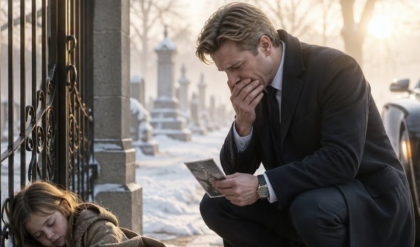
On the anniversary of my mother’s death, we visited her grave together.
Alejandro placed the old photograph beneath a bouquet of white flowers.
“I found her,” he whispered.
“I finally found our daughter.”
I took his hand.
“You found us both.”
At sunset, we returned home.
Not to Diego’s apartment in Santa Fe.
That property had been sold, and the money was transferred back into the trust.
I purchased a smaller house with a garden, sunlight in every room, and no memories attached to the walls.
My son slept upstairs.
My father sat at the kitchen table reading through foundation reporTS.
And I stood beside an open window, listening to the ordinary sounds of a life no one controlled.
For years, Diego had told me I would leave our marriage with only a small bag and the face of a victim.
He had been wrong about everything.
I left with my child.
I found my father.
I recovered my name.
And the empire Diego believed he had stolen from me became the very thing that exposed him.
But the greatest inheritance was not the money.
It was the moment I finally understood that silence and surrender were not the same thing.
I had stayed silent on those courthouse stairs because I was protecting my baby.
When I finally spoke, I protected myself too.
And that was the day Diego Santillán lost far more than his fortune.
He lost the woman he had spent years convincing she was powerless.
Because once she discovered the truth, she never bowed her head again.