Bring Her to Me!” He Ordered—The Mafia Boss Broke Down When He Saw Her Bruised and Terrified
THE CITY FEARED DOMINIC RUSSO—THEN HIS MEN FOUND A BRUISED WOMAN AT THE DOCKS WITH HIS SISTER’S TATTOO
Dominic Russo had made an entire city lower its voice when his name was spoken.
Then his most trusted man called at midnight and said they had found a half-conscious woman by the docks with a swallow tattoo on her wrist.
Twenty minutes later, the man no one had ever seen break dropped to his knees, because the woman he had failed to protect whispered his childhood name—and then told him his own people had sold her.
PART 1 — THE SWALLOW ON HER WRIST
Dominic Russo was not a man people interrupted after midnight.
Not unless something was burning, bleeding, or about to become both.
He sat alone behind the heavy walnut desk in his private office above the old harbor district, the city stretched beneath him in black glass and yellow light.
Rain slid down the windows in thin silver lines.
Beyond the rooftops, the river moved toward the docks, carrying fog, diesel smell, and secrets the city preferred not to name.
Dominic had built his empire from nothing.
Russo Maritime Holdings owned warehouses, trucking contracts, construction permits, night security, import routes, and enough favors to make politicians smile before they knew why.
People called him powerful.
Some called him dangerous.
Most called him only when they had already run out of safer men.
He never raised his voice.
He never begged.
He never lost control.
Then his phone rang.
Marco Leone’s name lit the screen.
Dominic answered.
“Talk.”
For one second, there was only wind on the other end.
Then Marco spoke, and his voice was wrong.
“Boss, we found someone near Pier Seventeen.”
Dominic turned away from the window.
“Alive?”
“Yes.”
“Then take her to Dr. Kapoor’s clinic.”
“We were going to.” Marco swallowed audibly.
“But there’s something else.”
Dominic’s fingers tightened around the phone.
“What?”
“She has a tattoo on her left wrist.
Small.
A swallow.”
The room went silent.
Not quiet.
Silent.
Rain struck the window.
The clock ticked.
Somewhere below, an elevator hummed inside the building.
Dominic heard all of it and none of it.
“Say it again.”
“A swallow, boss.”
Dominic stood so fast his chair hit the floor behind him.
There was only one person in the world he knew with that mark.
Elena had gotten it at twenty, in a little studio in Lisbon after her first art residency.
She had sent him a photograph with the caption: So I always remember how to come home.
He had replied with a money transfer and one sentence: Be careful.
That was three years ago.
The shame of that reply hit him now with physical force.
“Bring her here,” Dominic said.
“Boss, she needs medical—”
“Here.
Now.
Kapoor comes here.
No hospital.
No second location.
No one touches her except you, Marco.”
A pause.
“Yes, boss.”
Dominic lowered the phone.
For the first time in years, his hands shook.
He paced the office for twenty minutes while old memories rose like ghosTS. Elena at eleven, sleeping on the sofa after their parents’ funeral because she was afraid to be alone.
Elena at thirteen, following him around with a sketchbook.
Elena at eighteen, furious because he had sent her away “for safety” without asking whether safety felt like exile.
He had told himself distance was protection.
He had told himself money was care.
He had built walls so high around his life that even his sister’s voice had stopped reaching him.
Headlights cut through the rain below.
The elevator opened.
Marco entered first, pale beneath his dark coat.
Two men followed, carrying a young woman wrapped in a torn gray blanket.
Her hair hung wet across her face.
Bruises darkened one cheek and both arms.
Her bare feet were dirty, one ankle swollen, her whole body trembling so hard the blanket shook.
Dominic moved before thought returned.
“Elena.”
At the sound of her name, the woman lifted her head.
Her eyes were glassy with shock, but recognition moved through them like a flame catching paper.
“Dom?”
That childhood name broke him.
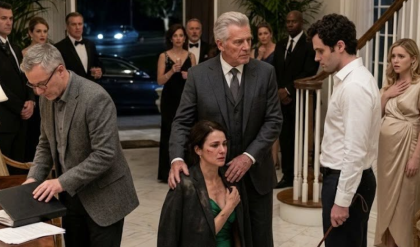
Dominic Russo dropped to his knees on the office floor.
No one in the room breathed.
He reached toward her as if any wrong movement might make her vanish again.
His fingers brushed the wet hair from her bruised face.
She was older, thinner, frightened beyond anything he had allowed himself to imagine, but she was Elena.
His little sister.
The girl he had promised to protect.
“I’m here,” he whispered, his voice breaking.
“I’m here now.”
Tears ran down his face.
He did not wipe them away.
Marco looked at the floor.
The other men turned their heads.
The city’s most feared man knelt in front of a broken woman and held her hand as if it were the only thing keeping him alive.
“Doctor,” Dominic said, voice raw.
“On the way,” Marco answered.
Elena’s fingers tightened weakly around his.
“Dom,” she whispered.
“I know.
Don’t speak.
You’re safe.”
Her eyes filled.
“No.” Her voice cracked.
“I’m not.”
Dominic went still.
Elena looked past him, terrified of the room, of the windows, of the men who carried guns beneath expensive coaTS.
Then she whispered the sentence that made every man in the office turn cold.
“They said you sold me.”
PART 2 — THE NAME THEY USED TO BREAK HER
The Doctor and the Silence
Dr. Hana Kapoor arrived thirteen minutes later with a black medical case, wet hair pinned badly beneath a scarf, and the expression of a woman who had treated too many injuries caused by men who preferred silence.
She took one look at Elena and did not ask unnecessary questions.
“Everyone out except Dominic and Marco.”
Nobody moved.
Dominic turned his head.
“Out.”
The room emptied in three seconds.
Dr. Kapoor worked with calm precision.
Blood pressure.
Pupils.
Temperature.
Respiratory check.
Bruising map.
Shoulder cut cleaned and dressed.
Ankle wrapped.
Shock assessed.
No life-threatening wounds, but enough injuries to tell a story Elena could not yet speak.
Dominic stood by the windows with his hands at his sides, forcing himself not to hover.
Every sound cut him.
The snap of gloves.
Elena’s sharp inhale when disinfectant touched her shoulder.
Kapoor’s low voice saying, “You’re safe here.
Tell me if anything hurTS.”
Dominic almost turned away.
Then hated himself for wanting the mercy of not seeing.
Elena had lived it.
He could witness it.
When Kapoor finished, she covered Elena with a warm blanket and gave her something mild to calm her shaking.
“She needs sleep, fluids, and monitoring,” the doctor said quietly.
“No hospital unless she worsens.
But Dominic—”
He looked at her.
“She needs more than doctors.”
“I know.”
“No,” Kapoor said.
“You need to know before you start thinking like the man downstairs thinks you are.”
Dominic’s jaw tightened.
Kapoor had known him twenty years.
She had patched up men who worked for him, women who ran from worse men, children caught between adult stupidity.
She was one of the few people in the city who could speak to Dominic Russo without softening the blade.
“Do not turn her into an excuse for a war,” she said.
Marco looked away.
Dominic’s voice came low.
“If someone hurt her—”
“Someone did,” Kapoor said.
“And right now she is lying on your couch terrified that the people who hurt her wore your name like a badge.
If you answer that with more fear, you prove them right.”
That landed.
Dominic looked at his sister.
Elena had fallen into an uneasy sleep, one hand still curled around the edge of the blanket.
On her left wrist, beneath dirt and bruising, the swallow tattoo remained.
Small.
Black.
Defiant.
“I won’t scare her,” he said.
Kapoor softened only slightly.
“Good.
Start there.”
The First Morning
Elena woke at dawn.
The office had changed around her.
The harsh overhead lights were off.
A floor lamp glowed warm near the couch.
The storm had passed, leaving the city washed gray beyond the windows.
Someone had placed fresh clothes folded on a chair, a glass of water on the side table, and a bowl of broth waiting beneath a silver cover.
Dominic sat across the room, not too close.
He had not slept.
He looked older in the morning light.
Elena stared at him for a long time before speaking.
“Is this really your office?”
He gave a weak attempt at a smile.
“Too dramatic?”
“You always liked big desks.”
That nearly broke him again.
He swallowed.
“I thought you hated big desks.”
“I hate what people do behind them.”
Silence opened.
Dominic accepted the blow.
“I deserve that.”
She looked away.
Her face tightened, not from anger exactly, but from the effort of staying awake inside a body that wanted to disappear.
“Where am I?”
“Harbor district.
My building.
Marco found you near Pier Seventeen.”
Fear flashed across her face.
“Marco works for you?”
“Yes.”
Her hand moved beneath the blanket toward her wrist.
Dominic saw the instinct.
Protect the tattoo.
Protect the only proof of herself that had survived the night.
“He will not hurt you.”
“They said that before.”
Dominic leaned forward, then stopped himself.
“Who said that?”
Elena’s eyes filled.
For several seconds, she could not answer.
Then she said, “Men at the gallery.”
Aurelia House
Elena spoke in pieces.
Not because she was hiding.
Because trauma does not move in chronological order.
She had returned to the city six months earlier, she said, though Dominic had not known.
She wanted to surprise him after finding work.
She had been proud.
Too proud, maybe.
After years of receiving money from an older brother who seemed more like a wire transfer than family, she wanted to show him she could stand on her own.
“I sent you a message,” she said.
Dominic looked up sharply.
“When?”
“Twice.
Through your office.
First when I arrived.
Then after I got the job.”
He had received neither.
He felt Marco stiffen beside him.
“What job?”
“Aurelia House Gallery.”
Dominic knew the name.
Old warehouse converted into an art space near the east docks.
Rich collectors liked it because it felt dangerous without requiring them to meet danger honestly.
He had attended one event there two years ago and left early because the champagne was warm and the owner smiled too much.
“Malcolm Reed,” Dominic said.
Elena nodded.
“He said he knew you.”
“Everyone says that.”
“He said you funded the restoration.”
“I didn’t.”
Her face changed.
There.
A first crack in what she had been told.
“He showed me papers.”
“What papers?”
“Donation papers.
Shipping permiTS. Artist granTS. He said Aurelia worked with Russo Maritime for protected transport.
He said if I was your sister, I already belonged to the family.”
Dominic’s stomach turned.
Family.
A word men used when they wanted obedience without contracTS.
Elena continued.
“At first it was normal.
I catalogued paintings.
Helped with exhibitions.
Managed artist files.
Then I noticed invoices that didn’t match the work.
Paintings listed twice.
Shipments with blank insurance values.
Artists who supposedly received grants but never came in.”
Marco spoke for the first time.
“Money laundering?”
Elena flinched at his voice.
Marco immediately stepped back.
“Sorry.”
She stared at him, then returned to Dominic.
“I didn’t know what it was.
Not fully.
I just knew the numbers were wrong.”
Dominic felt a cold familiarity.
Numbers that did not match.
Empty entities.
Paperwork made pretty enough to hide theft.
“Did you confront Reed?”
“I asked questions.”
That was so like her, the younger Elena, who once interrogated a priest for replacing church flowers with plastic ones.
Dominic closed his eyes briefly.
“What happened?”
“Nothing at first.
Then my supervisor told me to stop being naive.
Then Malcolm Reed invited me into his office and said curiosity was dangerous in buildings your brother protected.”
“My brother protected.”
Her voice broke.
“He said your name like a locked door.”
Rocco Bellini
Dominic did not shout when the name surfaced.
That frightened Marco more than shouting would have.
Rocco Bellini had been Dominic’s operations chief for eight years.
Smooth, disciplined, ambitious in the way men often are when they believe loyalty is a stepping stone.
He managed shipping schedules, warehouse inspections, contractor vetting, and the quiet favors that kept Russo Maritime profitable.
He also managed Dominic’s office communications when Dominic traveled.
The messages Elena sent had gone through Rocco.
Dominic asked Marco for the internal archive.
Marco brought it within ten minutes.
There they were.
Two messages flagged, then diverted into an administrative folder labeled Nonessential / Personal.
The first:
Dom, I’m back in the city.
Don’t be mad I didn’t tell you sooner.
I want to build something on my own first.
I’ll call when I’m ready.
I miss you.
— Elena
The second, four months later:
I’m working at Aurelia House.
They say they know you.
Something feels off.
Can you call me? Please don’t send money.
I need advice.
Rocco had marked both as reviewed.
Dominic stared at the screen.
Something ancient and violent moved inside him.
He shut it down.
Not gone.
Contained.
Kapoor’s warning returned.
Do not turn her into an excuse for a war.
“Where is Rocco?” he asked.
Marco’s face had gone pale.
“He’s overseeing the customs inspection at Warehouse Nine.”
“No.
He isn’t.”
Dominic’s voice was soft.
“He’s cleaning evidence.”
Elena’s Folder
Elena had not run empty-handed.
That became clear after Kapoor helped her change into clean clothes and Dominic arranged for breakfast in his private apartment upstairs.
She refused to eat until Dominic promised no one would enter without knocking.
He promised.
Then she asked for the coat she had been wearing when Marco found her.
It was torn, wet, and folded in an evidence bag because Marco had more instincts than he admitted.
Inside the lining, Elena had sewn a thin flash drive.
Dominic looked at it.
She tried to smile.
“You used to hide emergency money in coat seams.”
He remembered.
Their father had done that during lean years.
Dominic had taught Elena after their parents died.
“Good girl,” he whispered.
She looked down.
“I didn’t know who else to trust.”
The drive contained photographs, invoice scans, artist contracts, shipping manifests, and a video Elena had recorded through a cracked office door.
The video showed Malcolm Reed seated at a glass desk in Aurelia House.
Rocco Bellini stood beside him.
Another man, partially turned away, smoked near the window.
Reed said, “The swallow makes him useful.
If she disappears, Russo moves.
If she stays scared, Russo stays owned.”
Rocco answered, “Dominic doesn’t even know she’s here.”
The smoking man laughed.
“He will when we need him to.”
Elena’s recorded breath shook behind the camera.
Then Reed said the sentence that explained everything:
“Until Caldwell signs the Pier Nine transfer, the girl stays leverage.”
Dominic stopped the video.
“Caldwell.”
Marco frowned.
“Elias Caldwell?”
Dominic looked at him.
“You know the name?”
“Private lender.
Offshore shells.
He financed half the dirty renovations along the docks before disappearing behind trusTS.”
Dominic stared at the frozen frame of Rocco.
Pier Nine belonged to Russo Maritime.
Or it had.
A transfer meant someone was trying to move a major piece of Dominic’s harbor control using Elena as pressure.
Not just money.
Territory.
Reputation.
Family.
Elena whispered, “I’m sorry.”
Dominic turned to her.
“No.”
“I brought this to your door.”
“No.”
His voice was firm enough that she looked up.
“They brought it to mine the day they used my name to frighten you.”
The Rule Elena Made
Dominic called a meeting at noon.
Marco.
Kapoor.
Mira Sloane, Dominic’s attorney, who arrived wearing a camel coat, black boots, and the expression of a woman who had not been surprised by a man since 1998.
Gideon Vale, a retired federal investigator who now worked private corruption cases for people with enough money to prefer discretion but enough sense to use legal channels.
Elena sat at the far end of the table with a blanket around her shoulders and a mug of tea untouched between her hands.
Dominic laid out the facTS.
Aurelia House.
Rocco.
Malcolm Reed.
Caldwell.
Pier Nine.
The intercepted messages.
The flash drive.
When he finished, everyone waited for him to give the old kind of order.
Find them.
Bring them.
Make them talk.
Elena knew it too.
Her hand tightened around the mug.
Dominic saw the fear before she could hide it.
He looked around the table.
“No one disappears.”
Marco’s eyes flickered.
Dominic continued.
“No back rooms.
No midnight corrections.
No bodies in rumors.
We do this clean.”
Mira Sloane leaned back.
“Well, that is refreshing.”
Gideon Vale studied him.
“Clean means slower.”
“Then we move fast within the law.”
Marco said, “Boss—”
Dominic cut him off.
“Elena spent months being told my name meant fear.
I will not prove them right to save my pride.”
Elena’s eyes filled.
Dominic looked at her.
“You set the rule.”
She swallowed.
“My rule?”
“Yes.”
She looked around the table, startled by being asked instead of managed.
Then she said, “No one gets hurt because of me.”
Dominic nodded.
“Done.”
Mira opened her laptop.
“Then we start with warrants, preservation notices, bank freezes, and federal referral.
Mr. Russo, congratulations.
You are about to learn that paperwork can be more satisfying than violence.”
Dominic did not smile.
But Marco almost did.
Warehouse Nine
By dusk, Gideon had contacted two trusted federal agents who owed him nothing and trusted him enough to listen.
Mira sent preservation notices to Aurelia House, three shell carriers, two banks, and a property trust linked to Pier Nine.
Marco quietly pulled loyal security away from Warehouse Nine and replaced them with licensed off-duty officers hired through a legitimate emergency security contract.
Dominic did not go to the warehouse.
That was deliberate.
If he went, the story became Dominic Russo settling scores.
If he stayed back, the evidence had room to breathe.
Still, every instinct in him fought.
Elena fell asleep on the sofa in the private apartment just after sunset.
The city lights came alive beyond the windows.
Dominic sat in a chair nearby, watching her breathe, while Marco delivered updates in low tones from the hall.
At 8:40 p.m., Warehouse Nine’s night cameras captured Rocco’s men moving crates off the books.
At 9:05, federal agents arrived with local financial-crime officers.
At 9:22, the first sealed crate was opened.
No drugs.
No weapons.
Worse, in some ways.
Paintings.
Dozens of them.
Some stolen.
Some forged.
Some real works by young artists whose grant files Elena had photographed, their names used as pass-through accounts for fake sales, inflated valuations, and political donations laundered through charity auctions.
At 10:11, Marco entered the apartment.
Dominic looked up.
“Say it.”
Marco’s voice was quiet.
“They found Elena’s paintings.”
Elena stirred but did not wake.
Dominic stood.
“What paintings?”
Marco held out a tablet.
On the screen was a large canvas of a little girl standing near a river, a swallow above her shoulder, the sky painted in impossible gold.
Dominic knew it.
Elena had painted a version of it at sixteen.
She called it The Way Home.
Marco said, “It’s listed for auction tomorrow night at the Bellwether.
Artist name changed.
Estimated opening bid: two hundred thousand.”
Dominic’s gaze went to his sleeping sister.
The old violence moved inside him again.
This time, he gave it a name.
Not revenge.
Evidence.
“Let it go to auction,” he said.
Marco stared.
“Boss?”
Dominic’s face hardened.
“Let every buyer, every board member, every man who touched this see the painting on the wall.”
He looked at the image.
“Then we take the room.”
The Bellwether Auction
The Bellwether Hotel had chandeliers older than most family fortunes and carpets soft enough to make moral compromise feel elegant.
By seven the next evening, its grand auction hall glittered with collectors, developers, patrons, politicians, and people who used art as a mirror for wealth rather than beauty.
Waiters moved through the crowd with champagne.
A string quartet played near the staircase.
The air smelled of lilies, perfume, and expensive wool warmed by too many bodies.
Dominic arrived without a visible entourage.
That was intentional too.
A dark suit.
No tie.
Marco at his side.
Mira Sloane behind him with a leather portfolio.
Gideon Vale near the bar, speaking casually into a concealed microphone as federal agents waited outside the room with warrants that would become active the moment the stolen works were publicly represented for sale.
Elena had insisted on coming.
Dominic had argued.
She had simply looked at him and said, “If my work is on that wall, I want to see them lose it.”
He had stopped arguing.
She wore a black dress borrowed from Mira, a soft coat, and a silk scarf covering the worst bruise near her shoulder.
Her left wrist was uncovered.
The swallow showed.
Dominic stayed close but did not touch her unless she reached first.
That was another lesson he was learning.
Protection without possession.
Malcolm Reed stood near the front in a velvet dinner jacket, smiling as if he owned beauty itself.
Rocco Bellini stood beside him, face composed, one hand resting near his phone.
Then Rocco saw Dominic.
For a fraction of a second, his face changed.
Not enough for most people.
Enough for Dominic.
Fear.
Good, Dominic thought.
Then he corrected himself.
No.
Not good.
Useful.
The auctioneer stepped onto the stage.
“Ladies and gentlemen, our next featured work is an extraordinary contemporary piece from a private emerging artist collection.
Title: Golden Migration.”
Two attendants unveiled the painting.
Elena’s breath caught.
The room admired what it did not understand.
The little girl by the river.
The swallow.
The golden sky.
Her stolen childhood turned into inventory.
Dominic heard her whisper, “That’s mine.”
His voice was low.
“I know.”
The bidding opened at one hundred thousand.
A woman near the front raised her paddle.
Then a developer.
Then another collector.
At two hundred twenty thousand, Malcolm Reed smiled.
At two hundred fifty, Rocco’s phone buzzed repeatedly.
At three hundred, Dominic lifted his paddle.
The room turned.
Whispers moved.
Russo.
Dominic Russo.
Why is he bidding?
The auctioneer brightened.
“Three hundred thousand from Mr. Russo.”
Dominic did not look at the stage.
He looked at Reed.
“Three hundred twenty-five?” the auctioneer asked.
Silence.
Dominic lifted his paddle again.
“Five hundred thousand.”
The room gasped.
Elena turned sharply.
“Dom.”
He did not answer.
The auctioneer struck the gavel.
“Sold to Mr. Dominic Russo.”
Applause began.
Then Dominic stood.
“Before you congratulate me,” he said, voice carrying without a microphone, “you should know this painting was stolen.”
The applause died.
Malcolm Reed’s smile vanished.
Rocco stepped back.
The ballroom doors opened.
Agents entered.
And Dominic Russo, for the first time in his life, did not need anyone to fear him.
He had the truth walking in with badges.
The Room Turns
People do not gasp all at once in real life.
They inhale in waves.
First the front row, where they can see the agents clearly.
Then the middle, where expensive guests try to calculate whether staying seated looks innocent.
Then the back, where people begin whispering names into phones they should probably not be using.
The auctioneer froze with the gavel still in his hand.
Malcolm Reed stepped forward.
“This is absurd.”
Mira Sloane handed a packet to the nearest federal agent.
“Documented chain of title dispute, stolen-artist claim, fraudulent valuation support, and interstate laundering evidence.”
Reed pointed toward Elena.
“She is confused.
She is unwell.”
Dominic moved one step before catching himself.
Elena saw it.
She touched his sleeve.
Barely.
Enough.
He stopped.
Mira spoke instead.
“Mr. Reed, describing injured women as unstable appears to be a theme in your paperwork.
I advise trying a different one in court.”
A few guests looked toward Elena now.
Not with pity only.
Recognition.
She stepped forward.
Her voice shook, but it carried.
“My name is Elena Russo.
I painted that work.
It was taken from my studio at Aurelia House after I questioned grant invoices and shipping documenTS. I have original sketches, pigment receipts, time-stamped photographs, and a hidden signature beneath the lower varnish.”
The auctioneer looked ill.
A federal art-crimes specialist approached the painting with a portable inspection light.
Elena closed her eyes briefly.
Dominic stood beside her, forcing himself to let the process happen.
Under angled light, the hidden signature appeared near the bottom edge, blended into reeds by the riverbank.
E.
Russo.
The room exhaled.
Reed’s attorney, who seemed to materialize from nowhere, whispered urgently in his ear.
Rocco Bellini moved toward a side exit.
Marco was already there.
Not blocking with a gun.
Blocking with a uniformed officer and a warrant.
“Rocco,” Marco said softly.
“Leaving won’t improve the paperwork.”
Rocco’s Last Performance
Rocco tried loyalty first.
It was pathetic.
“Dominic,” he said, hands half raised as agents approached.
“You know me.”
Dominic looked at him.
“That is exactly the problem.”
“I was protecting the business.”
“You intercepted my sister’s messages.”
Rocco’s expression hardened.
“She was a risk.”
“She was my blood.”
“She was leverage whether I used her or someone else did.”
Elena flinched.
Dominic’s voice went quiet.
“You just explained yourself better than any prosecutor could.”
Rocco realized too late that Gideon stood nearby recording with the agents’ knowledge.
His mouth closed.
An agent stepped between them.
“Rocco Bellini, you are being detained pending questioning related to wire fraud, art theft, extortion, and conspiracy.”
Rocco looked around the room, searching for old power.
None came.
That was the first time Dominic understood something important.
Fear had made his organization fast.
It had not made it loyal.
Loyalty required something fear could never buy.
Choice.
Caldwell’s Paper Empire
Elias Caldwell did not attend the auction.
Men like Caldwell rarely stand near rooms when the first wall falls.
But his documents did.
TrusTS.
Bridge loans.
Property options.
Pier Nine transfer drafTS.
 The last person Adrian expected to see at his wedding was the woman he had destroyed five years ago.
Fake appraisals.
Art-backed loan agreements inflated through Aurelia House sales.
Elena’s stolen painting was not simply art theft.
It was collateral.
If the painting sold at a false value, Caldwell’s network could support loan valuations tied to properties along the docks.
Pier Nine would become distressed, then transferred, then “rescued” by one of Caldwell’s holding companies.
And Elena?
Elena was leverage against Dominic.
If Dominic interfered, they could threaten her again.
If he resisted, her presence in the gallery would be spun as participation.
If she disappeared, grief might make him reckless.
They had calculated him as carefully as they had calculated the paintings.
They had nearly been right.
Nearly.
The public auction created jurisdiction.
The stolen work created probable cause.
The records Elena saved connected Aurelia House to warehouse transfers.
Rocco connected Russo Maritime’s internal breach to Caldwell.
And Dominic’s decision not to respond with private violence allowed every piece to remain usable.
Mira told him this in the hotel’s service corridor while agents boxed evidence.
“You understand what you did tonight?”
Dominic looked toward Elena, who sat on a bench wrapped in Marco’s coat while Kapoor checked her pulse.
“I bought a painting.”
Mira’s mouth twitched.
“You resisted becoming the story.”
That was harder.
He knew it.
Elena Breaks Differently
After the auction, Elena did not collapse until they were back in Dominic’s apartment.
People imagine survivors falling apart during the rescue.
Sometimes they do not.
Sometimes they stay upright while danger is visible because the body understands the assignment.
Then a door closes.
A kettle boils.
Someone says, “You’re safe.”
And the body stops pretending.
Elena stood in the kitchen while Dr. Kapoor poured tea.
Then her knees buckled.
Dominic caught her before she hit the floor.
She made a sound he had never heard from her.
Not crying.
Not screaming.
Something younger.
Animal.
Broken loose from a place language had not reached.
He sat on the floor with her because moving her felt wrong.
Kapoor knelt nearby but did not crowd.
Marco stood in the doorway, eyes wet.
Elena gripped Dominic’s shirt.
“They put my painting on the wall,” she sobbed.
“They changed the name.
They changed my name.”
Dominic’s jaw trembled.
“I know.”
“They said nobody would believe me.”
“They were wrong.”
“They said you wouldn’t come.”
He closed his eyes.
That one deserved to hurt.
“I didn’t,” he whispered.
“Not soon enough.”
She cried harder.
He did not defend himself.
Not with money.
Not with intent.
Not with I thought you were safe.
Not with I sent you away because I loved you.
Some truths do not deserve excuses.
He held her while she broke and let the guilt stay where it belonged.
On him.
The Trial of Accounts
The legal process took eighteen monThS.
Not days.
Not weeks.
Eighteen months of subpoenas, forensic audits, art authentication, witness statements, property injunctions, insurance claims, bank reviews, and men in expensive suits discovering that paper cuts can bleed empires dry.
Malcolm Reed pled guilty first to fraud and stolen-property charges after two young artists testified that Aurelia House had used their grant identities without payment.
Rocco held longer.
Then Caldwell’s attorneys made the mistake of framing him as the “rogue operator.” Rocco responded the way men like him do when denied importance.
He gave prosecutors calendars, call logs, and recordings.
Caldwell was indicted on financial-crime charges tied to property manipulation, art-backed lending fraud, and extortionate collection practices disguised as civil enforcement.
Dominic testified voluntarily.
That became news.
Reporters waited outside the courthouse, cameras bright in the morning.
Dominic wore a dark suit and answered no shouted questions.
Elena entered through a side door with Mira and Kapoor.
On the stand, Dominic did not pretend innocence of his past.
That startled even Mira.
“Mr. Russo,” the prosecutor asked, “why did you not handle this privately, given your reputation?”
Dominic looked toward the gallery.
Elena sat in the second row.
“Because my reputation was part of the weapon used against my sister.”
The courtroom quieted.
He continued.
“For years, men feared my name.
I benefited from that.
Then someone used that fear to convince Elena no one would help her.
At that point, silence would have made me an accomplice to my own myth.”
The prosecutor paused.
“No further questions.”
Defense tried to make him sound like a dangerous man cleaning house only when family was touched.
Dominic did not deny the ugliness.
“You built an organization that operates in shadows, correct?” the attorney asked.
“I built one that knew how to navigate them.”
“And now you expect this court to believe you suddenly respect the law?”
“No,” Dominic said.
“I expect this court to believe documents, bank records, videos, and the stolen painting.
My feelings are irrelevant.”
Mira looked down at her notes to hide a smile.
The Swallow House
While courts moved, Elena healed.
Not cleanly.
Not romantically.
Healing is not a montage.
It is ugly, repetitive, and easily irritated by well-meaning people with inspirational phrases.
Some mornings she painted for six hours.
Some weeks she did not touch a brush.
Some nights she woke convinced she heard Reed’s voice in the hallway.
Dominic learned not to burst in unless she called.
He learned to knock.
He learned that buying expensive security systems did not equal making someone feel safe.
He learned that apology without changed behavior is only noise wearing a suit.
Elena found a therapist named Dr. Mara Chen, who had no fear of Dominic and once told him, “Your guilt is not a treatment plan.”
He wrote that down.
Elena laughed when she saw it on his desk.
“Did she really say that?”
“Yes.”
“She’s my favorite.”
“She is expensive.”
“Good.”
Dominic paid without complaint.
Eventually, Elena asked for something no one expected.
“I want Aurelia House.”
Dominic looked up.
“The building?”
“Yes.”
“It’s under seizure.”
“After it clears.”
“For what?”
“A studio.
A grant center.
Legal help for artisTS. A place where nobody gets told their work belongs to men with better paperwork.”
Dominic stared at her.
For the first time in months, her eyes held fire instead of only survival.
“How much do you need?”
She folded her arms.
“I’m not asking you to buy me a toy because you feel guilty.”
He sat back.
Good.
There she was.
“What are you asking?”
“For you to fund a foundation with independent trustees.
Not your men.
Not your friends.
Real people.
ArtisTS. Lawyers.
AccountanTS. Survivors.
I want governance so clean it bores your old associates to death.”
Dominic felt something in his chest loosen.
“Done.”
“I’m not finished.”
“Continue.”
“You step away from anything illegal, gray, or ‘historically complicated.’”
Marco, who had entered with coffee, nearly dropped the tray.
Dominic did not move.
Elena held his gaze.
“You said power protected us.
It didn’t.
If you want to help me build something safe, stop making danger part of the family business.”
The room went still.
This was the question under every apology.
Dominic looked at Marco.
Then the city beyond the windows.
Then his sister.
“All right.”
Elena blinked.
“That easy?”
“No,” Dominic said.
“But yes.”
Dismantling a Throne
Leaving power is harder than seizing it.
Dominic learned this slowly.
It was not enough to say he would step back.
Russo Maritime was a living machine, built from contracts, favors, loyalties, hidden understandings, men who knew men, old debts, gray arrangements, licenses, permits, warehouses, unions, politicians, and security teams who had long ago stopped asking where legal ended and habit began.
Mira oversaw the restructuring.
She enjoyed it too much.
“Congratulations,” she told Dominic, sliding a stack of compliance papers across his desk.
“You are about to become boring.”
“Is that necessary?”
“For legitimacy? Deeply.”
Marco took over a narrowed, fully audited logistics division.
Every contract reviewed.
Every side arrangement ended.
Every consultant disclosed.
Every shell relationship severed.
Men who preferred the old way left.
Some loudly.
Some with threaTS. None survived audit.
Dominic sold two warehouses tied to questionable deals and donated the proceeds to the new foundation after taxes and victim restitution.
Reporters called it a transformation.
Old associates called it weakness.
Dominic called it overdue.
One night, Marco found him alone in the half-empty office, staring at the city.
“Do you miss it?” Marco asked.
Dominic knew what he meant.
The fear.
The speed.
The way doors opened before he touched them.
“Sometimes.”
Marco nodded.
Dominic continued.
“Then I remember Elena thinking my name meant no one would save her.”
Marco looked down.
“I should have known Rocco was dirty.”
“So should I.”
“Boss—”
“Dominic,” he corrected.
Marco frowned.
“What?”
“If we are building honest things, start with my name.”
Marco tried it.
“Dominic.”
It sounded strange.
Good.
Elena Testifies
Elena testified on the final day of Reed’s sentencing.
She wore a soft blue dress and no scarf.
The scar near her shoulder had faded to a thin line.
The bruise on her cheek was long gone.
The swallow tattoo stood clear on her wrist.
Dominic sat behind her.
Not at her side.
This was her statement.
She unfolded one page.
Then folded it again.
“I wrote something,” she said to the judge.
“But I don’t want to read it.”
The judge nodded.
“Take your time.”
Elena looked at Malcolm Reed.
He stared at the table.
“You told me my brother sold me,” she said.
“You told me artists like me should be grateful when powerful men used our names because it meant we mattered.
You told me nobody would believe me unless Dominic said it first.”
Her voice shook.
She continued anyway.
“You were wrong.
My work was mine before you priced it.
My name was mine before you forged it.
My fear was real, but it was never proof that you were powerful.
It was proof that you were cruel.”
Reed did not look up.
Good.
He did not deserve her eyes.
She turned toward the judge.
“I don’t ask for revenge.
I ask for every artist file to be reviewed.
Every stolen work returned.
Every grant account audited.
Every person he used to be named.”
The judge’s expression softened.
“That will be considered.”
Elena nodded.
When she sat down, Dominic did not reach for her.
He waited.
A second later, she reached back and squeezed his hand.
That meant more than forgiveness spoken too early.
What Happened to the Painting
The Way Home remained evidence for a year.
Then it was returned to Elena with proper paperwork, restored title, and a letter from the federal art-crimes unit that she framed mostly because Marco said bureaucracy deserved interior design when it did something good.
She did not sell the painting.
She hung it in the entrance of Swallow House.
The building that had once held Aurelia House became almost unrecognizable after renovation.
White walls.
Open studios.
A legal clinic on Thursdays.
A financial-literacy room where artists learned contracts, taxes, intellectual property, and how to read the fine print predators hope beauty will ignore.
At the front desk, a sign read:
Your work is not exposure.
Your name is not collateral.
Your fear is not consent.
Elena wrote those lines herself.
Dominic funded the foundation but held no board seat.
That was Elena’s rule.
He obeyed.
The opening night was crowded with artists, students, donors, lawyers, local reporters, and people who came mostly to see whether Dominic Russo would look uncomfortable in a room where he was not the center.
He did.
Elena loved that.
During her speech, she stood beneath her painting and said, “Some houses are built to make people disappear.
We rebuilt this one so people can be found.”
Dominic looked down.
Kapoor handed him a handkerchief without comment.
He used it.
No one laughed.
The Letter He Never Received
Six months after Swallow House opened, Elena gave Dominic a box.
They were sitting in the garden behind the studio, late afternoon light falling through young trees.
The air smelled of wet soil, turpentine, coffee, and paint drying somewhere inside.
“What is this?” he asked.
“Letters.”
He opened the lid.
Dozens.
Some sealed.
Some opened and returned.
Some addressed to his old office.
Some to apartments he no longer owned.
Some to PO boxes managed by people who had apparently decided what counted as important enough for Dominic Russo.
His throat tightened.
“You wrote these?”
“For years.”
He lifted one carefully.
The envelope was dated nine years earlier.
Dom, I got into the art program.
I pretended I wasn’t scared when they called.
I was lying.
I wish you were here.
Another:
I know you send money.
Thank you.
But I miss your voice.
Money doesn’t laugh at my bad jokes.
Another:
I got the swallow tattoo.
Don’t be angry.
It means I can leave and come back.
That’s what swallows do.
Dominic closed his eyes.
He had paid tuition.
Paid rent.
Paid travel.
Paid emergencies.
He had not read the sentences where she asked for him instead of his money.
“I thought you stopped writing,” he said.
“I thought you stopped answering.”
The garden was very quiet.
“I’m sorry,” he whispered.
She nodded.
“I know.”
“No.
Elena—”
“I know,” she said again, more firmly.
“But sorry doesn’t give us those years back.”
He accepted that.
It was the truest thing she could have said.
“What do we do with them?” he asked, touching the letters.
She leaned back.
“We read them.
Slowly.
Not all at once.
I don’t want to drown in what we missed.”
Dominic nodded.
“Slowly, then.”
The House Outside the City
Dominic sold the office tower.
People acted as though he had abdicated a throne.
Maybe he had.
He bought a house forty minutes outside the city, where the river widened, mornings smelled of grass instead of diesel, and fog sat over the fields like unspoken forgiveness.
Elena did not live with him.
That had been his first mistake after her rescue: imagining closeness could be repaired by proximity.
She corrected him gently but firmly.
“I need my own locks,” she said.
He understood.
He bought the house for himself and kept a guest room she could use when she chose.
Elena rented a small apartment above Swallow House, with high windows and terrible plumbing she refused to let him replace until the lease allowed.
“Control issues,” she told him.
“Yours or mine?”
“Yes.”
They had dinner every Sunday.
Sometimes at his house.
Sometimes in her studio.
Sometimes at a diner where no one recognized them and Dominic learned that pancakes could be dinner if Elena declared it so.
They fought too.
About security.
About money.
About his instinct to solve problems before asking whether she wanted them solved.
One evening, after he quietly paid off the rent for three struggling artists at Swallow House, Elena appeared at his door furious.
“You can’t keep fixing people by making them financially disappear.”
“I helped.”
“You erased their agency.”
He opened his mouth.
Closed it.
Then said, “I see.”
She stared.
“That’s it?”
“I am learning that defending myself wastes time.”
Her anger faltered.
“Annoying growth.”
“I apologize.”
“You should.”
He made tea.
They drank it in silence until she said, “One of them cried because she could keep her studio.”
“I know.”
“I’m still mad.”
“I know.”
“Thank you.”
“I know.”
She threw a napkin at him.
He laughed.
A real laugh.
It startled both of them.
Marco’s Choice
Marco stayed.
Not as a soldier.
As chief operations officer of the cleaned company.
He struggled more than he admitted.
Men like Marco understand loyalty through obedience first, then conscience later.
Dominic’s transformation forced him to choose which version of loyalty he believed in.
One night, he came to Swallow House for an event on artist contract safety and stood awkwardly near the door.
Elena found him there.
“You look like you’re guarding a bank.”
“I don’t know where to stand.”
“Try where people are.”
He gave her a faint smile.
“I’m sorry I carried you into that office.”
She tilted her head.
“That is not the part you need to apologize for.”
He looked at her.
She continued, “You found me.
You did what you could.
But before that, you worked in a system where women like me were not part of the calculation unless we belonged to someone powerful.”
Marco swallowed.
“Yes.”
“Are we part of it now?”
“Yes.”
“Good.
Then stand near the coffee.
Artists trust men holding pastries less than men standing by exiTS.”
He followed instructions.
By the end of the night, he had spoken to three painters, two attorneys, and a sculptor who convinced him to commission a memorial piece for the old dockworkers injured in unsafe warehouses.
Dominic heard about it and said, “You bought art?”
Marco looked defensive.
“It has structural integrity.”
Elena laughed for a full minute.
Caldwell Sentenced
Elias Caldwell received seven years.
Not enough for what he had done to the city.
Enough to remove him from it.
The judge also ordered restitution, asset forfeiture, and independent review of every art-backed and property-transfer loan tied to his firms.
At sentencing, a restaurant owner spoke.
A widow spoke.
Two artists spoke.
Elena did not.
She had already testified where she needed to.
Dominic attended quietly in the back row.
Afterward, outside the courthouse, a reporter called, “Mr. Russo, do you feel responsible for allowing people like Caldwell to operate in your district?”
Mira started to move him along.
Dominic stopped.
“Yes,” he said.
The cameras shifted.
He continued.
“I did not create every crime he committed.
But I helped create a culture where people believed fear was currency.
Men like Caldwell spend that currency well.”
The reporter blinked.
“What are you doing to change that?”
Dominic looked toward Elena, waiting near the car.
“Less talking,” he said.
“More records.”
Elena smiled despite herself.
That evening, Swallow House received three anonymous donations from people who used to avoid Dominic.
No donation stayed anonymous for long under Elena’s accounting rules.
She made them all sign disclosure forms.
Dominic framed the first one just to annoy her.
She took it down.
The Anniversary of the Dock
One year after Marco found her near Pier Seventeen, Elena asked Dominic to drive her there.
He wanted to say no.
He said, “What time?”
Progress.
They went at dawn.
The docks smelled of salt, oil, wet rope, and cold metal.
Gulls screamed overhead.
The warehouses stood in rows, some still working, some shuttered, some waiting for redevelopment plans that would now pass through more honest hands.
Elena wore jeans, boots, and a thick sweater.
Her wrist was uncovered.
They walked to the place Marco had found her.
For a while, neither spoke.
Water slapped against the pilings.
A truck rumbled in the distance.
Finally, Elena said, “I thought I was going to die here.”
Dominic’s eyes closed briefly.
“I know.”
“No,” she said.
“You don’t.
But that’s okay.”
He accepted the correction.
She crouched and placed something near the edge of the pier.
A small painted wooden swallow.
Bright blue.
Gold wing.
“What is that?” he asked.
“A marker.”
“For what?”
“That I left.”
She stood.
“Not that I was found.
Not that I was saved.
That I left.”
Dominic felt the distinction settle into him.
“Yes,” he said.
“You did.”
She looked at him.
“You helped after.”
“I did.”
“Both matter.”
He nodded.
The fog lifted slowly over the water.
Years Later
Years later, people told the story differently depending on what they needed from it.
Some called it the night Dominic Russo’s empire went legitimate.
Some called it the Aurelia House scandal.
Some called it the stolen painting case.
Some called it a brother’s redemption.
Elena disliked that one.
“Redemption makes it sound too tidy,” she said during an interview for an arts journal.
“My brother did not rescue me and become good.
He listened, changed systems, gave up power, and kept showing up after the dramatic part ended.
That is harder than rescue and less photogenic.”
The quote went everywhere.
Dominic pretended to hate it.
He kept a copy in his study.
Swallow House expanded into three cities.
Its legal clinic helped recover unpaid royalties, stolen works, forged consignment agreements, and predatory loans.
Its grant program funded young artists who lacked family money and knew too much about being dismissed.
Elena became known for large canvases full of birds, rivers, broken doors, and impossible light.
Critics called her work “haunted but defiant.”
She said critics used too many adjectives.
Dominic attended every opening from the back of the room.
Never front.
Never center.
He learned.
The Final Canvas
On Dominic’s sixtieth birthday, Elena unveiled a painting in the garden behind Swallow House.
No press.
No donors.
Just family in the chosen sense: Marco, Dr. Kapoor, Mira, Gideon, a few artists, and Dominic standing awkwardly because surprise parties made him look like he expected betrayal from cake.
The canvas was covered with linen.
Elena stood beside it, nervous in a way he had not seen in years.
“I painted this from memory,” she said.
“Should I worry?”
“Always.”
She pulled the linen away.
The painting showed a small apartment from their childhood.
Not the docks.
Not Aurelia.
Not the office.
The apartment where they lived after their parents died.
A boy of nineteen sat on the floor beside a sofa, back against the wall, one arm stretched upward to hold the hand of a little girl sleeping beneath a blanket.
The window was open.
Outside, dawn turned the city pale.
On the sill sat a swallow, tiny and watchful.
Dominic could not speak.
He remembered that night.
Elena had been eleven.
She had nightmares for weeks after the funeral.
He had sat on the floor until sunrise because she refused to sleep unless she could hold his hand.
He had forgotten the bird.
Or thought he had.
Elena stood beside him.
“I know you failed me later,” she said.
He flinched.
She continued.
“But before all that, you stayed awake.”
The garden blurred.
Dominic covered his face with one hand.
Elena took the other.
This time, he let himself cry without shame, without apology, without turning away.
No one in the garden pretended not to see.
Some tears deserve witnesses.
The Last Lesson
Dominic Russo had once believed protection meant distance.
Money wired on time.
Danger kept away.
Names spoken in rooms Elena would never enter.
He thought if he built enough power, nobody could reach what he loved.
He had been wrong.
Power without presence leaves empty chairs at the table.
Fear without tenderness becomes a road other men can pave toward the people you abandoned for their own good.
He did not learn that lesson all at once.
No one does.
He learned it in hospital reports and court transcripTS. In Elena’s nightmares.
In unread letters.
In board meetings where he wanted to fix everything with a check and Elena made him listen instead.
He learned it in knocking.
In waiting.
In asking.
In hearing no and not treating it like betrayal.
He learned it every Sunday dinner when Elena brought too much bread, criticized his coffee, and left when she wanted because love is not a locked door.
The Last Scene
One late spring morning, Dominic sat on the porch of the house outside the city with two cups of coffee cooling between him and Elena.
The river moved beyond the field, bright under the sun.
Birds stitched the sky with black wings.
Somewhere in the kitchen, Marco argued with the toaster while Kapoor laughed at him.
Swallow House was hosting a student exhibition that afternoon, and Elena had paint on her wrist because she never managed to remain clean on important days.
Dominic looked at the swallow tattoo.
Still there.
No longer a clue on a wounded stranger.
A mark on a woman who had found her way home and then built doors for others.
Elena caught him looking.
“What?”
“Nothing.”
“You’re doing the sad old man face.”
“I do not have a sad old man face.”
“You absolutely do.”
He smiled.
For years, smiles had been tools in his world.
Warnings.
Negotiations.
Masks.
This one was only a smile.
“I was thinking about the night Marco called,” he said.
Elena grew quiet.
“Me too, sometimes.”
“I thought finding you was the moment everything changed.”
“Wasn’t it?”
“No.” He looked toward the river.
“That was the moment I saw what had already changed without me noticing.”
Elena considered that.
Then nodded.
“I like that better.”
The wind moved through the porch screens.
Coffee cooled.
The world did not demand anything for a few seconds.
Dominic had once measured his worth by how many doors opened when he approached.
Now he measured it differently.
By which doors Elena opened herself.
By whether young artists signed contracts they understood.
By whether Marco asked before acting.
By whether his name made people safer than afraid.
By whether Sunday dinner happened.
Elena leaned back in her chair.
“You still owe me fifteen years of terrible birthday gifTS.”
“I intend to pay.”
“With interest.”
“Naturally.”
They sat together, brother and sister, not healed perfectly, not restored magically, but present.
And presence, Dominic had learned, was the one form of protection money could never replace.
On the porch railing, a small swallow landed, bright-eyed and restless.
Elena smiled.
“Look.”
Dominic did.
The bird stayed for one breath, two, then lifted into the morning air and flew toward the river.
For once, nobody chased it.
Nobody owned it.
Nobody named it collateral.
It simply flew.
And Dominic Russo, who had once ruled a city through fear, sat beside his sister in the clean light of an ordinary morning and understood that this was power too.
Not control.
Not reputation.
Not men waiting for orders.
A door unlocked.
A hand offered.
A promise kept late, but kept every day after.
That was enough.
At last, it was enough.