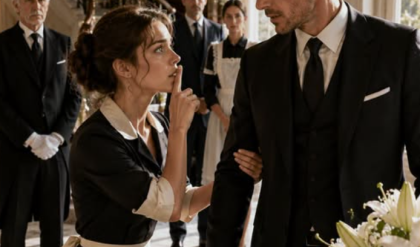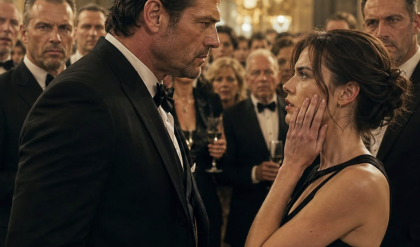
No nanny ever made it through dinner with the mafia boss’s quadruplets—until a broke stranger stepped in…
The last nanny rushed past Serena Valente on the front steps with no coat, no purse, and not a single shred of dignity left in her.
Rain had soaked straight through the woman’s blouse.
Mascara ran in dark lines down both cheeks.
One of her heels was gone.
“Don’t go in there,” she choked out, barely slowing her pace.
“Those children are not children.
They’re—”
Whatever word she had been about to say vanished beneath a crash of thunder.
Then she was gone, racing down the long driveway of the Rinaldi estate as if the devil himself had opened the front door behind her.
Serena remained beneath the stone archway, her cheap black blazer damp across the shoulders, her last pair of presentable shoes squeaking against marble that probably cost more than her rent for an entire year.
Through the tall window beside the entrance, she could see the war zone.
Orange juice spreading over white Italian marble.
Breakfast cereal falling from somewhere overhead.
Four six-year-old boys in identical red pajamas moving with the frightening coordination of a trained military squad.
And in the corner of the kitchen, leaning against the counter with a glass of red wine in one hand, stood Victor Rinaldi.
Mafia boss.
Widower.
Billionaire.
Father of the most dreaded quadruplets in New York.
At that moment, he looked less like a criminal kingpin and more like a man silently raising a toast to his own surrender.
Serena’s phone vibrated in her pocket.
A message from her lawyer.
Custody hearing moved up.
Two weeks.
Be ready.
Two weeks.
That was all the time she had to prove she could give her seven-year-old daughter, Lucia, a stable home.
Two weeks to convince a judge she had reliable income, a safe place to live, and enough money in her account to stop Lucia’s father from taking the child out of pure spite.
Serena looked once more at the mansion.
Then she pressed the doorbell.
A housekeeper in a gray uniform opened the door and studied Serena from head to toe with the weary pity of someone watching a lamb walk willingly into a lion’s cage.
“You’re the new one?”
“Serena Valente.”
“The test begins at dinner,” the woman said.
“If you last that long.”
Something broke somewhere deep inside the house.
A child burst out laughing.
Another yelled, “Direct hit!”
The housekeeper moved aside.
“Most of them don’t even make it to lunch.”
Serena stepped inside.
She was not there because she thought she could repair a mafia boss’s children.
She was not there because she was looking for adventure.
She was there because she had thirty-six dollars in her checking account, an overdue electric bill, and a daughter who still slept with one hand clutched around Serena’s sleeve because she was terrified people disappeared when she let go.
The housekeeper guided her through corridors lined with oil portraits and silent ancestors.
The estate smelled of old money, polished wood, rain, and fresh destruction.
When they reached the kitchen, Serena saw the Rinaldi boys clearly for the first time.
One stood on the island, pouring orange juice from far above his head as though he were testing gravity and deeply annoyed by its limiTS.
Another crouched beneath the table, constructing a fort out of cereal boxes while emptying the contents across the floor.
A third had learned that butter made the lower cabinets slick enough to work as a slide.
The fourth sat cross-legged in the corner, quiet and observant, curls falling over his dark eyes.
And there was Victor Rinaldi.
Black suit.
Open collar.
Dark hair.
Neatly trimmed beard.
Eyes like sealed doors.
He looked exactly like the photos the tabloids adored, except those pictures never captured exhaustion.
They never showed a man who could make hardened criminals shake, yet could not make his own sons sit down for dinner.
“You’re the new one,” he said.
It was not a question.
“Serena Valente.”
“I don’t care.” He took a slow drink of wine.
“I don’t care about your résumé.
I don’t care about references.
I don’t care what child psychology theory you picked up from some overpriced program that told you all children need is patience and understanding.”
The boy on the island poured the rest of the orange juice onto the floor.
Victor did not even flinch.
“The rules are simple.
If you can get them sitting at this table eating an actual dinner before eight o’clock, you’re hired.
Full salary.
BenefiTS. Room and board, if you want it.”
Serena looked at the clock.
6:47 p.m.
Seventy-three minutes.
“If you can’t,” Victor went on, motioning with his wine glass toward the chaos, “don’t let the door hit you on your way out.”
The boy beneath the table crawled out with cereal tangled in his hair and a grin full of challenge.
“The last one cried,” he declared proudly.
“She cried so hard she couldn’t breathe right.”
“Marco,” Victor warned.
The boy shrugged as if his father’s dangerous tone was nothing more than background noise.
Serena placed her worn purse on the only clean corner of the counter.
Then she rolled up her sleeves.
“Where do you keep the knives?”
Victor lifted an eyebrow.
“Why?”
“Because if I have seventy-three minutes to get four boys fed with real dinner, I’m going to need to cook.”
For the first time since she had entered, the kitchen went almost silent.
Almost.
Serena opened the refrigerator and surveyed its contents like she was preparing a rescue operation.
Eggs.
Cream.
Parmesan.
Butter.
Pancetta.
Garlic.
Pasta in the pantry.
Bread.
Fruit.
Perfect.
Marco stepped into her way.
He was the tallest, with his father’s sharp stare and the stance of a tiny commander.
“You’re not allowed to use the stove.”
“According to who?”
“According to me.”
His brothers gathered behind him.
Nico, the wild one, snatched an apple from the fruit bowl and weighed it in his hand like a weapon.
Alessandro had part of a cereal box taped across his chest, serious and thoughtful.
The quiet one, Tommy, kept watching from the corner.
Serena moved around Marco and started washing fruit.
“You should leave,” Marco said.
“You look nice.
Nice ones cry the hardest.”
The apple shot past Serena’s face so close she felt the air shift.
It burst against the backsplash.
Victor’s voice lowered.
“Nico.”
Serena did not react.
She cut an orange into perfect round slices.
The boys looked at one another.
That was not how the game was supposed to go.
Adults yelled.
Adults threatened.
Adults begged.
Adults tried to seize control and ended up losing it.
Serena laid the orange slices neatly on a plate.
“You’re supposed to be angry,” Alessandro said.
Serena filled a pot with water and placed it on the stove.
“Why?”
“Because he threw an apple at you.”
“I saw that.”
Nico threw a banana next.
It struck Serena’s shoulder and left a pale streak across her cheap blazer.
She wiped it away and continued slicing strawberries.
“Why aren’t you shouting?” Alessandro whispered.
“Because shouting means I care about the game,” Serena said softly.
“Right now, I care about dinner.
You can throw things.
You can climb on furniture.
You can turn
this kitchen into a crime scene.
It still won’t change what I’m doing.”
The water started to boil.
Marco climbed onto the counter and blocked the pantry.
“You can’t get the pasta.”
Serena looked up at him.
For one brief second, she did not see a monster.
She saw a small boy with his father’s jaw and his dead mother’s shadow in his eyes.
A child who had learned that if he broke people first, they could not abandon
him afterward.
“You’re right,” she said.
Then she returned to slicing apples.
Marco frowned.
The confusion moved through them.
At last, he shifted one inch.
Serena slid past him, opened the pantry, and took down the spaghetti.
Behind her, Victor watched without moving.
By 7:23 p.m., the kitchen was still a wreck, but the battle had shifted.
The boys had stopped attacking.
Now they were observing.
Tommy, the silent one, stood up from his corner and moved closer, one careful step at a time.
Serena did not look straight at him.
“The pattern is interesting,” she said as she whisked eggs and cream together.
“Three loud ones make the distraction.
One quiet one studies what works.”
Tommy stopped.
“They think I’m shy,” he whispered.
“I don’t think you’re shy.”
His eyes lifted.
“Shy means afraid.
You’re not afraid.
You’re careful.”
He took one more step toward her.
“What are you making?”
Có thể là hình ảnh về trẻ em
The heavy, copper-bottomed pot hummed against the professional grade induction cooktop, the water rising into a rolling, white-capped boil that sent plumes of clean, starchy steam into the chaotic air of the Rinaldi kitchen.
The scent of rendering pancetta—fat rendering down into a golden, smoky pool, kissed by a single crushed clove of garlic—began to wrap around the room, cut through the sharp, sticky odor of spilled citrus and artificial fruit dye.
Tommy stayed exactly where he was, his small, bare feet anchored to the cold marble floor just outside the radius of the cooking grease.
He was watching her hands.
Serena’s hands moved with a swift, fluid rhythm that didn’t belong to the high-society nannies Victor Rinaldi usually imported from British agencies.
Her fingers were quick, deft, and precise—the hands of a woman who had spent years preparing meals under pressure, who knew exactly how to stretch a single box of pasta and a few leftover eggs into comfort when the world outside was falling apart.
“It’s called Carbonara,” Serena said, her voice dropping into a low, even register that forced the boys to lean in slightly just to hear her over the bubbling water.
She didn’t look at Tommy; she kept her eyes on the pan, using a wooden spoon to turn the pancetta so it crisped evenly without burning.
“It’s what people in Rome eat when they’ve had a long, hard day and need something that feels like a warm blanket.
My grandmother taught me how to make it when I was exactly your age.”
May you like
My father slapped me so hard at my military academy graduation that my cap flew across the stone courtyard and landed beside my diploma…018
After three years in prison, I returned home expecting nothing more than to embrace my father, but my stepmother opened the door and said, “He d:ied a year ago.
This house is mine now.” …018
On Christmas Eve, I found my grandson barefoot and freezing in the snow outside his house.
Inside, his father and cruel stepmother were laughing, eating dinner….018
“Our mother was from Rome,” a quiet voice said from behind the island.
Serena didn’t turn around immediately.
She let the information settle.
It was Alessandro.
He had taken the cereal box armor off his chest, though he still gripped the cardboard tightly in his right hand like a shield he wasn’t quite ready to drop.
“Then she knew that the secret isn’t in the cream,” Serena murmured, sliding the hot pan off the direct flame to let the temperature drop before the crucial moment.
“A lot of people cheat.
They use heavy cream because they’re afraid the eggs will scramble.
But real Roman Carbonara is made with patience.
Just eggs, pecorino cheese, black pepper, and the starchy water from the pasta.
If you rush it, you get an omelet.
If you stay calm, you get velvet.”
From the corner of her eye, she saw Victor Rinaldi shift his weight against the distant counter.
The glass of red wine remained halfway to his lips, his dark, impenetrable eyes fixed on her profile.
He hadn’t spoken a word since he set the terms of her trial, but the air around him had changed.
The cynical, mocking tilt of his shoulders had straightened.
He was no longer watching a comedy; he was watching a strategist map out a battlefield.
“We don’t like pepper,” Marco stated, though his voice lacked the sharp, cutting authority he had used to drive the previous nanny out into the torrential rain.
He had climbed down from the island and was now standing by the edge of the stove, his small nose twitching as the savory, rich aroma of the cured pork filled his lungs.
“It’s too spicy.”
“Real black pepper isn’t spicy like a chili,” Serena countered smoothly, lifting the long strands of spaghetti with a pair of stainless-steel tongs and dropping them directly into the pan with the pancetta, letting the residual fat coat the pasta with a loud, satisfying hiss.
“It’s warm.
It wakes up the cheese.
But if you’re too weak to handle it, Marco, I can leave yours plain.
Just noodles and butter.
Like a baby.”
Marco’s cheeks flushed a deep, instant crimson.
“I am not a baby! I’m the oldest! By four minutes!”
“Then prove it,” Serena said, finally looking him directly in the eye.
She held out a small wedge of aged Pecorino Romano and a microplane grater.
“Help me grate the cheese.
If you’re old enough to command an army in this kitchen, you’re old enough to handle a grater without taking your skin off.”
The kitchen fell completely silent.
Nico dropped the third apple back into the ceramic bowl with a soft *thud*.
Alessandro slowly set his cardboard armor on a chair.
Tommy took three more steps forward until he was standing right beside Serena’s hip, his dark, curly head tilting back to look at her face.
Marco stared at the block of cheese like it was an unexploded device.
He looked back at his father, looking for guidance, or perhaps an order, but Victor remained motionless, a dark silhouette against the gray window where the rain continued to lash the glass.
“Take it,” Serena said softly, her voice devoid of taunting now, offering only a direct, respectable partnership.
“We have precisely twelve minutes before the clock hits eight.
The pasta is perfectly al dente.
If the cheese isn’t ready, the sauce will ruin.”
With a sudden, sharp movement, Marco snatched the grater and the cheese from her hand.
“Show me how.”
“Keep your fingers flat,” Serena instructed, leaning over him just enough to guide his small hands without taking over the movement.
“Let the weight of your arm do the work.
Don’t press too hard.
Let it snowfall onto the cutting board.”
*Skritch.
Skritch.
Skritch.*
The sound of the cheese meeting the sharp metal teeth filled the space.
Nico and Alessandro crept closer, drawn by the rhythm, their previous hostility melting into the intense, primitive curiosity that always governs six-year-old minds when an adult treats them like capable human beings instead of inconveniences.
“Can I do the eggs?” Nico asked, his wild, erratic energy suddenly finding a focus.
“Can you crack them without getting the shell in the bowl?” Serena asked, not looking up as she measured out a splash of the cloudy, salted pasta water into a separate cup.
“I can do it with one hand!” Nico boasted, stepping up to the counter.
“Two hands,” Serena corrected instantly, her tone firm but entirely free of anger.
“We aren’t on television, Nico.
We’re hungry.
Crack them carefully into the blue bowl.”
For the next ten minutes, the Rinaldi kitchen looked less like a war zone and more like an assembly line in a high-end trattoria.
Nico cracked four eggs with surprising care, only dropping a single tiny speck of shell which Serena showed him how to fish out using a larger piece of shell—a trick that made his eyes go wide with absolute fascination.
Alessandro was tasked with setting the heavy linen placemats onto the large, circular oak table in the center of the room, his meticulous nature turning the chore into a geometric exercise.
Tommy remained by Serena’s side, holding the pepper mill, waiting for his cue like a tiny, solemn apprentice.
When the clock on the wall ticked to 7:54 p.m., Serena took the pan completely off the heat.
She poured the egg and cheese mixture over the hot spaghetti, immediately tossing the pasta with a rapid, circular flick of her wrist.
The heat of the noodles cooked the eggs instantly without scrambling them, creating a rich, glossy, golden sauce that coated every single strand of pasta perfectly.
She nodded to Tommy.
“Three turns of the mill, Tommy.
Right over the center.”
The boy twisted the wooden mill with intense concentration.
*Crack.
Crack.
Crack.*
“Perfect,” Serena whispered.
Có thể là hình ảnh về trẻ em
She began plating the food, dividing the carbonara into four identical, steaming white bowls.
She didn’t wait for them to ask.
She didn’t beg them to sit.
She simply carried two plates to the table, where Alessandro had already placed the forks.
“Dinner is served,” Serena said, her voice carrying across the room to where Victor Rinaldi still stood in the shadows.
The four boys didn’t run.
They didn’t shout.
They moved toward the table with an almost eerie, synchronized solemnity, climbing into their chairs one by one.
Marco took his fork, twisted a massive nest of pasta around the prongs, and shoved it into his mouth.
His eyes widened.
He chewed slowly, his gaze locked on Serena, who was currently wiping down the counter with a damp cloth as though she hadn’t just defused a bomb with six minutes to spare.
“It’s good,” Marco muttered, his voice muffled by the food.
“It tastes… like warm.”
The other three boys immediately dove into their food, the kitchen filling with the sound of silver scraping against porcelain and the quiet, satisfied sighs of four children who had finally been given boundaries they couldn’t break through.
Serena picked up her damp black blazer from the back of a chair, shook it out, and turned to face Victor Rinaldi.
The clock on the wall struck 8:00 p.m.
Victor set his wine glass down on the counter with a soft, deliberate click.
He walked out of the shadows, his tailored leather shoes silent against the marble.
He stopped exactly three feet away from her, his towering frame casting a long shadow over her smaller figure.
Up close, she could smell him—expensive tobacco, cedarwood, and the cold, metallic scent of the rain.
He looked down at the four boys, who were currently scraping the last bits of golden sauce from their bowls, then back at Serena.
His expression was completely unreadable, a stone wall that had kept federal prosecutors and rival families at bay for a decade.
“You’re thirty seconds late with the cleanup,” he said, his voice a low, gravelly baritone that vibrated through the floorboards.
Serena didn’t blink.
She met his terrifyingly dark eyes with the steady, unyielding gaze of a mother who had stared down poverty, eviction notices, and the threat of losing her child.
“The rules were to have them sitting at the table eating an actual dinner before eight o’clock.
They were seated at 7:56.
The cleanup wasn’t part of the contract, Mr. Rinaldi.”
A tiny, almost imperceptible muscle twitched at the corner of Victor’s mouth.
It might have been a smile, or it might have been a warning.
With a man like him, they were often the same thing.
“The housekeeper will show you to your quarters,” he said, turning his back to her as he walked toward the doorway.
“Your salary starts tomorrow at six in the morning.
Don’t be late.”
“Mr. Rinaldi,” Serena called out before he could leave the room.
He paused, his profile sharp against the dim hallway light.
“What?”
“I need an advance,” she said, her voice perfectly steady despite the fact that her heart was hammering against her ribs like a trapped bird.
“Five thousand dollars.
Cash.
By tomorrow morning.”
Victor turned slowly, his eyes narrowing into cold sliTS. “You’ve been in my house for less than two hours, Miss Valente.
You haven’t earned five hundred dollars, let alone five thousand.
In my world, people who ask for money upfront before proving their loyalty usually end up at the bottom of the East River.”
“In my world,” Serena countered, taking a step toward him, her hands clenched into fists at her sides, “a mother who has two weeks to save her daughter from a spiteful, wealthy ex-husband doesn’t have the luxury of waiting for a bi-weekly paycheck.
You want your children controlled? You want this house to stop looking like an asylum? Then you pay for the peace I just bought you.
Five thousand dollars is nothing to you.
To me, it’s the difference between keeping my daughter and watching her get dragged across the country.”
Victor studied her.
The silence stretched between them until it felt heavy enough to shatter.
The boys had stopped eating, their four identical faces turning toward their father, waiting to see how the monster of New York would respond to a woman who dared to demand terms.
“Five thousand,” Victor said softly, the words sounding like a mathematical calculation.
“If a single dish breaks tomorrow, if a single boy throws an apple, I take that money out of your skin, Miss Valente.
Do we understand each other?”
“Perfectly,” Serena said.
Victor left the kitchen without another word.
***
The nanny’s quarters on the third floor of the Rinaldi estate were larger than the entire apartment Serena currently rented in Queens.
The bed was covered in crisp, Egyptian cotton sheets that smelled of lavender water, and the private bathroom featured a deep soaking tub with brass fixtures that gleamed in the soft light of the vanity.
But Serena didn’t sleep.
She sat on the edge of the mattress, her phone clutched in her lap, watching the minutes tick away into the early hours of the morning.
At 2:14 a.m., she pulled out the worn, creased photograph she kept in her blazer pocket.
It was Lucia, her sweet, dark-haired seven-year-old, smiling with a gap-toothed grin while holding up a finger-painted picture of a butterfly.
“Two weeks, baby,” Serena whispered into the darkness, her thumb tracing the edge of the photo.
“Just two weeks, and mommy will have the money to pay the lawyer.
I’ll bring you here.
You’ll have a garden to play in.
No one is taking you away from me.”
A soft, scraping sound from the hallway cut through her thoughTS.
Serena went entirely still.
Her maternal instincts, honed by years of hyper-vigilance, instantly cataloged the noise.
It wasn’t the heavy, deliberate tread of Victor Rinaldi, nor was it the rhythmic, practiced step of the security guards she had seen patrolling the grounds outside.
It was small.
Hesitant.
She rose from the bed, slipped her shoes off to keep her footsteps silent, and moved toward the heavy mahogany door.
She turned the brass handle slowly, easing the door open just a fraction of an inch.
Có thể là hình ảnh về trẻ em
Sitting on the plush runner carpet of the hallway, his knees pulled up to his chin, was Tommy.
He was wearing his red pajamas, his dark curls messy from sleep, staring blankly at the wall across from her room.
Serena opened the door fully and leaned against the frame.
“It’s late, Tommy.
Even careful people need to sleep.”
The boy didn’t startle.
He turned his head slowly, his dark eyes wide and remarkably clear for three in the morning.
“The house is too loud when it’s quiet,” he said simply.
Serena understood that logic perfectly.
When you live in a constant state of chaos, the sudden absence of noise doesn’t feel like peace—it feels like an ambush.
It feels like the moment before the roof falls in.
“Come inside,” Serena said, stepping back to let him enter.
“But only if you promise not to wake your brothers.”
Tommy climbed to his feet and slipped into her room like a ghost.
He didn’t head for the bed or the comfortable armchair; instead, he walked over to the desk where Serena had laid out her few personal belongings, his eyes instantly tracking the small, creased photograph of Lucia.
“Who is she?” he asked, pointing a small finger at the picture.
“That’s Lucia,” Serena said, sitting on the foot of the bed.
“She’s my daughter.
She’s seven.”
“Does she live here?”
“Not yet,” Serena whispered, a faint ache tightening in her throat.
“But she will soon.
Hopefully.”
Tommy looked at the picture for a long time, his expression carrying that strange, ancient gravity that made him seem so different from his brothers.
“Our mother died in a car,” he said, his voice entirely flat, devoid of the theatrical grief adults usually expect from children.
“Marco says someone made the car crash on purpose.
Is that true?”
Serena felt a cold chill run down her spine.
The dark, bloody realities of the Rinaldi empire were not something she wanted to touch, but she knew better than to lie to a child who was looking for truth in the middle of the night.
“I don’t know, Tommy,” she said honestly, keeping her eyes level with his.
“But I do know that your father is doing everything he can to keep you and your brothers safe inside this house.
That’s why he’s so strict.
That’s why he looks so tired.”
Tommy turned the photograph of Lucia back around so it faced the room.
“The other nannies always said our mother was an angel in heaven and that we had to be good so she wouldn’t cry.
But Nico said heaven is just a place people made up so they don’t have to talk about the dirt.”
Serena closed her eyes for a brief second, feeling a wave of intense anger toward the previous caretakers who had used emotional manipulation on four grieving boys.
She opened her eyes, reached out, and placed her hand on the mattress beside her, inviting him to sit.
He hesitated for a moment, then climbed up, his small body remarkably light.
“Let me tell you a secret about mothers, Tommy,” Serena said softly.
“We don’t care about heaven, and we don’t care about dirt.
Wherever we are—whether we’re in the next room, or whether we’re gone somewhere we can’t come back from—our love doesn’t just vanish.
It stays in your bones.
It’s the reason your hair curls exactly the way it does.
It’s the reason you’re careful.
Your mother didn’t leave you because she wanted to.
She left because she had to.
But she left her strength inside the four of you.
Marco got her protectiveness.
Nico got her wild heart.
Alessandro got her mind.
And you?”
Tommy looked up, his lips slightly parted.
“What did I get?”
“You got her sight,” Serena said, reaching out to gently poke his chest.
“You see everything.
And that means you have to be the one who keeps your brothers together when they get too loud.”
The boy sat in silence for a long time, processing her words with the deep, internal machinery that set him apart from the quadruplets’ collective madness.
Finally, his small eyelids began to flutter, the heavy burden of the night finally lifting from his shoulders.
He slumped sideways against Serena’s arm, his breathing slowing down into the deep, rhythmic cadence of sleep.
Serena didn’t move him back to his room.
She simply pulled the lavender-scented blanket over his shoulders, adjusted herself against the headboard, and kept watch over the mafia boss’s son until the first light of dawn broke through the New York rain.
***
At exactly 5:55 a.m., a soft, heavy knock sounded on Serena’s door.
She was already awake, her hair tied back into a neat, professional bun, her damp blazer hanging in the closet while she wore a clean, simple white button-down shirt she had brought in her small suitcase.
Tommy was gone; she had carried him back to his own bed at 5:00 a.m., finding him surprisingly easy to move when he was completely dead to the world.
She opened the door.
Victor Rinaldi stood in the hallway.
He had changed his suit—this one was a deep navy wool that looked almost black—but his face carried the same dark, morning severity.
In his right hand, he held a thick, heavy cream envelope.
He didn’t say good morning.
He simply held the envelope out.
Serena took it.
The weight of the cash inside was unmistakable.
It felt like survival.
It felt like two more weeks of fighting.
“Five thousand,” Victor said, his voice low and raspy from the early hour.
“My attorney has already drawn up the provisional contract.
If you are still here in fourteen days, you will receive the rest of your sign-on bonus.
If you leave before then, my people will find you, Miss Valente.
And I will take back every single dollar with interest.”
“I won’t be leaving, Mr. Rinaldi,” Serena said, slipping the envelope safely into the deep pocket of her trousers.
“Thank you.”
“The boys wake up at six,” Victor said, turning to walk down the stairs.
“Breakfast is your responsibility.
The housekeeper handles the heavy cleaning, but you handle the schedule.
If I hear a single scream while I’m on my morning calls, the agreement is void.”
Có thể là hình ảnh về trẻ em
“Understood,” Serena said.
She marched down to the kitchen, her mind already racing through the logistical nightmare of the day ahead.
School was out for the summer, which meant she had fourteen long hours to fill with four highly volatile, deeply traumatized children who were used to treating adults like prey.
When she entered the kitchen, the remnants of the previous night’s mess had been cleared away by the night staff, but the air still felt tense.
The four boys were already sitting at the island, their identical red pajamas replaced by dark blue t-shirts and shorTS. They looked like a miniature boardroom meeting, their faces serious as they huddled together, whispering.
The moment Serena walked in, the whispering stopped.
Marco looked at her, his jaw set in imitation of his father.
“We want pancakes,” he announced.
“With chocolate chips.
And whipped cream.
And the little colorful sprinkles.”
“No,” Serena said, walking past them to open the refrigerator.
Nico banged his fists on the counter.
“We want pancakes! The last nanny made us pancakes every day!”
“And that’s probably why she left with one shoe and a broken spirit,” Serena said, pulling out a carton of eggs, a loaf of whole-grain bread, and a massive bowl of fresh berries.
“Pancakes are for Sundays.
Today is Tuesday.
On Tuesdays, we eat scrambled eggs with cheddar cheese and whole-wheat toast with real butter.
If you want sugar, you can have a handful of strawberries.”
“We won’t eat it,” Alessandro said, crossing his arms over his chest.
“We’ll go on a hunger strike.
Like the prisoners in the movies.”
“Excellent,” Serena said, cracking eggs into a glass bowl with practiced ease.
“That means more for me.
And when your father asks why you’re too weak to play outside later, I’ll tell him you decided to become actors.”
Tommy didn’t say anything.
He just watched her, a tiny, knowing smile playing at the edge of his mouth.
He was the first one to reach out and take a strawberry from the bowl Serena placed on the counter.
He popped it into his mouth and chewed contentedly.
“Tommy’s a traitor!” Nico yelled.
“Tommy’s smart,” Serena corrected, setting the pan on the stove.
“He knows that a real soldier doesn’t go into battle on an empty stomach.
Now, who wants to show me where the small plates are?”
By 7:30 p.m.
that evening, Serena had survived her first full day.
It hadn’t been easy.
There had been two major arguments—one over a Lego tower that Nico had smashed with a plastic golf club, and another when Alessandro refused to take a bath because he claimed the water was “chemically compromised.” But Serena hadn’t raised her voice once.
Every time they escalated, she simply lowered her volume, forcing them to quiet down just to hear her commands.
She didn’t offer bribes, she didn’t threaten them with their father, and most importantly, she didn’t leave them alone when they threw their tantrums.
She simply sat on the floor near them, waiting out the storm until the exhaustion of their own rage brought them back to sanity.
Now, dinner was over—a simple roasted chicken with sweet potatoes that the boys had actually finished—and the mansion had settled into a fragile, uneasy peace.
Serena was standing on the back terrace, looking out over the sprawling, manicured lawns that sloped down toward a private lake.
The rain had stopped, leaving the air thick with the scent of damp earth and late-summer roses.
“You’re tougher than you look, Valente.”
The voice came from the darkness near the edge of the stone balustrade.
Serena turned to see a man stepping into the light of the terrace lanterns.
He wasn’t Victor Rinaldi.
He was younger, broader, with a thick scar cutting through his left eyebrow and a silver-hilted pistol visible beneath his open leather jacket.
His eyes were sharp, calculating, and full of a dangerous curiosity.
“I’m Matteo,” the man said, leaning against the stone railing and lighting a cigarette.
“Victor’s underboss.
And his cousin.
I’m the one who usually has to hire the cleanup crews after the nannies leave.”
Có thể là hình ảnh về trẻ em
“There won’t be a need for a cleanup crew this time,” Serena said, her voice remaining neutral.
Matteo took a long drag of his cigarette, the orange cherry illuminating the harsh lines of his face.
“We’ll see.
The boys are only half the problem in this house, Serena.
The real danger is the shadow they live under.
Victor is a man with a lot of enemies.
Some of them don’t care about the unwritten rules of the Commission.
Some of them think a widower with four kids is soft.”
“Does Victor look soft to you?” Serena asked.
Matteo let out a short, harsh laugh.
“No.
But he’s distracted.
Ever since Maria died… he’s been fighting a war on two fronTS. One in the streets of Manhattan, and one in that kitchen.
If you’re here to steal or if you’re here because someone paid you to look through his desk, I suggest you take your five grand and run tonight.
Because if I find out you’re a plant, Victor won’t even have to look at you.
I’ll handle it myself.”
Serena took a step closer to him, her fear entirely suppressed by the singular, burning focus that had kept her moving forward through every tragedy of her life.
“Let me make something very clear to you, Matteo.
I don’t care about your Commission.
I don’t care about your turf wars.
I don’t care about whatever secrets Victor Rinaldi keeps in his office.
I am here for my daughter.
That five thousand dollars is going directly to a family lawyer tomorrow morning so I can keep my child safe from a man who wants to destroy her just to hurt me.
If any of your ‘enemies’ or your ‘streets’ try to interfere with me doing my job and getting my daughter back, you won’t have to worry about Victor handling it.
You’ll have to worry about me.”
Matteo stared at her, the cigarette smoke curling around his scarred eyebrow.
For three long seconds, he looked like he was about to draw the silver-hilted pistol from his jacket.
Then, slowly, his chest began to heave.
He threw his head back and let out a booming, genuine laugh that echoed across the dark lake.
“Holy shit,” Matteo gasped, wiping his eyes with the back of his hand.
“Victor actually found one.
You’re just as crazy as he is.”
Before Serena could respond, the heavy glass doors of the terrace slid open.
Victor Rinaldi stepped out onto the stone, his eyes instantly locking onto Matteo, then shifting to Serena.
The air temperature between the three of them seemed to drop ten degrees in an instant.
“Matteo,” Victor said, his voice dropping into that terrifyingly quiet register that meant danger.
“Why are you talking to my nanny?”
“Just checking the security protocols, boss,” Matteo said, his grin fading into a respectful, professional mask as he stepped away from the railing and crushed his cigarette beneath his heel.
“She passed.”
“Get inside,” Victor ordered.
“The Lucchese family just called a meeting at the docks.
We leave in ten minutes.”
Matteo nodded once to Serena, a strange look of newfound respect in his eyes, before slipping past his cousin into the house.
Victor remained on the terrace, the evening wind catching the edges of his navy suit coat.
He walked over to where Serena stood, his eyes scanning her face with that deep, clinical intensity she was beginning to recognize.
“You gave the money to your attorney?” he asked.
“I’m dropping it off tomorrow morning while the boys are with their tutor,” Serena said.
“Good.” Victor turned his gaze out toward the dark water of the lake.
“A person who fights for their child is predictable, Miss Valente.
They have everything to lose.
That makes them reliable.
But it also makes them vulnerable.
Don’t let my cousin see your weaknesses again.
Matteo is a good soldier, but he smells blood faster than a shark.”
“It wasn’t a weakness, Mr. Rinaldi,” Serena said softly, looking at his sharp, grieving profile.
“It was a promise.”
Victor didn’t look at her, but she saw his jaw tighten until the bone looked like it might break through the skin.
“Go to bed, Serena.
Tomorrow is a long day.”
***
The next seven days passed in a blur of exhausting, high-stakes domesticity.
To the outside world, Serena Valente was simply a woman managing four rowdy boys in a massive mansion.
But inside the walls of the Rinaldi estate, she was running a high-intensity psychological operation.
She learned their triggers.
She figured out that Marco’s anger always flared when he felt he wasn’t being treated as the leader, so she gave him responsibilities—making him the “captain of the line” when they walked to the library or the garden.
She discovered that Nico’s destructive energy disappeared if he was given heavy, physical work, so she had him help the groundskeeper haul bags of mulch and clean the old tennis courts until his small muscles were too tired to throw things.
Alessandro needed logic, so she bought him complex puzzle books and chess sets, sitting with him for hours as he tried to figure out how to beat her.
And Tommy… Tommy remained her shadow.
He didn’t need a task.
He simply needed to be near someone who didn’t look at him like he was a ghost.
By the start of the second week, the Rinaldi estate had transformed.
The housekeepers no longer wore the expressions of terrified refugees.
The orange juice remained in its pitcher.
The cereal boxes remained in the pantry.
But the peace was a thin layer of ice over a deep, black winter river.
Có thể là hình ảnh về trẻ em
It happened on a Thursday afternoon.
The boys were in the formal garden behind the house, playing a game of tag that Serena had structured with strict boundaries to keep Nico from climbing the ancient stone walls.
The sun was hot, the air heavy with the promise of another summer thunderstorm.
Serena was sitting on a stone bench, her notebook in her lap, writing down notes for her upcoming custody hearing.
Her lawyer had been encouraged by the five-thousand-dollar retainer, but the battle was far from over.
Lucia’s father had hired a high-priced firm that was currently trying to dig up any dirt they could find on Serena’s employment history.
“Miss Valente.”
Serena looked up to see the head housekeeper, a kind but perpetually nervous woman named Teresa, standing by the rosebushes.
Her face was as white as paper, her hands trembling violently against her gray apron.
“Teresa? What’s wrong?” Serena asked, standing up instantly, her maternal radar flashing red.
“There is… there is someone at the front gates,” Teresa whispered, looking back toward the mansion as if she expected the walls to crumble.
“A man.
He says he’s here for you.
He says he’s your husband.”
Serena’s blood went entirely cold.
The notebook slipped from her fingers, landing with a soft slap against the gravel path.
*Julian.*
He wasn’t her husband—they had never married—but he had used that title for years to terrify landlords, employers, and anyone who tried to help her escape him.
He was a man of small-time cruelty, a gambler who owed money to people in the dark corners of the city, a man who had spent the last three years trying to break Serena’s spirit just to prove he could.
“Where are the guards?” Serena asked, her voice dropping into a harsh whisper.
“The guards… they are at the main checkpoint, but he’s at the service entrance,” Teresa stammered.
“He told the intercom that he has legal custody papers.
He said if we don’t let him in, he’s calling the police to report a kidnapping.”
 Eight days after burying my husband, his parents threw me and our six children into a freezing midnight storm.
Serena didn’t think.
She didn’t plan.
She turned to the garden where the four boys were still running through the grass.
“Marco!” she called out, her voice carrying a sharp, military authority that made all four of them freeze instantly.
The boy stopped, his dark eyes snapping to her face.
“Take your brothers inside through the basement entrance.
Now.
Lock the door behind you and stay with Teresa.
Do you understand me, Captain?”
Marco saw the look on her face—the pure, animal terror that she was trying so desperately to hide.
He didn’t question her.
He didn’t argue.
He reached out, grabbed Nico and Alessandro by their shirts, and gave Tommy a sharp nod.
“Come on.
Moving out.
Now.”
The boys vanished into the lower level of the mansion with the frightening efficiency they had learned over the past week.
Serena turned and walked through the long, silent corridors toward the front of the estate.
Her heart was pounding so hard she could hear it in her ears, a frantic, desperate rhythm.
She had spent three years running from this man, moving from apartment to apartment, taking low-paying jobs under the table just to keep Lucia out of his reach.
And now, he had found her.
He had found her at the one place that was supposed to save her.
When she pulled open the massive mahogany front door, she saw him.
Julian was standing at the edge of the stone archway, his cheap leather jacket damp from the heavy air, a smirk of absolute triumph spreading across his sharp, fox-like face.
He was holding a stack of legal documents in his right hand, tapping them against his thigh.
“Well, well, well,” Julian sneered, his eyes moving over her clean white shirt and the luxury of the Rinaldi courtyard behind her.
“Look at you, Serena.
Living in a castle.
Nannying for billionaires.
And here I thought you were broke and living in a rat-hole in Queens.”
“What do you want, Julian?” Serena said, her voice shaking despite her best efforts to keep it steady.
She stood at the top of the stone steps, refusing to let him step across the threshold.
“I want my daughter,” Julian said, his smile turning vicious.
“My lawyers found out where you were working.
Did you really think you could hide from me here? And guess what? My firm did a little research on your new boss, Victor Rinaldi.
Tabloids say he’s a legitimate businessman, but the streets say something else entirely.
They say he’s the head of the Rinaldi syndicate.
Criminal enterprise.
Murder.
Extortion.”
He took a step up the stone stairs, his eyes gleaming with a disgusting, parasitic joy.
“How do you think it’s going to look to a family court judge when I tell them you’re raising our sweet little Lucia inside the headquarters of a mafia family, Serena? Huh? You think they’re gonna give custody to a woman who lives with killers?”
Serena felt the ground shifting beneath her feet.
The cold, hard reality of his words struck her like a physical blow.
He was right.
If the judge found out she was working for Victor Rinaldi, the custody battle wouldn’t just be difficult—it would be over.
Julian would take Lucia, and she would never see her daughter again.
“She isn’t here, Julian,” Serena whispered, her hands shaking at her sides.
“Lucia is with my sister.
She doesn’t come here.”
Có thể là hình ảnh về trẻ em
“Doesn’t matter,” Julian snapped, his voice rising into a sharp, ugly shout.
“Your income is dirty.
Your residence is dirty.
I’m taking these papers to the courthouse tomorrow morning, and by Friday afternoon, Lucia is gonna be on a plane with me to Florida.
And there isn’t a single thing a broke little seamstress like you can do to stop it.”
He reached out, his hand moving toward her face to pinch her chin with that familiar, patronizing cruelty he had used for years to remind her of her place.
“You lost, Serena.
You should’ve stayed with me when you had the chance.”
His hand never reached her face.
A massive, leather-gloved hand intercepted Julian’s wrist in mid-air.
The movement was so fast, so perfectly silent, that neither of them had seen him approach.
Victor Rinaldi stood on the stone steps beside Serena.
He was wearing his heavy, black cashmere overcoat, his dark hair damp from the gathering storm outside.
His face didn’t carry anger.
It didn’t carry outrage.
It carried the absolute, chilling vacuum of a man who looked at Julian the way a butcher looks at a side of beef.
The grip on Julian’s wrist tightened.
A sharp, wet *crack* echoed through the stone archway as the bones in Julian’s wrist shifted under the immense, crushing pressure.
Julian let out a high-pitched, strangled scream, his knees instantly buckling as he dropped the legal papers onto the wet stone.
“Ah! Let go! Who the hell are you? Let go of me!”
Victor didn’t say a word.
He simply turned his wrist, forcing Julian down onto his knees until his face was inches away from the muddy gravel of the driveway.
Victor looked up at Serena, his eyes completely calm.
“Is this the man who was making you cry, Serena?” Victor asked, his voice a low, gravelly hum that sounded more dangerous than the thunder rolling overhead.
“Victor… Mr. Rinaldi, please,” Serena gasped, her maternal protective instincts suddenly swinging toward the legal disaster this could cause.
“He has lawyers.
He’s trying to take Lucia.
If you hurt him, he’ll use it against me in court.”
Victor didn’t let go.
He leaned down, his face inches from Julian’s pale, sweat-streaked forehead.
“Your name is Julian Miller,” Victor said softly, his voice cutting through Julian’s whimpers like a scalpel.
“You owe forty-two thousand dollars to a sports-book operator named Carmine in South Brooklyn.
You spend your weekends at an illegal poker den on Atlantic Avenue.
And you think you have the authority to come to my gates and threaten a woman who belongs to my household?”
Julian’s eyes went wide with a sudden, paralyzing terror.
The smirk, the triumph, the arrogant legal certainty vanished in an instant.
He was no longer a big man bullying a broke mother; he was a small-time cockroach who had accidentally crawled into the nest of a tiger.
“I… I didn’t know,” Julian choked out, his voice cracking with dry panic.
“I didn’t know she was with you.
I swear to God, I didn’t know.”
“She isn’t *with* me,” Victor said, his grip tightening just enough to elicit another sharp scream from the younger man.
“She works for me.
And in this city, anyone who works for Victor Rinaldi is under my protection.
If you file a single document in that courthouse, if you breathe her name to a judge, or if you ever look in the direction of her daughter again, Carmine won’t be looking for his forty-two thousand dollars anymore.
Because your body will be split into four different containers at the bottom of the Newark basin.
Do you understand me, Julian?”
“Yes! Yes! I understand! I won’t do anything! Just let me go!” Julian wept, his face pressed against the stone.
Victor released him with a dismissive flick of his hand, as if he were discarding a piece of used tissue.
Julian scrambled backward down the stairs, his broken wrist cradled against his chest, before turning and running down the driveway toward his car as if the devil himself were chasing him.
The heavy rain began to fall then, large, cold drops that instantly soaked the legal papers scattered across the stone steps.
Serena stood frozen, her breath coming in short, ragged gasps.
The threat was gone, but the reality of her situation had never been more terrifyingly clear.
She looked at Victor, who was currently using a clean silk handkerchief to wipe the rain from his leather gloves.
“He’s right, you know,” Serena whispered, her voice cracking as the tears she had held back for years finally began to fall.
“If the court finds out I work here… if they see what you just did… they’ll say I’m an unfit mother.
They’ll say this house isn’t safe for Lucia.”
Victor finished wiping his gloves and tucked the handkerchief back into his pocket.
He turned to face her, his dark eyes carrying a strange, unexpected light that wasn’t cold at all.
“The court won’t find out, Serena,” Victor said softly.
“Because tomorrow morning, my legal team is taking over your case.
Marcus Vance isn’t just an estate lawyer; his firm handles the most high-profile family law cases in the state.
By Friday afternoon, Julian Miller will sign a full, non-revocable surrender of his parental righTS. He will take a check for fifty thousand dollars from one of my shell companies, and he will move to another state.
He will never trouble you again.”
Serena stared at him, her lips parted in utter disbelief.
“Why? Why would you do that for me? You don’t even know me.
You told me you didn’t care about my résumé.”
Có thể là hình ảnh về trẻ em
Victor took a step closer to her, the heavy cashmere of his coat brushing against her damp shirt.
He looked through the glass doors of the mansion, where the four boys were currently standing by the window, their faces pressed against the glass, watching the two of them with quiet, intense concern.
“I don’t care about your résumé, Serena,” Victor said, his voice dropping into a low, fiercely protective register that made her heart skip a beat.
“But I care about my sons.
For two years, this house has been a graveyard.
My boys were trying to break everyone who came through that door because they were terrified that if they loved someone, that person would disappear just like their mother did.
In seven days, you didn’t just feed them.
You showed them that someone could face their worst storms and still stay.”
He reached out, his long, scarred fingers gently brushing a wet strand of hair away from her cheek.
His touch was remarkably gentle for a man who had just broken a human wrist with his bare hands.
“You gave my children their future back, Serena,” Victor whispered.
“The least I can do is secure yours.”
The storm broke completely overhead, a massive crash of thunder that illuminated the grand Rinaldi estate in a brilliant, blinding white light.
But for the first time in her life, Serena Valente didn’t feel like running.
She stood her ground on the stone steps, looking up into the eyes of the mafia boss, knowing that the war was far from over—but that this time, she wasn’t fighting alone.
***
The transition from a temporary nanny to a permanent fixture in the Rinaldi empire happened with the quiet, unstoppable momentum of a shifting tide.
True to Victor’s word, the legal machinery of Vance, Sterling & Associates moved with terrifying precision.
Within forty-eight hours, Julian Miller had signed the non-revocable surrender of parental rights in a windowless room in downtown Manhattan, his broken wrist still encased in a plaster cast as he grabbed the pen with his left hand.
The fifty thousand dollars had been delivered in a certified bank draft, along with a one-way ticket to an apartment in Scottsdale, Arizona, and a very clear verbal warning from Matteo regarding the lifespan of men who break their promises to the Rinaldi family.
On the tenth day of her employment, Serena stood in the grand entrance hall of the mansion, her hands clasped tightly in front of her.
The storm had passed, leaving behind a crisp, early-autumn clarity that filled the house with bright, golden light.
The front door opened, and a security guard stepped inside, carrying a small, bright pink suitcase with wheels shaped like ladybugs.
Behind the guard walked Lucia.
She was seven years old, wearing her favorite denim jacket with the embroidered butterfly patch on the shoulder, her dark eyes wide as she took in the massive marble staircase, the oil paintings, and the towering ceilings of the Rinaldi estate.
She looked small, fragile, and utterly precious against the backdrop of old money and hidden power.
“Mommy!” Lucia cried out, her small shoes squeaking against the polished floor as she broke into a run.
Serena dropped to her knees, her arms opening wide as her daughter slammed into her chest.
She buried her face in Lucia’s sweet-smelling hair, the heavy, suffocating weight that had rested on her heart for three long years finally lifting completely.
She wept openly, her shoulders shaking as she held her child in the one place where no one could ever touch them again.
“I’ve got you, baby,” Serena whispered into her hair.
“I’ve got you.
You’re safe now.
We’re both safe.”
From the landing of the grand staircase, four identical faces peered down through the carved oak balustrades.
The quadruplets had been waiting for this arrival for three days.
Serena had told them all about Lucia—about her favorite books, her fear of the dark, and her love for finger-painting.
She had warned them that her daughter had had a hard time, just like they had, and that she needed a quiet place to heal.
Marco stepped out from the group first, his posture rigid as he descended the stairs with a slow, deliberate dignity.
He was followed closely by Nico, Alessandro, and Tommy.
They stopped at the foot of the stairs, forming a small, silent semicircle around Serena and Lucia.
Lucia pulled back from her mother’s embrace, her small fingers clutching Serena’s sleeve as she looked at the four identical boys.
“Are they the princes?” Lucia whispered, her voice echoing clearly in the vast hall.
Nico let out a loud, snorting laugh.
“We’re not princes.
We’re the Rinaldi boys.
I’m Nico.
I can do a flip off the sofa.”
“I am Alessandro,” the analytical one said, stepping forward and offering a small, polite bow that he had clearly practiced in the mirror.
“We have a library with four hundred books.
You may read any of them, provided you do not fold the corners of the pages.”
Marco looked at the pink ladybug suitcase, then up at the security guard.
“Give that to me,” he ordered the grown man, his voice carrying that tiny, executive authority.
He grabbed the handle of the suitcase and looked at Lucia.
“I am the captain.
I’ll carry your bag to your room.
It’s next to ours.
It has the window that sees the lake.”
Lucia looked at Marco, then down at her suitcase, a tiny, hesitant smile breaking across her face.
“Thank you, Captain.”
Tommy didn’t say anything.
He simply walked over to Lucia, reached out his small hand, and offered her a small, perfectly smooth blue sea-glass stone he had found by the lake the morning before.
It was his most prized possession.
Lucia took the stone, her eyes widening as she held it up to the light.
“It’s beautiful.”
“It means you’re part of the line now,” Tommy whispered.
Serena watched them move up the stairs together—four boys in matching blue shirts guiding a single girl in a denim jacket, their voices rising into a bright, chaotic harmony that the grand hall hadn’t heard in a very long time.
“They look good together.”
Victor Rinaldi stepped out from the shadow of the library doorway.
He had left his suit jacket inside; his white shirt sleeves were rolled up to his elbows, exposing the thick, pale scars along his forearms—reminders of the wars he had fought to secure the empire his sons would one day inherit.
He walked over to where Serena stood, his eyes following the children until they vanished around the turn of the second-floor landing.
“Your daughter has her mother’s eyes, Serena,” Victor said softly, his voice carrying a deep, gravelly warmth that she had never heard before.
“They see too much.
They look for the danger.”
“She won’t have to look for it anymore, Mr. Rinaldi,” Serena said, turning to face him.
“Thanks to you.”
Victor looked down at her, his dark eyes fixed on her face with an intensity that made the breath catch in her throat.
The distance between them felt smaller now, the rigid boundaries of employer and nanny melting into something far more complex, far more dangerous, and infinitely more beautiful.
“In my world, Serena, protection isn’t a gift,” Victor whispered, his hand rising to rest against the warm wood of the staircase banister, just inches from her shoulder.
“It’s an investment.
I protected your family because you became the heart of mine.
The contract is permanent now.
If you want it.”
Serena looked up at the mafia boss, the billionaire, the widower, and the father.
She saw the lines of exhaustion around his eyes, but she also saw the unyielding, iron-clad loyalty that defined every breath he took.
She thought of her thirty-six dollars in the checking account, the damp blazer, and the rain-soaked steps.
That world was gone.
Có thể là hình ảnh về trẻ em
“I want it, Victor,” she said softly, using his first name for the very first time.
Victor’s mouth curved into a real, genuine smile—the first one his household had seen in two long years.
He reached out, his large hand wrapping around hers, his fingers warm and strong as he led her up the stairs toward the beautiful, chaotic noise of their children.
The house along the Hudson River still smelled of old money, polished wood, and rain.
But as the afternoon sun flooded through the tall glass windows, the shadows finally began to recede.
The Rinaldi estate was no longer a fortress built to keep the dead inside.
It was a home, guarded by a monster who had found his match in a woman who knew exactly how to turn a war zone into velvet.
***
Six months later, the first snow of winter fell over New York, covering the Rinaldi estate in a thick, immaculate blanket of white.
The private lake had frozen into a smooth sheet of gray ice, reflecting the pale, quiet sky.
Inside the mansion, the heat hummed through the antique brass floor registers, filling the rooms with the cozy, dry warmth of mid-December.
The grand dining table had been extended to its full length.
Tonight was not a simple Tuesday dinner of scrambled eggs.
Tonight was the Feast of the Seven Fishes—a traditional Italian Christmas Eve celebration that Serena had insisted on reviving, much to the initial panic of the kitchen staff.
But Serena wasn’t letting anyone else cook tonight.
She stood at the massive commercial range, her cream-colored linen apron tied tightly around her waist.
Her hair was down, falling in soft waves over her shoulders, her face flushed from the heat of the ovens.
She was currently checking on a massive platter of baked clams, the scent of garlic, white wine, and toasted breadcrumbs filling the entire lower level of the house.
“The Lucchese family sent a crate of blood oranges from Sicily,” Matteo said, stepping into the kitchen with his usual silent, predatory grace.
He was wearing a formal tuxedo tonight, though the silver-hilted pistol was still visible beneath the silk lining of his jacket.
“Victor told them if they contained a single trace of pesticide, he’d rewrite their distribution contract in the Bronx.
They’re terrified of you, Serena.
They think you’re the one pulling the strings now.”
Serena laughed, not looking up as she pulled the hot platter from the oven.
“I don’t pull strings, Matteo.
I just make sure people eat their vegetables.
Now, take this platter out to the dining room before Nico tries to use the lemons as hockey pucks.”
Matteo grinned, his scarred eyebrow lifting as he took the heavy ceramic platter from her hands with the easy strength of a seasoned soldier.
“You got it, boss.”
As Matteo walked out, the kitchen doors slid open again, and five children burst into the room in a flurry of laughter and holiday energy.
The quadruplets were dressed in identical black velvet suits with small white collars, looking like miniature versions of their father.
Lucia was between them, wearing a deep red velvet dress with a white satin bow in her hair, her hand clutched tightly around Tommy’s sleeve.
They had become an inseparable unit—a five-headed monster of childhood joy that ruled the upper floors of the mansion with absolute authority.
“Mommy! Marco said we’re allowed to open one present before dinner because he’s the captain!” Lucia declared, her eyes sparkling with excitement.
“Marco is the captain of the line, not the captain of Christmas,” Serena said, setting her oven mitts down and leaning against the counter.
“The rule is after dinner.
Once the plates are completely clear.”
“But Alessandro calculated the time!” Nico complained, hopping on one foot.
“He said if we wait until after dinner, we lose fourteen minutes of playing time before bedtime!”
“The calculation is mathematically sound, Serena,” Alessandro said, holding up a small digital tablet with a serious expression.
“The efficiency of gift-appreciation drops significantly when the children are fatigued.”
Serena looked at Victor, who had just entered the kitchen through the private side door.
He was wearing a perfectly tailored black tuxedo that made him look completely devastating, his dark hair brushed back, his eyes fixed on Serena with a warmth that could have melted the ice on the lake outside.
He carried a small, velvet-lined box in his left hand.
“What do you think, Mr. Rinaldi?” Serena asked, a playful tilt to her voice.
“Should we trust the mathematician, or should we stick to the rules?”
Victor walked over to the island, his presence instantly drawing the children into a quiet, respectful circle.
He looked down at his four sons, then at Lucia, his hand rising to rest gently on the little girl’s head.
“The rules stand,” Victor said, his deep voice carrying that final, absolute authority that no one in New York dared to question.
“But… the captain may choose one stocking to open now.
Provided he splits the contents evenly with his brothers and his sister.”
The children let out a collective cheer, Marco immediately leading the charge back out toward the grand living room where the massive twenty-foot spruce tree stood, its lights reflecting against the dark glass windows.
Tommy stayed behind for a second, looking up at Serena with his clear, quiet eyes.
“I put the silver star on the top of the tree, Serena.
Just like you said.
Careful people don’t drop things.”
“I know you didn’t, Tommy,” Serena whispered, leaning down to kiss his forehead.
“Thank you.”
The boy smiled and raced out after the others, his patent-leather shoes clicking against the marble.
The kitchen went quiet again, the distant sound of holiday music and children’s laughter filtering through the heavy oak doors.
Victor walked around the island until he was standing directly in front of Serena.
The scent of him—expensive cologne, fresh winter air, and the rich tobacco of his private study—wrapped around her like a heavy coat.
He set the velvet-lined box down on the counter beside her flour-dusted notebook.
“You’re beautiful when you’re managing an empire, Serena,” he murmured, his hands rising to rest on her waist, his thumbs tracing the line of her linen apron.
“It’s just a dinner, Victor,” she said, her voice dropping into that soft, intimate register they shared when the rest of the world was locked outside.
“It’s never just a dinner with you,” Victor said, his eyes narrowing with a deep, fierce affection.
He reached down and opened the small velvet box.
Inside, resting on a bed of white silk, was a heavy, platinum ring set with a flawless, deep blue sapphire surrounded by a cluster of small, brilliant diamonds.
It looked like a sea-glass stone frozen in ice—a beautiful, unyielding piece of art that carried the weight of a lifetime promise.
Có thể là hình ảnh về trẻ em
“Marcus finished the final restructuring of the family trust today,” Victor whispered, his fingers lifting the ring from the box.
“The estate, the shipping lines, the properties in Italy… everything is secure.
But more importantly… so are you.
This isn’t an investment anymore, Serena.
This is a surrender.”
He slid the ring onto her finger, the heavy platinum fitting perfectly against her skin, right above the faint calluses from her old sewing machine.
Serena looked at the ring, then up into the dark, protective eyes of the man who had terrified an entire city, yet had allowed a broke stranger to rebuild his heart from the ashes of his past.
She didn’t see the mafia boss.
She didn’t see the billionaire.
She saw her partner.
She saw the man who had stood on the stone steps in the pouring rain and promised her a world where she would never have to run again.
“I love you, Victor,” she whispered, her arms rising to wrap around his neck, her fingers tangling in his dark, thick hair.
“I loved you the moment you told my son you didn’t care about his game,” Victor said, his lips finally descending onto hers, his kiss deep, warm, and full of the unyielding, quiet strength that had turned their war zone into a sanctuary.
Outside, the snow continued to fall over Malibu, over Queens, over the jagged skyline of New York, covering the old wounds of the past in a deep, beautiful silence.
But inside the walls of the Rinaldi estate, the fire was bright, the table was set, and the kitchen was full of the chaotic, beautiful music of a family that had finally found its way home.
***
The weeks following the Feast of the Seven Fishes brought a different kind of rhythm to the Rinaldi estate.
The heavy snows of December turned into the gray, slushy reality of January in New York, but inside the mansion, life had blossomed into a warm, predictable sanctuary.
Serena’s daily routine had shifted.
She was no longer just the nanny who managed the kitchen; she was the woman who sat at the head of the long mahogany table during family breakfasts, the woman whose opinion Victor sought before he made decisions that affected the household, and the woman the staff looked to for guidance.
Lucia had adjusted with the remarkable resilience of childhood.
She had her own bedroom now, painted a soft, pale lavender, with shelves filled with books and a small desk where she spent hours finger-painting butterflies and horses.
But she rarely spent time in her room alone.
More often than not, she was found in the third-floor playroom, surrounded by four identical boys who treated her like a cross between a sacred relic and a trusted lieutenant.
It was a Wednesday afternoon, exactly three weeks after New Year’s, when the fragile peace of the winter was tested once again.
The boys and Lucia were in the library, working on a massive, three-thousand-piece puzzle of the ancient Roman Colosseum that Alessandro had insisted would improve their spatial awareness.
Serena was sitting in the corner of the room, a basket of mending in her lap.
Despite her new status and the platinum ring that gleamed on her finger, she still preferred the quiet, tactile comfort of a needle and thread.
She was currently repairing the hem of one of Nico’s velvet suits, her fingers moving with that old, familiar precision.
The heavy oak doors of the library slid open, and Victor walked in.
He wasn’t wearing his usual corporate suit.
He was dressed in a dark, charcoal-gray wool sweater with the sleeves pushed up his forearms, looking relaxed yet inherently formidable.
His face was unreadable, his eyes fixed on Serena as he walked across the thick Persian rug.
“Serena,” he said, his voice dropping into that low baritone that always made the children quiet down.
“Marcus is in my study.
He brought the final, certified documents from the family court.”
Serena’s fingers froze on the needle.
The old, phantom panic that had lived in her chest for three years flared for a split second before her mind caught up with the reality of her current life.
She pushed the velvet suit aside and stood up, her knees slightly weak.
“Is everything alright?” she asked, her voice hushed so the children wouldn’t hear.
“Everything is handled,” Victor said, reaching out to wrap his large hand around her waist, drawing her close against his side.
“The judge signed the final decree this morning.
Julian Miller’s parental rights have been legally terminated in the state of New York.
The custody of Lucia Valente is solely, exclusively yours.
Permanent and unappealable.”
A soft, trembling sigh escaped Serena’s lips.
She leaned her head against Victor’s shoulder, the final, lingering shadow of her old life evaporating into the warm air of the library.
It was over.
The running, the hiding, the terror of the doorbell ringing in the middle of the night—all of it was gone, buried beneath the absolute, unyielding power of the Rinaldi legal machine.
“Thank you,” she whispered into the gray wool of his sweater.
“Don’t thank me,” Victor murmured, his lips brushing the top of her head.
“Thank Marcus.
He threatened to audit the judge’s campaign finances if the paperwork wasn’t processed by noon.”
From the center of the room, where the puzzle pieces were scattered across a large felt mat, Tommy looked up.
He had been watching them with that quiet, analytical intensity that Serena had grown to love.
He stood up from the floor, walked over to where they stood, and reached up to tug on the hem of Serena’s white blouse.
“Is the bad man gone forever, Serena?” Tommy asked, his voice direct and devoid of the hesitation he usually showed around adulTS.
Serena dropped to her knees so she was level with him, her hands resting on his small shoulders.
“Yes, Tommy.
The bad man is gone forever.
He’s never coming back.
No one is ever going to try to take Lucia away from here.”
Tommy nodded once, a look of profound satisfaction settling over his small face.
“Good.
Because Nico said if he came back, he was going to use his plastic golf club to hit him in the shins.
And Marco said he was going to order the guards to lock him in the basement where the old furnaces are.”
Victor let out a short, rare laugh from behind her.
“The boys have very specific ideas about security protocol, it seems.”
“They get it from their father,” Serena said, smiling as she stood back up and looked at the five children who were currently arguing over the placement of a puzzle piece that formed the lower arches of the Colosseum.
“We have a dinner to attend tonight,” Victor said, his tone shifting into a more serious, professional register.
“The Commission has called a meeting at the hotel downtown.
The Lucchese family is trying to renegotiate the port distribution, and the Bonnano family is bringing their new underboss from Chicago.
It’s going to be a long night, Serena.
I want you and the children to stay inside the estate walls.
Matteo is staying behind with an extra detail.”
Serena looked at him, her eyes narrowing slightly.
Over the past six months, she had learned to read the subtle changes in Victor’s demeanor.
She knew that a “Commission meeting” wasn’t just a business conference; it was a high-stakes, potentially volatile gathering of the most dangerous men in the country.
“Is it dangerous, Victor?” she asked softly.
Victor reached out, his long fingers gently cupping her jaw, his thumb tracing the line of her cheekbone.
“It’s always dangerous, Serena.
That’s the nature of the life I built before I met you.
But I am not the man I was six months ago.
I have five reasons to come home now.
I don’t take risks anymore.
I only take control.”
He kissed her then—a deep, lingering kiss that tasted of cedar and the cold wind outside—before turning and walking out of the library, his long stride carrying him back toward the dark, heavy realities of his empire.
Có thể là hình ảnh về trẻ em
The night came quickly, the winter sky turning a bruised, heavy black by five in the afternoon.
The rain began to fall around seven—a freezing, icy sleet that rattled against the tall windows of the mansion like handfuls of small stones.
Serena had moved the children down to the small, cozy parlor on the first floor—the room with the large brick fireplace and the comfortable, overstuffed leather sofas that didn’t feel as intimidating as the grand formal living room.
She had made a massive pot of hot cocoa, thick and dark, with homemade marshmallows that Nico had helped her whip until the kitchen looked like it had been hit by a snowstorm.
The five children were sprawled across the thick wool rug in front of the roaring fire, playing a highly contentious game of Monopoly that Alessandro had modified with complex tax laws and interest rates that left the other children deeply confused and incredibly angry.
“That’s illegal, Alessandro!” Marco shouted, banging his plastic thimble piece against the board.
“You can’t charge me five hundred dollars just for landing on Chance! It doesn’t say that on the card!”
“It’s a corporate restructuring tax, Marco,” Alessandro explained calmly, adjusting his small, non-prescription glasses.
“Under section four of the revised Rinaldi rules, any player who holds more than three properties in the green district is subject to an immediate wealth redistribution tariff.
It’s standard economic practice.”
“It’s stupid!” Nico yelled, throwing a handful of yellow hundred-dollar bills into the air.
“I’m going bankrupt! I’m going to become a pirate!”
Lucia laughed, her small hand reaching out to pat Nico’s shoulder.
“You can be the pirate, Nico.
I’ll buy your railroads so you have money for a ship.”
Serena watched them from the sofa, a soft smile playing at her lips.
The sound of their bickering, their laughter, and the crackle of the wood fire filled the room with a sense of complete, absolute safety.
This was the peace she had fought for.
This was the family she had accidentally stumbled into when she had thirty-six dollars in her checking account and a damp blazer on her back.
A soft, rhythmic clicking sound from the hallway cut through the noise of the game.
Serena’s smile faded.
Her maternal radar, always active beneath the surface of her contentment, instantly tracked the sound.
It wasn’t the heavy, silent tread of Matteo, nor was it the regular, heavy step of the security guards patrolling the corridors.
It was lighter.
Shuffling.
She stood up from the sofa, her hand instinctively touching the platinum ring on her finger.
“Stay here, kids,” she said, her voice remaining calm and level so she wouldn’t alarm them.
“I’m going to check on the kitchen.
Alessandro, no corporate taxes while I’m gone.”
“No promises, Serena,” Alessandro muttered, his eyes already tracking Marco’s remaining cash.
Serena stepped out of the parlor and into the long, dim hallway that led toward the grand entrance hall.
The mansion was quiet, the only sound the distant, rhythmic hum of the heating system and the freezing rain lashing the glass of the high windows.
When she reached the entrance hall, she stopped dead in her tracks.
The massive mahogany front door was slightly ajar, a thin sliver of freezing winter air cutting across the marble floor, bringing with it a fine spray of icy sleet.
Standing in the center of the hall, her coat soaked through, her hair plastered to her skull in dark, wet ropes, was Chloe.
The daughter-in-law from Malibu.
Serena’s mind took a full three seconds to process the image.
Chloe looked entirely different from the woman who had stood proudly on the deck of the beach cottage six months ago.
The expensive resort wear was gone, replaced by a cheap, stained puffer jacket and a pair of mud-streaked sneakers.
Her face was pale, hollow, and twitching with a frantic, desperate energy that looked less like ambition and more like pure, unadulterated madness.
In her right hand, Chloe held a small, heavy black object.
A pistol.
Serena’s blood went entirely cold.
The universe seemed to drop into a terrifyingly slow motion.
She took a step forward, her hands rising instinctively in front of her chest, her mind instantly calculating the distance between Chloe and the parlor where the five children were currently playing by the fire.
“Chloe,” Serena said, her voice dropping into that low, perfectly level register she had used to defuse the quadruplets’ worst tantrums.
“What are you doing here?”
Chloe flinched at the sound of her voice, her head snapping around, her eyes wide, wild, and bloodshot as she met Serena’s gaze.
She raised the gun, her hand shaking so violently that the barrel traced erratic circles in the dim light of the hall.
“You,” Chloe whispered, her voice a sharp, raspy hiss that sounded like a broken pipe.
“You ruined everything.
You and that old bitch in Malibu.
You think you’re so smart? You think you can just call the police and take away my house? My life?”
“Chloe, listen to me,” Serena said, taking a slow, deliberate step toward her, keeping her eyes fixed on the trembling weapon.
“The beach cottage belongs to Evelyn.
It always did.
You made a mistake.
You need to put the gun down before someone gets hurt.”
“I didn’t make a mistake!” Chloe screamed, her voice rising into a sharp, ugly shriek that echoed clearly through the vast, empty space of the hall.
“Brandon left me! He took all the money! The lawyers took everything! I’m living in a motel in New Jersey, Serena! A motel! While you… look at you! Living in a palace! Nannying for a mafia boss! I found out where you were.
I followed you.
I watched the guards leave tonight.
I know who lives here.
I know what he is.”
She took a step closer to Serena, her teeth chattering from the cold and the frantic, chemical energy coursing through her veins.
“If I can’t have my life back, you don’t get to have yours.
I’m going to show Brandon what happens when people cross me.
I’m going to show that old woman what she destroyed.”
From the end of the hallway, the parlor doors slid open.
Có thể là hình ảnh về trẻ em
Marco stepped out into the light, his small face serious.
“Serena? Who’s shouting? Alessandro says the noise is disrupting his calculations—”
The boy froze.
His dark eyes instantly tracked the wet floor, the desperate woman, and the heavy black pistol pointed directly at his nanny.
“Marco, get back inside!” Serena shouted, her voice breaking through her professional calm for the very first time.
“Lock the door! Now!”
Chloe’s head snapped toward the boy, a vicious, parasitic smile breaking across her pale face.
“Oh… are these the kids? The special little quadruplets? The ones everyone is so afraid of?” She swung the barrel of the gun away from Serena, pointing it directly at Marco’s small, velvet-suited chest.
“Let’s see how tough your mafia boss is when he doesn’t have his heirs anymore.”
In that split second, Serena Valente didn’t think about her thirty-six dollars.
She didn’t think about the family court.
She didn’t think about the laws of the Commission or the power of Victor Rinaldi.
She thought about a six-year-old boy who had helped her grate cheese, who had learned to flat his fingers so he wouldn’t get cut, and who had trusted her to stay through the worst of his storms.
Serena lunged forward.
She didn’t run like a victim; she threw herself across the marble floor with the raw, primitive violence of a mother protecting her cub.
She hit Chloe’s hip with her entire weight, the two women slamming into the cold marble with a loud, wet *thud*.
*BANG.*
The sound of the gunshot was a deafening, white-hot explosion inside the enclosed space of the entrance hall.
A piece of the plaster molding from the ceiling shattered, raining down in a fine, white dust over their heads.
The gun skittered across the wet marble, sliding toward the base of the grand staircase.
Chloe let out a sharp, animal shriek, her fingers clawing at Serena’s face, her nails tearing a thin, bleeding line across Serena’s cheek.
She was frantic, stronger than she looked, fueled by the manic desperation of a woman who had lost everything and had nothing left to lose.
“Get off me! Get off me, you bitch!” Chloe screamed, her hands finding Serena’s throat, her fingers squeezing with a frantic, desperate strength.
Serena couldn’t breathe.
The air in her lungs turned to fire, her vision beginning to blur around the edges into dark, static spoTS. She reached out, her fingers searching the wet floor, looking for anything—a weapon, a tool, a leverage.
Her hand closed around the heavy, silver-tipped umbrella that Victor had left in the brass stand by the door.
With a final, desperate surge of maternal strength, Serena swung the heavy handle upward, striking Chloe squarely across the temple.
The pressure on her throat vanished instantly.
Chloe let out a soft, wet groan, her eyes rolling back into her head as her body went completely limp, slumping sideways onto the wet marble floor like a discarded coat.
Serena fell back against the stone base of the stairs, her chest heaving as she dragged the cold winter air back into her burning lungs.
She coughed violently, her hand rising to touch the bleeding scratch on her cheek, her body shaking from the massive, adrenaline-fueled shock of the confrontation.
“Serena!”
The parlor doors burst open completely, and all five children came racing down the hallway.
Marco reached her first, his small hands instantly gripping her shoulders, his face white with terror.
Nico had his plastic golf club raised over his head, his eyes wild and ready to strike.
Alessandro was already examining Chloe’s limp form, his mind cataloging the damage.
Tommy and Lucia threw their arms around Serena’s neck, weeping openly as they buried their faces in her stained white shirt.
“Are you okay? Did she hit you?” Marco gasped, his voice cracking with a genuine, terrified panic that she had never heard from him before.
“I’m okay, Marco,” Serena choked out, her voice raspy and broken from the pressure on her throat.
She pulled all five of them close against her chest, her arms wrapping around the collective mass of their velvet suits and dresses, her tears finally breaking through.
“I’m okay.
The line didn’t break.
We’re all okay.”
The heavy glass doors of the terrace didn’t just slide open; they were shattered inward by a massive, heavy boot.
Matteo burst into the hall, his silver-hilted pistol drawn and raised, his face a mask of pure, predatory fury.
Behind him, three security guards flooded the space, their weapons clearing the rooms with terrifying, military precision.
Matteo looked at the wet floor, the shattered plaster, the unconscious woman with the cheap puffer jacket, and then landed on Serena, who was currently sitting on the floor surrounded by five crying children, an umbrella clutched in her right hand.
Matteo lowered his weapon slowly, a look of profound, absolute disbelief spreading across his scarred face.
“Holy shit, Serena,” Matteo whispered, kicking Chloe’s fallen pistol away from her limp hand.
“You did it again.”
Có thể là hình ảnh về trẻ em
By midnight, the Rinaldi estate had been restored to its usual, terrifyingly clean state.
Chloe had been removed from the property—not by the police, but by two of Matteo’s heaviest soldiers, who had carried her out into the back of a nondescript van.
She wouldn’t be going to a New Jersey jail; she was being delivered directly to a secure, private psychiatric facility upstate that was owned by a subsidiary of the Rinaldi trust, where she would spend the next several years under heavy medication and constant, armed supervision, entirely erased from the world she had tried to disrupt.
The front doors opened, and Victor Rinaldi walked into the entrance hall.
He didn’t remove his cashmere coat.
He didn’t look at the security guards who stood at attention along the walls.
He walked straight through the house, his face a stone carving of pure, unadulterated terror—an expression that none of his underlings had ever seen on the face of the New York kingpin.
He burst into the parlor.
Serena was sitting on the sofa, a clean piece of medical tape covering the scratch on her cheek, a warm cup of tea clutched in her lap.
The five children had refused to go to bed; they were all packed onto the sofa around her, Tommy sleeping with his head on her knee, Marco sitting upright with his arms crossed, watching the door like a tiny sentinel.
The moment Victor saw her—the moment his eyes confirmed that she was breathing, that she was whole, that she was *there*—the iron composure that had ruled the Commission for a decade completely shattered.
He dropped his leather briefcase onto the floor, walked across the room in three massive strides, and fell to his knees in front of the sofa.
He reached out, his large hands wrapping around her waist, his face burying into the crook of her neck as his entire body began to shake with a silent, heavy sob.
“Victor,” Serena whispered, her hands rising to cradle his dark head, her fingers soothing the tense muscles of his neck.
“I heard the call,” Victor choked out, his voice broken, raspy, and entirely stripped of his criminal authority.
“Matteo called me from the car.
I thought… I thought I had lost you.
I thought the shadow had taken you too.”
“The shadow didn’t take anything, Victor,” Serena said softly, leaning down to press her forehead against his.
“We fought it.
The boys, Lucia, me… we stood our ground.
We’re a family now.
And a Rinaldi doesn’t run from a storm.”
Marco looked down at his father, his small hand reaching out to touch Victor’s shoulder.
“She hit her with an umbrella, Dad.
It was a direct hit.
Just like we practiced.”
Victor looked up, his dark eyes wet with tears, a soft, trembling smile breaking through the terror on his face.
He reached out, his large arms expanding to wrap around Serena, his four sons, and the sweet little girl who had brought her pink ladybug suitcase into his castle.
The winter storm continued to howl outside, the freezing rain lashing the jagged rocks along the river, a cold and hostile world that had tried so hard to break them apart.
But inside the thick, old-money walls of the Rinaldi estate, the fire was hot, the line was whole, and the broke stranger who had walked into a war zone with thirty-six dollars in her pocket had finally found the one thing that no amount of money or power could ever buy: a home that would never let her go.
***
The spring arrived late that year, but when it finally broke through the New York winter, it did so with a brilliant, explosive intensity.
The lawns of the Rinaldi estate turned a deep, vibrant green, and the wild dogwood trees along the driveway bloomed in thick clusters of white and pale pink blossoms.
The heavy glass doors of the back terrace were wide open, letting in the sweet, warm air of early May.
Serena stood by the stone balustrade, looking out over the private lake where the water was blue and clear, reflecting the high, white clouds of the morning sky.
She was wearing a simple, elegant green sundress, her hair tied back with a silk ribbon.
On her left hand, the platinum sapphire ring caught the sunlight, throwing brilliant blue sparks against the white stone of the railing.
From the lawn below, the sound of laughter rose into the morning air.
Victor was out there.
He had left his suits in the closet today; he was wearing a simple white linen shirt and dark trousers, his bare feet sinking into the grass as he helped Nico and Marco construct a massive, elaborate wooden fort near the edge of the water.
Alessandro was sitting on a lawn chair nearby, a clipboard in his lap, shouting out structural engineering advice that his brothers were completely ignoring.
Tommy and Lucia were closer to the terrace, sitting cross-legged on a large wool blanket, their hands covered in bright, messy jars of finger-paint.
They were working together on a massive sheet of butcher paper, creating a huge, sprawling painting of a butterfly with blue sea-glass wings.
“It needs more blue, Tommy,” Lucia said, her voice bright and full of that gap-toothed, seven-year-old certainty.
“The blue is the sky,” Tommy explained quietly, his small fingers carefully smoothing a layer of cobalt paint across the paper.
“The sky has to be big.
So the butterfly has room to fly without hitting the trees.”
Serena watched them, her heart full of a deep, quiet contentment that felt as solid and unyielding as the stone foundation of the mansion behind her.
She reached down, her fingers tracing the smooth linen of her apron—the cream-colored one with the blue forget-me-nots that Evelyn had sent her from Malibu three weeks ago as a wedding gift, along with a long, beautiful letter that read: *To the woman who knows that a real home isn’t bought; it’s stitched.*
“You’re thinking too much again, Serena.”
Victor’s voice came from behind her, low, warm, and rich with the morning sun.
She turned to see him stepping onto the stone terrace, his linen shirt damp from the lake breeze, his dark eyes carrying that deep, unyielding light that belonged only to her.
He walked over to where she stood, his large arms wrapping around her waist from behind, his chin resting gently on her shoulder as they looked out over the lawn together.
“I was just thinking about the first day I came here,” Serena whispered, leaning back against his chest, her hands resting over his on her waist.
“The rain.
The missing heel.
The orange juice on the floor.
I thought you were the most terrifying man I had ever seen.”
Victor let out a soft, gravelly laugh against her neck.
“I was terrified too, Serena.
I was a man who could command an army of killers, yet I was completely helpless against four six-year-old boys who wanted their mother back.
You didn’t just save my children, Serena.
You saved me from becoming the monster the tabloids thought I was.”
He turned her around in his arms, his dark eyes looking down into hers with an intensity that made the rest of the world vanish into the bright spring light.
He reached down, his fingers gently tracing the smooth white line of the medical tape that had long since been removed from her cheek, leaving behind nothing but a faint, nearly invisible scar—a tiny testament to the day the line had held.
“The Commission meeting went well yesterday,” Victor said softly, his voice dropping into that professional register that she now understood completely.
“The Bonnano family agreed to the new terms.
The port distribution is secure.
The streets are quiet, Serena.
The empire is safe.”
“I don’t care about the empire, Victor,” Serena said, a small, knowing smile breaking across her face as she reached up to adjust the collar of his linen shirt.
“I care about the fort.
Nico says if you don’t help him haul the heavy cedar logs by noon, he’s going to go on a hunger strike again.”
Victor smiled—a large, beautiful expression that made the harsh lines of his face soften into pure, unvarnished joy.
He reached out, his large hand wrapping around hers, his platinum band clicking softly against her sapphire ring as he led her down the stone steps toward the green grass and the bright, chaotic music of their children.
The Rinaldi estate still smelled of old money, polished wood, and rain.
But as the spring sun flooded through the open doors, the shadows were completely gone.
The castle along the Hudson River was no longer a fortress of fear.
It was a home, guarded by a family that had spent their whole lives learning how to survive the winter—and had finally found their spring.
Có thể là hình ảnh về trẻ em
The months rolled into years with the smooth, inevitable grace of the changing seasons along the Hudson.
The quadruplets grew taller, their identical red pajamas replaced by school uniforms, then sports gear, then the sharp, tailored suits of young men who carried their father’s gravity but possessed their mother’s heart.
Alessandro went to Columbia at sixteen, his analytical mind turning toward the legal and financial restructuring of the Rinaldi legitimate holdings, ensuring that every single dollar that entered the family trust was as clean as the marble in the grand hall.
Nico joined the military, his wild, destructive energy finding a focus in the high-stakes world of elite naval operations, though he still returned every Christmas to play hockey on the frozen lake with plastic golf clubs.
Marco stayed by his father’s side, learning the executive strategy of the shipping lines and the real estate development companies, his posture remaining that of a captain who knew exactly how to command a line.
And Tommy… Tommy became an architect.
He designed beautiful, expansive structures of glass and stone that looked out over the ocean, buildings that had room for the sky so the butterflies wouldn’t hit the trees.
Lucia became a writer.
She spent her summers in the third-floor playroom, typing away on an old mechanical typewriter that Victor had bought her for her tenth birthday, turning the stories of her childhood into beautiful, sprawling novels about princes who didn’t live in castles, but who knew how to cook carbonara when the world outside was falling apart.
Serena and Victor remained in the cottage by the lake.
They had moved out of the grand mansion when the children left for college, preferring the quiet, modest comfort of the old guest house that looked out over the water.
It was a Tuesday evening, exactly twenty years after Serena had first pressed the doorbell of the Rinaldi estate.
The rain was falling outside—a soft, warm spring rain that smelled of wet earth and early lilacs.
Serena stood at the kitchen counter of the cottage, her cream-colored linen apron tied around her waist, her hair now touched with elegant streaks of silver at the temples.
She was whisking eggs and pecorino cheese together in a small glass bowl, the sound of the whisk a steady, rhythmic cadence that filled the quiet room.
The front door opened, and Victor walked in.
He was seventy now, his dark hair completely white, his face mapped with the deep lines of a life lived fully and fiercely.
But his shoulders were still straight, his eyes still carrying that sharp, unyielding dark light that had defined his youth.
He carried a single, beautifully wrapped package under his arm.
He didn’t say good evening.
He simply walked over to where she stood, his large hands wrapping around her waist from behind, his face burying into the crook of her neck just as he had done every single night for two decades.
“The water is boiling, Serena,” he murmured, his voice a low, gravelly rasp that still made her heart skip a beat.
“I know it is, Victor,” she said, turning her head slightly to press a kiss against his cheek.
“What’s in the box?”
Victor set the package down on the counter beside the bowl of cheese.
“Marcus sent it from Malibu.
Evelyn passed away last week, Serena.
She left you something in her will.”
Serena’s fingers slowed on the whisk.
She set the bowl down and reached for the package, her hands slightly shaking as she tore away the heavy brown paper.
Inside, resting on a bed of tissue paper, was a small, leather-bound book.
It was an old ledger, its pages yellowed with age, filled with neat rows of handwritten numbers and dates—the mortgage payments of a small beach cottage in California, paid one stitch at a time.
And tucked inside the front cover was a fresh, unsealed cream-colored envelope.
Serena pulled the letter out, her eyes scanning the elegant, steady handwriting of the woman who had taught her the true meaning of independence.
“`text
Dear Serena,
If you are reading this, it means my long watch by the sea has finally come to an end, and I have gone to join Arthur under the quiet water.
I am leaving the Malibu cottage to you and Victor.
Not because you need a house—I know the Rinaldi family has palaces—but because that house needs a keeper who understands that the strongest fortresses are the ones built by women who refuse to cry when the apples start flying.
You kept the line whole, Serena.
You sewed a family together out of pieces that everyone else thought were garbage.
Never untie the apron.
Never let the shadow win.
With love,
Evelyn Vance-Manning
`Có thể là hình ảnh về trẻ em
Serena closed the letter, her tears falling softly against the yellowed pages of the ledger.
She leaned back against Victor’s chest, his strong arms wrapping around her, his chin resting on her silver-streaked hair as they looked out the window at the rain falling over their lake.
The world outside was still loud, still chaotic, and full of storms that no one could predict.
But inside the walls of their sanctuary, the water was al dente, the cheese was grated, and the velvet was perfectly smooth.
The line had held for twenty years—and it would hold for fifty more.
—
The spring rain eventually cleared, giving way to a midnight sky that was vast, deep, and brilliant with a thousand cold winter stars.
Inside the small cottage, the fire in the brick hearth began to settle into a soft, steady bed of orange coals, casting long, warm shadows across the polished pine floorboards.
The copper pot had been washed and hung back on its iron rack; the white porcelain bowls were clean and stacked neatly in the cupboard.
Victor had already gone up to their bedroom, his heavy, rhythmic footsteps fading into the quiet architecture of the upper floor.
Serena remained downstairs for a few final momenTS. She stood by the small kitchen window, looking out at the dark silhouette of the grand Rinaldi mansion across the lawn.
The windows of the big house were dark tonight, the children away in their own cities, living the lives they had fought so hard to secure.
But the structure didn’t look like a fortress of fear anymore.
In the starlight, it looked like a monument to survival.
She reached down, her fingers sliding over the knot of her linen apron.
She didn’t untie it.
She liked the weight of it against her hips; it felt like an armor she had earned through decades of high-stakes domestic warfare.
She walked over to the old mahogany desk in the corner of the parlor—the one where she kept her sewing patterns, her letters from the kids, and her personal journals.
She opened the bottom drawer and pulled out a small, velvet-lined box that she hadn’t opened in years.
Inside the box lay the very first thing she had ever bought with her own money after Victor’s legal team had secured her custody of Lucia.
It wasn’t a piece of jewelry, nor was it an expensive dress meant to impress the high-society wives of Manhattan.
It was a single, heavy industrial bobbin case for an old Singer sewing machine—a small, circular piece of cold steel that represented the exact moment she had stopped being a victim and started being an architect of her own destiny.
She held the piece of metal in her palm, its weight familiar and grounding.
She thought of the young woman who had stood beneath the stone archway twenty years ago, her blazer damp, her shoes squeaking, her checking account down to thirty-six dollars.
That woman had been terrified.
She had been one step away from losing everything that mattered to her.
But she hadn’t run.
Serena set the bobbin case back into its velvet bed, closed the drawer, and turned off the last lamp in the parlor.
As she walked up the creaking wooden stairs toward the bedroom where her husband was waiting, she felt a profound, absolute calm wash over her.
The mafia boss’s quadruplets had been a war zone.
The Rinaldi empire had been a shadow.
The family court had been a cliff.
But she had faced them all with nothing but a wooden spoon, a grater, and the cold, unyielding clarity of a mother’s love.
Now, her family stood secure, facing the endless, unpredictable future.
And as the dark waters of the Hudson River flowed quietly toward the sea, Serena Valente smiled into the darkness, knowing that the line would never break—because she was the one who held the needle.
“`