She Called My Charity Children Hers.
They Knew Who Owned the Room.
His mistress called the children from my charity “our little angels” during a gala speech.
Not his children.
Not her children.
Mine.
Three hundred people in black tie turned toward the stage of the Whitmore Grand Ballroom, where Celeste Monroe stood beneath a chandelier the size of a frozen moon and smiled like she had personally invented kindness.
My husband stood beside her.
Harrison Whitfield, heir to a real estate empire, patron saint of tailored cruelty, watched his mistress perform tenderness while cameras flashed silver across her face.
She had never visited The Lantern House before that night.
Not once.
The children knew that.
I knew that.
And the oldest child, a seventeen-year-old girl named June Carter with chipped silver nail polish and the sharp eyes of someone who had survived too much too young, knew it most of all.
Celeste touched the microphone and said, “When Harrison and I first dreamed of helping these little angels, we wanted them to feel seen.”
A slow, elegant silence moved through my body.
I did not flinch.
I did not look at Harrison.
I simply lowered my champagne glass onto the marble cocktail table beside me and let the lie finish dressing itself in diamonds.
Part 1 — The Woman at the Podium
The Whitmore Grand Ballroom smelled like white roses, old money, and expensive secreTS.
Every table had crystal candlesticks, hand-calligraphed name cards, and imported orchids spilling from gold vases like luxury had become a living thing.
Outside, Manhattan glittered beyond the arched windows.
Inside, my marriage died for the second time.
The first time had been six weeks earlier, in a hospital room at Lenox Hill.
I had been lying beneath a heated blanket after a miscarriage Harrison had treated like a scheduling inconvenience.
He had taken a call beside my bed.
He thought the curtain and the morphine made me harmless.
They did not.
He said, “I can’t keep pretending forever, Celeste.”
Then, softer, crueler, “She’s useful, not permanent.”
I remember staring at the ceiling tiles while blood moved out of me and my husband discussed replacing me like outdated wallpaper.
That was the day something inside me stopped begging to be loved.Preview
Not broke.
Not shattered.
Stopped.
There is a difference.
A shattered woman screams.
A stopped woman listens.
So I listened.
To his phone calls.
To his lawyers.
To his mother’s sharp little comments about fertility and family legacy.
To the way Celeste Monroe’s name began appearing beside Harrison’s at private lunches, advisory board meetings, and eventually, my charity gala.
The Lantern House had been my life’s work.
I founded it at twenty-six with the inheritance my grandmother left me, not with Whitfield money.
It was a residential shelter and education fund for children aging out of foster care.
It had a chapel turned music room, a library painted sunflower yellow, a kitchen where teenagers learned how to make spaghetti, file taxes, and trust adults again.
The Whitfields called it charming.
The press called it philanthropic.
The children called it home.
Harrison called it an asset.
That should have warned me sooner.
But I had been raised to believe that men like Harrison were complicated, not hollow.
His family owned hotels, hospitals, apartment towers, and half the skyline between New York and Boston.
They were the kind of people who donated wings to museums and ruined waiters for pouring red wine too slowly.
When I married him at St.
Bartholomew’s, his mother told a reporter, “Claire has brought softness into this family.”
She meant obedience.
I mistook it for approval.
For seven years, I became the elegant wife.
The wife in ivory silk at board dinners.
The wife who remembered donors’ children’s names.
The wife who smiled while Harrison squeezed my wrist under tables hard enough to leave half-moons.
The wife who raised money for children he never bothered to meet.
Then Celeste arrived.
She was twenty-nine, glossy, ambitious, and surgically delicate in the way New York women become when they confuse visibility with power.
She worked in “strategic partnerships,” which meant she knew how to enter rooms she had not earned.
Harrison brought her onto one of the Whitfield advisory committees after meeting her at a private equity dinner in Palm Beach.
Within three months, she was wearing the earrings I had seen charged to his black card.
Within five, she was photographed leaving the Carlyle with him.
Within six, she was onstage at my gala, calling my children hers.
“My first visit to The Lantern House changed me,” Celeste said.
June, seated at the front table with five other Lantern House teens, looked at me.
Her brows drew together.
Beside her, ten-year-old Milo whispered something to Tessa, who had been with us since she was nine and still slept with a night-light shaped like a moon.
My chest tightened, but my face stayed calm.
Celeste had never stepped inside The Lantern House.
If she had, she would have known Milo did not like being called an angel because his mother used to say it right before disappearing for weeks.
She would have known Tessa hated orchids because they looked like hospital flowers.
She would have known June always sat near exiTS.
She would have known every child there had earned more truth than the adults in that ballroom deserved.
Harrison’s eyes found mine across the room.
He did not look guilty.
He looked amused.
That was his mistake.
A guilty man is careful.
An amused man thinks he has already won.
Celeste continued, her voice bright with borrowed compassion.
“These children remind us that family is not only blood.”
Harrison smiled at her.
His mother, Evelyn Whitfield, dabbed one dry eye with a handkerchief.
The donors softened.
The cameras leaned in.
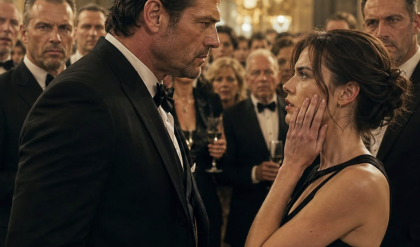
And I stood near the back of the ballroom in a midnight-blue couture gown, my diamond wedding ring cold against my finger, holding the kind of silence that could cut glass.
My assistant, Naomi, appeared at my shoulder.
“Claire,” she whispered, “do you want me to stop this?”
“No.”
My voice was so quiet she barely heard it.
“Let her finish.”
Naomi looked at me then.
Really looked.
She had been with me since The Lantern House opened, back when we had more leaks in the roof than donors on the list.
She knew the difference between my polite face and my dangerous one.
Onstage, Celeste placed one manicured hand over her heart.
“Harrison and I are honored to continue leading this mission together.”
The ballroom applauded.
Not everyone.
The children did not.
I watched June fold her arms.
I watched Milo stare at the centerpiece like he wanted to disappear inside it.
I watched Celeste accept applause for work she had never touched.
And I felt no rage.
Rage is loud.
What moved through me was colder.
Cleaner.
A door locking from the inside.
Part 2 — The Wife Who Did Not Cry
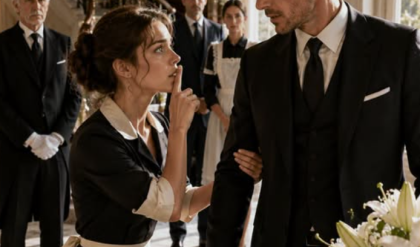
When Celeste stepped off the stage, Harrison came to me with the smile he used before cameras.
“My love,” he said.
My love.
The phrase landed between us like a dead bird.
“You look beautiful tonight.”
“So does your speechwriter,” I said.
His smile thinned.
Celeste joined him, flushed with applause and victory.
Up close, she smelled like jasmine, champagne, and another woman’s life.
“Claire,” she said, touching my arm as though we were friends.
“I hope I did your work justice.”
My work.
She said it softly, but Harrison heard.
So did Evelyn Whitfield, who approached with her pearls and her poisonous grace.
“Celeste was marvelous,” Evelyn said.
“Warmth matters so much at these things.
Some women have it naturally.”
I looked at my mother-in-law.
Evelyn had never forgiven me for failing to produce a Whitfield heir.
She had never said those words directly.
Women like Evelyn hire silence to do their dirty work.
After my miscarriage, she sent white lilies to the hospital with a card that read, “Rest and reflect.”
No love.
No sympathy.
Only instruction.
Celeste tilted her head.
“I was nervous,” she said.
“But Harrison told me the children needed to hear from someone who truly understands family.”
That one almost made Naomi drop the tablet she was holding.
I smiled.
Not warmly.
Not cruelly.
Just enough.
“How fortunate for them,” I said.
Harrison stepped closer.
His hand touched the small of my back.
To the room, it looked intimate.
To me, it was a warning.
“We should greet the mayor,” he said.
His fingers pressed into my spine.
I moved away before the pressure deepened.
“Yes,” I said.
“You should.”
A flicker crossed his face.
Men like Harrison do not like being corrected in public.
They prefer bruises in private.
The mayor approached, and Harrison turned his charm back on like electricity.
Celeste moved beside him as if she belonged there.
That was what she wanted tonight.
Not love.
Position.
The mistress never truly wants the man.
She wants the seat beside him.
The cameras found them again.
Harrison and Celeste, glowing beneath the chandelier.
Evelyn nearby, smiling approval.
And me, the wife, standing alone beside the charity wall where framed photographs of the children lined the velvet panels.
That was the image they wanted.
The replaced woman.
The barren wife.
The elegant failure.
They had rehearsed my humiliation carefully.
But they had forgotten one thing.
I had built the stage.
Every gala contract bore my signature.
Every donor pledge was tied to my foundation.
Every vendor, sponsor, photographer, and press outlet had been approved through my office.
And every microphone in that ballroom was connected to a recording system I had installed three years earlier after a donor made an inappropriate comment to one of our sixteen-year-old girls.
Harrison knew about the system.
He had simply forgotten because men like him believe safety policies are decorative until they become evidence.
At 9:17 p.m., the live auction began.
A weekend in Aspen went for eighty thousand.
A private dinner with a celebrity chef went for one hundred twenty.
A Cartier bracelet donated by Evelyn went for less than she expected, which pleased me more than it should have.
At 9:42 p.m., Harrison took the stage.
He adjusted his cufflinks and smiled at the crowd.
“My wife has always cared deeply about this cause,” he began.
My wife.
This cause.
Not Claire.
Not The Lantern House.
Distance disguised as praise.
He thanked donors, sponsors, trustees, and, with a practiced pause, Celeste.
“For stepping into this mission with such grace.”
Applause.
Celeste lowered her lashes.
I watched the children watching me.
They were not confused anymore.
They were offended.
It is a terrible thing when children recognize adult betrayal before adults have the courage to name it.
Harrison continued.
“Tonight, the Whitfield Foundation is proud to announce a new era of partnership with The Lantern House.”
Naomi stiffened beside me.
That sentence was not in the approved script.
Harrison smiled wider.
“Our family will be overseeing expansion plans across three states.”
The room erupted.
Donors loved expansion.
Reporters loved ambition.
Evelyn loved control.
I looked at the large screen behind him, where an image appeared of a proposed campus in Connecticut.
My campus.
My plans.
Stolen from a confidential development packet I had drafted with Naomi and our legal counsel.
I felt the last soft thing in me go still.
Harrison looked directly at me from the stage.
There it was.
The real announcement.
Not an affair.
Not humiliation.
A takeover.
He did not want to leave me.
He wanted to erase me first.
Celeste stood and applauded as though she had not just watched him steal years from my hands.
Then Harrison said, “And I am personally honored that Celeste Monroe will serve as public ambassador for this expansion.”
The applause became thunder.
My ears rang.
Not from shock.
From memory.
My grandmother’s voice came back to me, warm and Southern and stern.
“Never put your life in a man’s hands unless you know what he is holding in the other.”
Grandmother Eleanor had been old money from Charleston, but she trusted contracts more than charm.
Before I married Harrison, she insisted on a prenuptial agreement so severe his lawyers called it hostile.
Harrison had laughed and signed it.
He loved me then, or liked the idea of me enough to pretend.
Besides, the Whitfields assumed my family money was decorative beside theirs.
They had not read carefully enough.
Or perhaps they had, but arrogance has a way of blinding people to ink.
The Lantern House did not belong to the Whitfield Foundation.
It did not belong to Harrison.
It did not even belong to me personally.
It belonged to the Eleanor Ashford Children’s Trust, an irrevocable charitable trust funded before my marriage, protected from marital claims, corporate interference, and family office manipulation.
I was not merely the founder.
I was the sole trustee.
Harrison could not take it.
He could not rebrand it.
He could not appoint Celeste as anything more meaningful than a woman in a borrowed gown standing too close to a stolen microphone.
But he did not know I knew what he had done.
He did not know I had discovered the forged board memo.
He did not know I had copies of emails between his counsel and Evelyn discussing “Claire’s removal due to emotional instability.”
He did not know the hospital had sent me my records.
He did not know the miscarriage timeline proved he had lied about where he was that night.
He did not know Celeste was pregnant.
And he definitely did not know I had the paternity test.
Not from a clinic.
From his own brother.
Part 3 — The Secret in the Silver Folder
The truth about Celeste’s pregnancy arrived in a silver envelope three days before the gala.
Not by mail.
By hand.
Delivered to my townhouse on East Seventy-Third by a man wearing a gray overcoat and the expression of someone who had spent his entire life disappointing powerful relatives.
Caleb Whitfield was Harrison’s younger brother.
The charming one.
The reckless one.
The one Evelyn called “unfocused” because he had refused to work for the family empire after rehab.
I found him standing in my foyer at dusk, rain shining on his shoulders.
“I need to tell you something,” he said.
I should have shut the door.
Instead, I let him in because his face looked like confession had already beaten him half to death.
He sat in my library beneath a painting of my grandmother and did not touch the tea my housekeeper brought.
“Celeste is pregnant,” he said.
“I know.”
His eyes lifted.
“You do?”
“I know what Harrison wants me to know.”
Caleb swallowed.
“It might not be his.”
That was the first crack.
He told me the affair between him and Celeste had happened during a Whitfield retreat in Napa.
Harrison had flown back to New York for two nighTS.
Celeste had stayed.
Caleb was sober enough to remember and ashamed enough to tell the truth.
“She said Harrison was going to leave you,” he said.
“She said it was already over.”
I almost laughed.
That sentence has ruined more women than war.
“She asked me for money afterward,” Caleb continued.
“Then she said if I ever spoke, she’d tell my mother I relapsed and forced myself on her.”
There are moments when betrayal multiplies so quickly it becomes almost mathematical.
Harrison betraying me with Celeste.
Celeste betraying Harrison with Caleb.
Evelyn protecting legacy over truth.
A child being used as leverage before it had even taken its first breath.
“I took a test,” Caleb said.
He pulled a document from the inside of his coat.
“Legal chain of custody.
Prenatal noninvasive paternity test.
I know how this sounds, Claire, but I had to know.”
I did not touch it at first.
Paper can be heavier than stone.
“Why bring this to me?”
“Because they’re going to destroy you tomorrow night.”
My gaze sharpened.
He looked down.
“I heard my mother with Harrison.
They’re planning to announce the foundation takeover publicly.
They think if donors applaud, the board will follow.
They have a psychiatrist ready to say you’re unstable after the miscarriage.”
My hands remained folded in my lap.
The room did not move.
Neither did I.
“That psychiatrist has never treated me,” I said.
Caleb nodded.
“I know.”
“And the board cannot remove me.”
“They think they found a way through the expansion agreement.”
“There is no signed expansion agreement.”
He looked sick.
“There is now.”
That was when he handed me the second document.
A scan of my signature appeared on the last page.
It was close.
Very close.
But my signature has a small upward cut on the C in Claire, a habit from years of fountain pens and impatient legal forms.
This one curved down.
Harrison had forged my name.
Not metaphorically.
Not emotionally.
Legally.
I stared at the page for a long time.
Then I stood, walked to my desk, and unlocked the bottom drawer.
Inside was a recorder.
A small black device no larger than a lipstick tube.
I placed it on the table between us.
“Start from the beginning,” I said.
Caleb looked frightened.
Good.
Truth should frighten people who have avoided it.
He spoke for forty-seven minutes.
He named dates.
Hotels.
Conversations.
ThreaTS.
He gave me emails, text screenshots, bank transfers, and the paternity report.
When he finished, he put both hands over his face.
“I’m sorry,” he whispered.
I believed him.
That did not make him innocent.
But remorse is not innocence.
It is only the first useful thing a guilty person can offer.
After he left, I called my attorney, Margaret Bell.
Margaret was seventy-one, Harvard-trained, widowed twice, and famous for making billionaires sweat through custom shirTS.
She answered on the second ring.
“Claire.”
“I need an emergency injunction prepared.”
There was a pause.
Then the sound of paper shifting.
“Against your husband?”
“And his foundation.”
Another pause.
“And?”
“Possibly his mother.”
Margaret exhaled.
“I always liked you.”
“You never said that.”
“I was waiting for you to become interesting.”
By midnight, Naomi was in my kitchen with her laptop open and her hair in a knot.
Margaret joined by secure video from her apartment overlooking Central Park.
Our trust counsel, Daniel Cho, logged in from San Francisco.
An investigator in Connecticut verified the forged filing.
A forensic document examiner agreed to be on standby.
The recording from Caleb was uploaded to three encrypted servers.
The paternity report was sealed.
The hospital records were copied.
And the gala program was quietly amended.
Not visibly.
Not yet.
By dawn, I had slept ninety minutes.
By noon, I was fitted into the midnight-blue gown Harrison had chosen because he said it made me look “less severe.”
By seven, I was in the ballroom.
By nine forty-two, he was onstage stealing my charity.
And by nine fifty-eight, I was ready.
Harrison finished his speech to a standing ovation from people who thought generosity had just been announced.
Celeste moved toward the stage stairs, glowing.
Evelyn kissed both her cheeks.
June Carter remained seated.
Her eyes were on me.
The live auctioneer returned to the podium.
“Before our final presentation,” he said, “Mrs. Whitfield will offer a few words.”
That was not in Harrison’s plan.
His head turned.
Slowly.
Across the ballroom, I began walking toward the stage.
Every eye followed.
My heels made no sound on the carpet, but the room seemed to hear me anyway.
Naomi stood near the AV table.
Margaret sat at table twelve in black velvet, wearing pearls and the expression of a woman who had come to watch a building burn legally.
I climbed the stairs.
Harrison leaned toward me as I passed.
“What are you doing?” he whispered.
I did not answer.
Celeste stood near the podium, still smiling, though something uncertain had entered her eyes.
I stepped to the microphone.
The chandelier light warmed my face.
The ballroom quieted.
For seven years, I had spoken gently in rooms like this.
For children.
For donors.
For Harrison.
That night, I spoke for myself.
“Good evening,” I said.
My voice was calm enough to make the first row lean in.
“Thank you all for your generosity tonight.”
A soft murmur.
“I also want to thank Miss Monroe for her moving remarks about The Lantern House.”
Celeste’s smile returned.
Poor thing.
She thought praise was safety.
“She said earlier that her first visit to our shelter changed her.”
I turned toward her.
“Unfortunately, that visit never happened.”
The room changed temperature.
Not loudly.
Not dramatically.
But all at once, like a door opening in winter.
Celeste blinked.
Harrison’s face hardened.
I continued.
“We checked our visitor logs, security records, volunteer sign-ins, program calendars, and staff communications.
Miss Monroe has never visited The Lantern House.”
A camera clicked.
Then another.
Celeste’s mouth parted.
I looked back at the crowd.
“That does not make her cruel.
It makes her uninformed.”
A few people shifted.
“But claiming children you have never met in order to gain applause from people holding checkbooks is something else.”
Evelyn stood halfway.
“Claire,” she said sharply.
I ignored her.
It is amazing how small powerful people become when you stop obeying their tone.
Part 4 — The Gala Where Everything Burned Quietly
Harrison stepped toward the microphone.
“That’s enough.”
I turned my head.
Only slightly.
“No.”
One word.
No raised voice.
No trembling.
Just no.
The room heard it like glass breaking.
Harrison’s jaw tightened.
“This is not the place.”
I smiled.
“But you chose the place.”
The silence became absolute.
I looked out at the donors, the board members, the reporters, the society photographers, the mayor, the bishop, the lawyers, and every person who had come expecting dessert and charity.
“You heard an announcement tonight about a new era of partnership between The Lantern House and the Whitfield Foundation.”
I paused.
“That announcement was false.”
Harrison moved again, but Margaret Bell stood from table twelve.
She did not say a word.
She merely adjusted her glasses.
For reasons known only to God and opposing counsel, that stopped him.
I lifted the silver folder Naomi had placed on the podium.
“The Lantern House is owned and governed by the Eleanor Ashford Children’s Trust, an irrevocable charitable trust established before my marriage.”
My voice carried cleanly through the ballroom.
“No Whitfield entity has authority over it.”
Evelyn’s face drained beneath her powder.
“No Whitfield family member controls it.”
Harrison’s expression sharpened.
“And no public ambassador has been appointed.”
Celeste looked at Harrison.
For the first time all night, she looked like a mistress instead of a future wife.
A woman waiting for a man to save her.
I almost pitied her.
Almost.
Behind me, the screen changed.
The Connecticut expansion rendering vanished.
In its place appeared a scanned document.
The forged agreement.
Gasps moved through the ballroom.
“This document was circulated to several donors this week,” I said.
“It contains my alleged signature authorizing Whitfield oversight of Lantern House expansion asseTS.”
I touched the folder.
“That signature is a forgery.”
Harrison whispered my name.
Not in warning now.
In fear.
There it was.
Small.
Late.
Useless.
I looked at him.
“You should have practiced the C.”
A woman at the front table covered her mouth.
Someone else said, “Oh my God.”
 She Survived Two Years of Whippings Until Atlantic City’s Most Feared Man Smashed Through Her Door
The screen changed again.
Visitor logs.
Email headers.
A memo from Whitfield counsel.
A proposed media strategy titled “Transitioning Claire Out.”
The phrase hung there in twelve-foot letters above the ballroom.
Transitioning Claire Out.
The humiliation they had prepared for me became their own.
I let them look.
That is the power of evidence.
It does not need to shout.
It simply stands where lies used to be.
Harrison lunged toward the AV table, but two security guards stepped in front of him.
My security guards.
Hired through my foundation.
Paid from my account.
Briefed by my attorney.
“Claire,” he said, trying to laugh.
“This is insane.”
That word again.
Insane.
Unstable.
Emotional.
Fragile.
The vocabulary of men who mistake a woman’s pain for a legal strategy.
I leaned into the microphone.
“For clarity, I have not been removed from any role.
I have not signed any transfer.
I have not authorized any expansion under the Whitfield Foundation.”
Margaret lifted a court-stamped packet.
“As of 6:08 p.m.
this evening, an emergency injunction was filed to prevent unauthorized use of Lantern House assets, donor lists, intellectual property, and child images.”
The mayor sat back.
The bishop stared at Harrison.
Reporters typed like their hands were on fire.
Celeste’s eyes filled, but tears did not suit her face.
They looked like accessories she had not learned to wear.
She touched Harrison’s sleeve.
He shook her off.
The small cruelty was instinctive.
I wondered if she felt the future arrive.
I continued.
“Because this gala involves minors, I will not discuss every detail here.”
Then I looked directly at Harrison.
“But the relevant authorities and counsel have received copies of all documents, recordings, and communications related to tonight’s attempted takeover.”
His face went gray.
Recordings.
He heard that word.
So did Evelyn.
So did Celeste.
A rich family can survive scandal.
It can survive infidelity.
It can survive cruelty.
It cannot easily survive documented fraud involving a children’s charity in front of three hundred donors and six cameras.
Evelyn walked toward the stage.
Her diamonds trembled.
“You ungrateful girl,” she hissed, forgetting the microphone would catch the edge of it.
The ballroom heard.
I turned to her.
“I was a wife, Evelyn.
Not inventory.”
The line landed harder than I expected.
Perhaps because every woman in the room understood it.
Some looked away.
Some did not.
Evelyn’s lips pressed white.
“You will regret this.”
“No,” I said.
“You will.”
Then Naomi approached the stage carrying a second microphone.
My stomach tightened because this was the only part I had not planned.
June Carter stood beside her.
Tall.
Thin.
Shoulders squared.
A white dress Evelyn’s stylist had chosen for the children made her look younger than she was, but her eyes refused to cooperate.
They were old eyes.
Truthful eyes.
“June,” I said softly, away from the microphone.
“You don’t have to.”
She nodded once.
“I know.”
Naomi handed her the microphone.
June faced the ballroom.
My heart clenched.
Adults love using children as symbols.
Children rarely get to speak as witnesses.
June’s hand shook, but her voice did not.
“My name is June Carter.
I’ve lived at The Lantern House for two years.”
Silence.
“Mrs. Whitfield was there the night I arrived.”
I closed my eyes for one second.
That night had been February cold.
June had come with a trash bag of clothes, a split lip, and an attitude sharp enough to keep the world from touching her.
“She sat on the kitchen floor with me because I wouldn’t sit at the table,” June said.
A small laugh moved through the children’s table.
“She didn’t ask me to talk.
She just made grilled cheese badly.”
Another soft laugh.
Even I smiled.
“It was very burnt,” June said.
Then her face changed.
“But she came back the next morning.
And the next.
And the next.”
She looked at Celeste.
“I don’t know you.”
Celeste froze.
June looked at Harrison.
“And I met you once.
You called us a project.”
Harrison shut his eyes.
The cameras kept flashing.
June turned back to the ballroom.
“We’re not angels.
We’re kids.
We know who shows up.”
That sentence finished what my documents had started.
Evidence can prove ownership.
Children prove love.
The applause began quietly.
Then grew.
Not the polished applause from Celeste’s speech.
Not the donor applause.
Real applause.
Messy.
Human.
June handed the microphone back to Naomi.
Then the oldest child walked past Celeste and handed me the flowers.
They were white roses from the stage arrangement.
Too formal.
Too expensive.
Too beautiful for what they had witnessed.
June pushed them into my hands like an offering.
Not to a savior.
To someone who had stayed.
That was when Celeste broke.
Not publicly.
Not loudly.
Her face simply lost its shape.
For one second, she understood that she had stolen the wrong thing.
Not my husband.
He was available to anyone willing to flatter him.
She had tried to steal my place in the hearts of children who knew the cost of being abandoned.
That could not be bought.
Not with diamonds.
Not with speeches.
Not with a Whitfield name.
Harrison stepped toward me.
“Claire, please.”
Please.
Another late word.
I looked at him over the flowers.
“You should go.”
He stared as though he did not understand the language.
Perhaps he didn’t.
No one had ever dismissed him before.
Security understood.
They escorted Harrison Whitfield from a ballroom his family thought they owned.
Evelyn followed, rigid with humiliation.
Celeste remained for three seconds too long, standing alone under the chandelier, wearing a blush gown and another woman’s future.
Then she ran after them.
The doors closed.
The room exhaled.
I thought I would feel victory.
Instead, I felt tired.
Deeply, bone-level tired.
Justice is satisfying in stories.
In life, it arrives carrying grief.
Because even when you win, you still have to mourn the person you thought someone was.
Part 5 — The Mansion, the Courtroom, and the Name on the Deed
The tabloids named it The Angel Gala Scandal by morning.
I hated the name.
The children hated it more.
June texted me at 7:12 a.m.
We are not angels.
Tell them to stop being weird.
I replied, Already handled.
Naomi issued a statement before breakfast.
The Lantern House serves young people, not symbols.
By noon, three major donors doubled their pledges.
By two, the attorney general’s charity bureau opened an inquiry into the Whitfield Foundation.
By five, Harrison called me twenty-three times.
I answered none.
He came to the townhouse at dusk.
Of course he did.
Men like Harrison believe closed doors are misunderstandings.
I watched from the upstairs window as he stood beneath the iron lanterns my grandmother had shipped from Savannah.
Rain darkened his cashmere coat.
For a moment, memory betrayed me.
I saw the man who once carried my heels through a Charleston garden after our engagement party.
The man who sent handwritten notes from London.
The man who cried when I walked down the aisle, or performed tears so beautifully that I built a marriage on them.
Then he looked up at my window with anger in his face, and the memory died properly.
Naomi let him into the front hall because I asked her to.
I met him in the library.
Not the bedroom.
Not the kitchen.
Not any room that had held softness.
He looked around as if seeing my home for the first time.
Maybe he was.
“This has gone too far,” he said.
“No hello?”
“Do not humiliate me with manners.”
I sat behind my grandmother’s desk.
He hated that.
The desk made every man feel like he was applying for something.
“You exposed private family matters in public,” he said.
“You committed fraud in public.”
His eyes flashed.
“That document was a draft.”
“With my forged signature.”
“You’re being advised by people who want to turn you against me.”
I almost smiled.
There it was.
The old formula.
A woman cannot be angry unless someone taught her.
“Harrison,” I said, “you had your mistress claim my charity in front of foster children.”
His expression tightened.
“Celeste got carried away.”
“No.
She got permission.”
He said nothing.
“From you.”
Still nothing.
“From your mother.”
His jaw moved.
“She was trying to help.”
“She called me unstable in a memo.”
“You lost a baby, Claire.”
The room went cold.
He had not said our baby.
Not once.
Not in the hospital.
Not at the funeral service I held alone in a chapel with twelve white candles.
Not now.
I folded my hands.
“Yes.
I did.”
He looked away.
“And while I was losing that baby, you were at the Mark Hotel with Celeste.”
His face changed.
The smallest change.
Enough.
“I have the receipts,” I said.
He laughed once.
Ugly.
“What do you want?”
The question was so empty I almost admired it.
Not forgiveness.
Not truth.
Transaction.
Always transaction.
“I want a divorce.”
He stared.
“For God’s sake, Claire.”
“I want the apartment in Boston returned to my trust.
I want the Cape house transferred as marital settlement per the prenup clause you forgot existed.
I want a public retraction regarding The Lantern House.
I want Whitfield Foundation withdrawal from every donor communication by Friday.”
He took one step toward the desk.
“And if I say no?”
I opened the drawer and placed a recorder on the blotter.
He stopped.
I pressed play.
His own voice filled the library.
“She’s useful, not permanent.”
He went still.
Celeste’s voice followed, soft and amused.
“Once the charity is under your foundation, no one will care what she says.”
Then Evelyn.
“Claire has become emotionally unreliable.
Donors need a steadier woman beside you.”
The recording clicked off.
Harrison’s face had gone colorless.
“That was illegally obtained.”
“No,” I said.
“New York is a one-party consent state when a participant records the conversation.
Caleb was in the room for part of that call.”
The name hit him like a slap.
“Caleb?”
I opened the silver folder.
This time, I did not soften anything.
“I also know Celeste’s baby may be his.”
Harrison stared at the paternity report.
I watched denial, calculation, and humiliation move across his face like weather.
For the first time in seven years, Harrison Whitfield had no room to perform in.
No audience.
No mother.
No mistress.
No trembling wife.
Only facTS.
“Claire,” he said.
There was something almost human in his voice now.
Too late.
“I made mistakes.”
I stood.
“No.
You made plans.”
That difference mattered.
A mistake is forgetting an anniversary.
A plan is building a woman’s public destruction while she is grieving your child.
His eyes shone, but I did not trust tears anymore.
He had used them too well.
“You loved me,” he said.
“I did.”
The past tense hurt him.
Good.
Not because I wanted revenge.
Because truth should hurt the people who forced others to live inside lies.
“I can fix this,” he said.
“You can sign.”
The divorce was filed the next morning.
The society pages had a week-long feast.
There were photos of Celeste leaving a medical building in sunglasses.
Photos of Caleb entering Margaret Bell’s office.
Photos of Evelyn Whitfield stepping into a black SUV while reporters asked whether she had tried to remove her daughter-in-law from a charity trust.
The Whitfields went silent.
That was their family tradition when money could no longer speak safely.
Two weeks later, Harrison’s attorneys requested mediation.
Margaret laughed for eight straight seconds on the conference call.
Then she said, “No.”
The prenup gave me more than they remembered.
Infidelity with reputational harm triggered a morality clause Harrison had mocked as “antique.”
Any attempt to interfere with my premarital charitable trust triggered indemnification.
Any forged document used to affect my assets opened a path to civil damages.
My grandmother had not written a prenup.
She had built a moat.
By December, Harrison signed the settlement.
The Cape house became mine.
The Boston apartment returned to the trust.
The Whitfield Foundation made a public correction so cold and legal that every journalist in Manhattan understood it was written under threat.
Celeste disappeared from boards, committees, and society lunches.
Her pregnancy became private, as it should have been from the beginning.
I did not pursue her further.
People expected me to.
They wanted a screaming confrontation outside a clinic.
They wanted wine thrown, hair pulled, a quote they could turn into a headline.
But punishment is not always power.
Sometimes power is refusing to make another woman the center of your story.
Celeste had not owed me vows.
Harrison had.
Evelyn had owed me decency.
The Whitfield name had owed those children protection once it dared to stand near them.
They failed.
So I removed them.
Quietly.
Completely.
Legally.
The final hearing took place in a federal courthouse downtown on a January morning so cold the city looked made of steel.
Harrison arrived in a navy suit.
He looked thinner.
Less polished.
Still handsome, which annoyed me.
The world rarely punishes beautiful men by making them look like what they have done.
Evelyn did not come.
Caleb did.
He sat in the back row and did not meet Harrison’s eyes.
Margaret sat beside me, crisp as a blade.
The judge reviewed the settlement, the trust protections, the injunction terms, and the divorce decree.
No drama.
No speeches.
Just pages turning.
There is a strange intimacy in watching a marriage become paperwork.
A name removed.
A title restored.
A signature placed where vows used to be.
When the judge asked if I understood the terms, I said yes.
When she asked Harrison, his voice cracked.
“Yes.”
The decree was entered at 10:43 a.m.
Seven years ended in under thirty minutes.
Outside the courtroom, Harrison followed me into the marble hallway.
For once, no cameras had made it past security.
No audience.
No chandelier.
No applause.
Just us.
“Claire.”
I stopped.
He stood a few feet away with his hands at his sides.
“I went to The Lantern House,” he said.
I turned slowly.
His eyes were red.
“They wouldn’t let me in.”
“That was wise of them.”
He swallowed.
“I saw the mural outside.
The one with the lanterns.”
The children had painted it the week after the gala.
Dozens of yellow lanterns rising into a cobalt sky.
At the bottom, June had written, We know who shows up.
Harrison looked at me like he wanted those words to become a bridge.
They were not a bridge.
They were a locked gate.
“I didn’t understand what it meant to you,” he said.
“No,” I replied.
“You understood exactly what it meant.
That’s why you tried to take it.”
He flinched.
I almost felt sorry for him.
Almost.
“I loved you,” he said.
I believed that he believed it.
But some people love the way children love toys.
Possessively.
Carelessly.
With grief only when the thing is gone.
“I know,” I said.
“That was never enough.”
He looked down.
“What happens now?”
I glanced toward the courthouse doors, where winter sunlight spilled across the steps.
“Now you live with what you chose.”
Then I walked away.
Not quickly.
Not dramatically.
Just away.
That is the part nobody tells you about revenge.
The best ending is not watching them suffer.
It is realizing you no longer need to watch them at all.
Conclusion — The Flowers on the Kitchen Table
The Lantern House gala returned the next spring.
Not at the Whitmore Grand.
Never again.
We held it in the renovated chapel behind the shelter, where the stained-glass windows turned sunset into pieces of honey.
The tables were rented.
The flowers came from a local market.
The dinner was made by a chef who had grown up in foster care and cried when Milo told him his mac and cheese was “aggressively good.”
No chandelier hung over us.
No society photographers shouted names.
No mistress wore silk and borrowed motherhood.
The donors came anyway.
More of them, actually.
Not because we looked richer.
Because we looked real.
June gave the speech.
She wore a black blazer, combat boots, and the silver nail polish she still refused to stop chipping.
She had been accepted to NYU with a full scholarship from the Eleanor Ashford Education Fund.
When she stepped up to the microphone, my eyes burned before she said a word.
“I used to think charity meant rich people taking pictures with sad kids,” she began.
The room laughed because June had the rare gift of making truth funny before it became painful.
“Then I met Mrs. Ashford.”
I had taken back my name by then.
Claire Ashford.
It felt strange at first.
Then it felt like breathing.
June looked at me.
“She never asked us to be grateful on command.
She never called us angels.
She never needed us to make her look good.”
Her voice softened.
“She just showed up.”
Milo, now eleven and still suspicious of formal clothing, leaned against my side.
Tessa sat on my other side with a sketchbook in her lap, drawing lanterns on the program.
Naomi cried openly.
Margaret pretended not to.
June lifted a bouquet from the podium.
White roses.
The same flowers from the gala.
But these were wrapped in brown paper and tied with kitchen twine.
No gold ribbon.
No florist card.
Just flowers.
“For the woman who owned the room before anyone else knew it,” June said.
I stood.
The room rose with me.
Not because I had won a divorce.
Not because I had beaten a powerful family.
Not because I had made headlines or protected assets or turned evidence into a weapon.
They stood because love had survived the attempt to counterfeit it.
I walked to June.
She handed me the flowers.
This time, I cried.
Quietly.
Without shame.
Because strength is not the absence of tears.
Strength is choosing where they fall.
That night, after the donors left and the children changed out of their formal clothes, we sat barefoot in the kitchen eating leftover cake from paper plates.
June argued with Milo about music.
Tessa fell asleep with her head on Naomi’s shoulder.
Rain tapped gently against the windows.
The shelter smelled like sugar, coffee, and home.
I placed the white roses in a chipped blue vase near the sink.
For years, I thought my life had been taken from me piece by piece.
My marriage.
My child.
My name.
My dignity.
But standing in that kitchen, watching the children laugh under warm yellow lights, I understood the truth.
Some things had been taken.
Others had been revealed.
Harrison had shown me the cost of being chosen by the wrong man.
Celeste had shown me the danger of confusing attention with belonging.
Evelyn had shown me that family power without love is just architecture.
And the children had shown me what no contract could.
The people who know your heart do not need a speech to recognize it.
They know your hands.
They know your footsteps.
They know who comes back the next morning.
Years later, people would still ask me about that night at the Whitmore Grand.
They wanted to know how I stayed so calm.
How I stood there while my husband and his mistress tried to steal my life beneath a million dollars of chandelier light.
I never gave them the answer they expected.
I did not stay calm because I was unhurt.
I stayed calm because the truth was already standing beside me.
It sat at the children’s table.
It waited in a silver folder.
It lived in visitor logs, trust deeds, forged signatures, recorded calls, and the eyes of a girl who knew exactly who had burned the grilled cheese and come back anyway.
Celeste claimed the charity.
Harrison claimed the power.
Evelyn claimed the family name.
But the children knew the wife.
And in the end, that was the only claim that mattered.