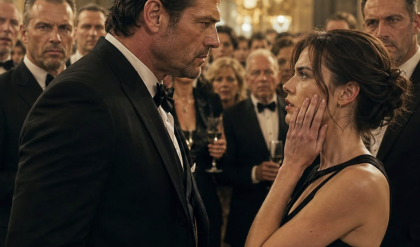
She Paid Extra for Her Daughter’s Window Seat.
Then One Pilot Announcement Made the Entire Plane Freeze.
PART 1
The airport smelled like burned coffee, floor wax, and the kind of stress that crawls under your skin before you even reach the gate.
But when I looked down at my seven-year-old daughter Chloe, all I saw was wonder.
Her little hand squeezed mine almost painfully, while the other clutched a battered blue spiral notebook filled with crayon drawings of airplanes, wings, engines, and flaps labeled with careful arrows.
She had deep brown skin, a missing front tooth, and two dozen braids I had spent four hours parting and decorating with clear beads the night before.
Every time she turned toward the massive planes outside the terminal windows, those beads clicked together like tiny applause.
To Chloe, this was not just a trip to Chicago to see my mother.
This was **the day the sky finally became real.**
We were waiting at Gate B14 in Hartsfield-Jackson Atlanta, and Chloe could barely stand still.
I am an administrative assistant at a mid-sized logistics company, not someone who buys plane tickets without checking my bank account three times first.
I had saved for eight months, skipped takeout, stretched groceries, and paid an extra forty-five dollars for Seat 14A, the window seat right over the wing because that was the only thing Chloe had asked for.
“Mama,” she whispered with scientific seriousness, “do flaps deploy when we push back or only when we start going fast?”
I smiled and handed her half a granola bar.
“You’ll have to watch out the window and tell me.” Her face lit up as she tucked her notebook into her pink backpack.
“I’ve got my pencil ready.
I’m logging takeoff time.” That was when I noticed the woman in the boarding line.
She wore a crisp white linen blazer, cream silk top, expensive heels, and carried a designer tote that probably cost more than my car.
Her blonde hair sat in a flawless knot, but her face was tight with impatience.
She kept checking her watch, sighing loudly, and glaring at the gate agents as if the entire airport had personally failed her.
For one second, her eyes met mine, then slid away quickly, as though I had caught her thinking something she knew better than to say out loud.
When our group was finally called, Chloe practically pulled me toward the scanner.
“We’re really doing it, Mama,” she whispered as we stepped into the jet bridge, where the air turned warm and smelled faintly of fuel and metal.
“We’re in the tunnel.
We’re almost inside the fuselage.” I laughed softly, checked our boarding passes again, and said, “Row 14, baby.
14A and 14B.”
We stepped onto the plane, passed the tired smile of the flight attendant, and moved slowly down the narrow aisle while passengers shoved bags overhead and sighed like boarding was a punishment.
Chloe counted the rows under her breath, touching the numbers beneath the bins with one tiny finger.
“Ten… eleven… twelve… thirteen…” Then we reached row 14, and I stopped so suddenly she bumped into my leg.
Someone was already sitting in 14A.
**The woman in the white linen blazer had taken my daughter’s window seat** and settled in as if she had purchased the whole aircraft.
Her designer tote was tucked below, her neck pillow arranged, her iPad open on the tray table, and her eyes fixed on the window like the sky belonged to her.
I checked my phone even though I knew exactly what it said.
14A and 14B.
“Excuse me,” I said gently.
She did not turn.
“Excuse me, ma’am,” I repeated louder.
Slowly, she looked over her shoulder, not embarrassed, not apologetic, only annoyed.
“I think you might be in our seat,” I said.
“We have 14A and 14B.” Her eyes moved from me to Chloe, who was half-hidden behind my leg, her beads clicking nervously.
It was a quick, measuring look, the kind that calculates what you can afford, how much noise you will make, and whether anyone will believe you if you complain.
Then she waved one manicured hand.
“Oh, I just took the window.
I get terrible claustrophobia in the aisle.
You can sit in the middle and aisle.” She said it like she was granting us a favor.
For a moment, I couldn’t speak.
I looked down at Chloe, and the excitement had drained from her face so completely it felt like someone had reached into my chest and squeezed.
“Ma’am,” I said, keeping my voice low, “I paid extra for that specific seat.
For my daughter.
It’s her first flight.”
The woman sighed dramatically and leaned closer.
“Look, it’s two hours.
She’s a child.
She won’t even know the difference.”
Heat rushed into my hands.
“She does know the difference,” I said.
“And that is her seat.”
A young flight attendant squeezed through the aisle, sweat darkening the collar of his blue uniform shirt.
“Is there a problem here?” he asked, glancing at the passengers backed up behind us.
“Yes,” I said clearly.
“This passenger is sitting in our assigned seat and refusing to move.” The woman instantly changed her face, pressing one hand to her chest.
“I have severe anxiety,” she said shakily.
“If I don’t sit by the window, I’ll have a panic attack.” The flight attendant looked trapped.
People behind us started huffing.
A man muttered, “Come on, let’s go.”
Then the attendant turned to me with pleading eyes.
“Ma’am, boarding is really backed up.
If she has a medical anxiety issue, would you mind taking the middle and aisle so we can leave the gate?”
I stared at him, then at the woman, whose trembling lips could not hide the triumph in her eyes.
I knew the trap.
If I raised my voice, I would become the problem.
If I demanded what I paid for, I would be **the angry woman holding up the plane.**
Then Chloe tugged softly on my jeans and whispered, “It’s okay, Mama.
I don’t need the window.” That was the moment my heart broke, because at seven years old, my daughter was already learning to shrink herself for someone else’s comfort.
“Fine,” I whispered.
The woman did not thank us.
She simply adjusted her neck pillow and turned back to the window.
I slid into the middle seat and guided Chloe into the aisle, watching her push her blue notebook into the seatback pocket without opening it.
As the cabin door closed and the plane began to push back, I noticed an older flight attendant near the front galley holding an iPad, staring directly at row 14.
Then the captain’s voice crackled over the speaker, calm but strangely firm.
**“Ladies and gentlemen, before takeoff, we need to correct a seating issue involving Seat 14A.”**
PART 2
For a second, nobody moved.
Then every head near Row 14 turned toward us, including the woman in the white blazer, who suddenly sat very still.
The young flight attendant, whose name tag read Jared, went pale.
He looked toward the front galley, where the older flight attendant was already walking down the aisle with the iPad tucked against her side.
Her silver-gray hair was pulled into a neat bun, and her expression had the stillness of someone who had worked too many flights to be impressed by anyone’s performance.
“Jared,” she said quietly, “show me the seating notes for Row 14.”
Jared swallowed.
“Marlene, I was just trying to keep boarding moving.”
“I didn’t ask why,” she said.
“I asked for the notes.”
The woman in 14A lifted her chin.
“I have a medical condition.
I told him I cannot sit anywhere else.”
Marlene looked at her.
“What is your assigned seat, ma’am?”
The woman blinked.
“That is private.”
“No,” Marlene said.
“It is operational.”
A few passengers murmured.
Chloe pressed her knees together and stared down at her shoes, trying to disappear into the aisle seat.
I wanted to wrap my arms around her and say, You did nothing wrong.
Instead, I sat trapped in the middle seat, anger burning behind my ribs.
The captain’s voice came again.
“We are holding position until the assigned passenger for Seat 14A is seated there.”
The woman’s face flushed.
“This is ridiculous.”
Marlene checked the iPad.
“Ms.
Vanessa Whitmore, your assigned seat is 14C.”
The woman’s mouth tightened.
“Aisle seats trigger my anxiety.”
“Then you should have requested accommodation before boarding,” Marlene replied.
“You cannot self-assign another passenger’s paid seat.”
Vanessa turned to me with a cold little smile.
“Honestly, it’s a child.
Why are we making this dramatic?”
That broke something in me.
Not loud.
Not wild.
Just enough.
“Her name is Chloe,” I said.
“And she saved drawings of this flight for three monThS.”
Chloe’s cheeks went shiny with tears she refused to let fall.
She pulled her notebook closer to her chest as if protecting it from the whole cabin.
Vanessa looked at the notebook and laughed softly.
“That’s sweet.
But the window is not a human right.”
Marlene’s eyes sharpened.
“Neither is taking what you did not purchase.”
Jared stared at the floor.
Passengers behind us had stopped complaining now.
Some looked embarrassed.
Some looked curious.
A man across the aisle whispered, “She really took a kid’s seat?”
Vanessa heard him and spun.
“I have anxiety.”
Marlene’s voice stayed calm.
“And the child has a paid seat assignment.”
The plane stopped moving entirely.
Outside the oval window, the wingtip rested beneath gray Atlanta light, still and waiting.
Chloe looked toward it, just for a second, then looked away because looking hurt too much.
Marlene leaned toward her.
“Sweetheart, is that your notebook?”
Chloe nodded without speaking.
“May I see it?”
Chloe looked at me first.
I nodded.
She pulled the battered blue spiral notebook from the pocket with both hands and passed it to Marlene.
The first page opened to a crayon drawing of a plane wing, with little arrows labeled FLAPS, AILERON, ENGINE, CLOUDS.
Marlene’s face softened.
“You drew this?”
Chloe whispered, “My grandma helped me spell aileron.”
Marlene went very still.
“Your grandmother?”
I said, “We’re flying to Chicago to see my mother.”
Marlene looked at the notebook again.
Then at Chloe’s full name on the seating list.
Her expression changed so quickly that my stomach tightened.
“Chloe Carter?” she asked.
I nodded.
“Yes.”
Marlene’s fingers tightened around the iPad.
Then she looked toward the cockpit and whispered, “Oh my goodness.”
PART 3
The silence around Row 14 became different.
Not just tense now.
Charged.
Vanessa noticed before I did.
“What?” she snapped.
“Why are you looking at her like that?”
Marlene closed the notebook gently.
“Ms.
Carter, may I ask your mother’s name?”
I answered carefully.
“Ruth Carter.”
The older flight attendant’s eyes filled so suddenly that I forgot my anger for half a breath.
“Captain Ruth Carter?” she asked.
Chloe looked up, startled.
“My grandma was a captain.”
A ripple moved through the nearby passengers.
Vanessa rolled her eyes.
“Oh, now the grandmother is a captain.” Her voice was dripping with disbelief.
“How convenient.”
I felt the insult like a slap, but Marlene turned toward her first.
“Mrs. Whitmore,” she said, voice cold enough to make Jared straighten, “Captain Ruth Carter was one of the finest pilots this airline ever had.”
Vanessa’s mouth opened, then closed.
Marlene looked back at Chloe.
“I flew with your grandmother for fourteen years.
She trained half the pilots in this company.”
Chloe’s eyes widened.
“You knew Grandma Ruth?”
Marlene smiled through tears.
“She once landed us in Denver during crosswinds so rough I thought I’d swallowed my own heart.
Then she apologized because the landing was ‘a little untidy.’”
For the first time since boarding, Chloe smiled.
Tiny.
Fragile.
Real.
The cockpit door opened.
A man in a captain’s uniform stepped out, tall, broad-shouldered, with salt-and-pepper hair and eyes that scanned the cabin once before settling on Row 14.
The cabin went quiet again.
Marlene walked toward him and spoke in a low voice.
He looked at the iPad.
Then at Chloe.
Then at me.
His expression changed too.
He took the intercom handset from the front wall.
“Ladies and gentlemen,” he said, “this is Captain David Ellis.
We apologize for the delay.
We have a young passenger on board whose assigned window seat was improperly occupied.”
Vanessa stared at him, furious.
“This is humiliating.”
The captain looked directly at her.
“Yes, ma’am.
It is.”
She seemed relieved, thinking he meant her.
He continued.
“Especially for the child asked to give up a seat her mother paid for.”
A few passengers murmured approval.
Vanessa went red.
Captain Ellis lowered the handset and walked down to Row 14 himself.
He stopped beside us, and Chloe sat up straighter as though meeting royalty.
“Are you Chloe Carter?” he asked.
She nodded.
He smiled gently.
“Your grandmother taught me how to fly through thunderstorms.”
Chloe’s mouth fell open.
I covered mine.
He crouched slightly so he was closer to her height.
“She also told me that every child deserves one good look out the window on their first flight.”
Chloe’s eyes shimmered.
Vanessa scoffed.
“Captain, with all respect, this is not a sentimental issue.
I explained my anxiety.”
Captain Ellis stood slowly.
“With all respect, Mrs. Whitmore, you explained it after taking a seat that was not yours.”
Her face hardened.
“Do you know who my husband is?”
The cabin inhaled together.
Captain Ellis did not blink.
“I know exactly who he is.”
Vanessa looked victorious for half a second.
Then the captain added, “Which makes your behavior more concerning, not less.”
PART 4
Vanessa’s confidence cracked at the edges.
“Excuse me?”
Captain Ellis turned to Jared.
“Who approved the passenger displacement?”
Jared’s throat moved.
“No one approved it, Captain.
I asked them to switch because boarding was delayed.”
“Did you verify the seat purchase?”
“No, sir.”
“Did you ask for documentation of the claimed medical accommodation?”
“No, sir.”
Marlene closed her eyes briefly, pained but not surprised.
Vanessa snapped, “He was being compassionate.”
The captain looked at her.
“Compassion does not require taking from a seven-year-old.”
The sentence landed cleanly.
Passengers who had complained earlier now stared down at their laps.
I looked at Chloe.
She was holding the notebook against her chest again, but her shoulders had lifted a little.
 THEY ABANDONED ME BECAUSE CANCER WAS “TOO EXPENSIVE.” FIFTEEN YEARS LATER, I GAVE THEM FRONT-ROW SEATS TO THE TRUTH.
Captain Ellis turned to me.
“Ms.
Carter, I apologize.
Your daughter’s seat will be restored.”
My eyes burned.
“Thank you.”
Vanessa grabbed her designer tote.
“I am not sitting in the aisle.
I told you, I cannot.”
“Then,” the captain said, “we can return to the gate and rebook you on a flight where your needs are documented properly.”
Her face changed.
“You would remove me?”
“You are delaying departure by refusing your assigned seat.”
I almost laughed.
Not because it was funny, but because that sentence had nearly been turned against me minutes earlier.
Vanessa looked around the cabin, searching for support.
She found none.
Sarah, a woman behind us with a toddler on her lap, spoke up.
“Give the child her seat.”
A man near the overhead bin added, “She paid for it.”
The same passengers who had huffed at me now found their voices.
It did not erase what had happened, but it changed the air.
Vanessa stood abruptly, nearly knocking her iPad from the tray table.
“Fine.
Enjoy your little window.”
She stepped into the aisle, forcing Chloe to shrink back.
Captain Ellis raised one hand.
“Careful.”
Vanessa ignored him, shoved her tote under 14C, and sat hard in the aisle seat.
Her face burned with humiliation.
Chloe did not move at first.
She looked at me.
“Go ahead, baby,” I whispered.
She climbed slowly over my knees, beads clicking softly, and slid into 14A like it was a throne.
Her face turned toward the window.
The wing stretched beside her, silver and enormous.
She placed one hand against the window shade and whispered, “Hi.”
I had to look away.
Then Captain Ellis crouched beside her again.
“Chloe, would you do me a favor?”
She nodded quickly.
“I need an official wing observer today.
Someone to make sure the flaps behave.”
Chloe’s eyes widened.
“Me?”
“Only if you’re qualified.”
She reached for her notebook.
“I know what a flap track fairing is.”
The captain looked impressed.
“Then you are extremely qualified.”
Passengers laughed softly, this time kindly.
Vanessa muttered, “This is absurd.”
Marlene heard her.
So did the captain.
He stood.
“Mrs. Whitmore, one more comment directed at this child, and we will return to the gate.”
Vanessa went silent.
Then the captain looked at Jared.
“You and I will discuss this after landing.”
Jared nodded, ashamed.
“Yes, Captain.”
PART 5
The flight finally departed seventeen minutes late.
Chloe logged the pushback time, taxi time, engine sound, wing flex, and the moment the flaps extended.
Her pencil moved fast across the page.
Her tears had dried.
“Flaps deploying,” she whispered, voice filled with awe.
“Mama, look.
They’re really moving.”
I looked past her face to the wing and felt the ache in my chest loosen.
Not disappear.
Just loosen.
For the first time all morning, Chloe was not shrinking.
She was expanding.
When we reached cruising altitude, Marlene came back with two cups of apple juice, a packet of cookies, and a small pair of plastic pilot wings.
“These are from Captain Ellis,” she said.
Chloe held them like diamonds.
“For me?”
“For the official wing observer.”
Vanessa stared out into the aisle, jaw clenched.
She had not spoken since takeoff.
I thought the worst was over.
I was wrong.
About an hour into the flight, the Wi-Fi finally connected, and phones began buzzing across the cabin.
A passenger across the aisle looked at his screen, then at Vanessa, then at us.
Another whispered, “Oh my God.”
Marlene’s iPad chimed.
She stepped into the galley, read something, and stiffened.
Captain Ellis emerged again a few minutes later.
His face had changed from warm to grave.
He walked directly to Vanessa.
“Mrs. Whitmore, I need to speak with you.”
Vanessa straightened.
“If this is about my husband—”
“It is.”
The cabin went quiet.
He lowered his voice, but not enough.
“Your husband’s office contacted operations regarding this incident.”
Vanessa’s face brightened.
“Finally.”
The captain continued, “He claimed you were the victim of passenger harassment and requested that Ms.
Carter and her daughter be met by security in Chicago.”
The apple juice cup shook in my hand.
Chloe looked at me.
“Mama?”
I forced a smile.
“It’s okay.”
But it was not okay.
Not even close.
Vanessa’s confidence returned fully.
“Well, there it is.
I told you she was aggressive.”
Marlene looked at her with open disgust.
Captain Ellis held up a tablet.
“Your husband also requested the removal of the cabin report.”
Vanessa’s smile faltered.
“And that,” the captain said, “triggered an automatic compliance review.”
Jared looked up from the galley, startled.
The captain turned toward me.
“Ms.
Carter, I need to ask something.
Your mother is Ruth Carter, retired captain?”
“Yes.”
He nodded slowly.
“Then you should know that your mother chairs our Passenger Integrity Review Board.”
Vanessa went still.
I stared at him.
“What?”
Marlene touched my shoulder.
“Your mother never told you?”
I shook my head.
Chloe turned from the window.
“Grandma has a board?”
Captain Ellis smiled faintly, but his eyes stayed serious.
“She helped create it after retiring.
It reviews passenger rights violations and crew misconduct.”
Vanessa’s face drained of color.
Then the captain said the words that made the cabin freeze all over again.
“Mrs. Whitmore, your husband works for that board.”
PART 6
The rest of the flight felt suspended between sky and consequence.
Vanessa sat in 14C as if the aisle seat had turned into stone.
Chloe kept drawing, but now she glanced at every adult voice, trying to understand how quickly people with power changed when someone else had more.
I hated that she had to learn that.
I loved that she was learning it from the window seat she had been told to give up.
When we landed in Chicago, security did meet the aircraft.
But not for me.
Two airline compliance officers boarded with a gate supervisor.
Captain Ellis stood with Marlene beside Row 14 as passengers waited in perfect silence.
“Mrs. Whitmore,” one officer said, “we need you to step off the aircraft for a formal statement regarding seat interference, false medical accommodation claims, and attempted retaliatory security referral.”
Vanessa looked around wildly.
“This is insane.”
Chloe whispered, “Mama, is she in trouble?”
I said, “She is being asked to tell the truth.”
Vanessa stood, trembling with rage.
As she passed, she looked at me and said, “I hope you’re proud of yourself.”
Before I could answer, Chloe spoke.
“I am proud of my mama.”
The cabin went silent.
Then someone clapped.
One person.
Then another.
Then nearly half the plane.
Vanessa walked out under the sound, face red, shoulders stiff, no longer queen of anything.
At the gate, my mother was waiting.
Ruth Carter was seventy-one, small, silver-haired, and still carried herself like the cockpit obeyed her.
Chloe ran into her arms so hard my mother laughed and nearly dropped her cane.
“Grandma, I saw the flaps!”
“I knew you would.”
Then my mother looked over Chloe’s head at me.
Her eyes softened.
“I heard what happened.”
“You chair a review board?” I asked.
She winced.
“I was going to tell you over lunch.”
“Mom.”
She sighed.
“After I retired, I got tired of reading complaints about people being pressured out of seats they paid for.
So I made noise.”
“Apparently, you made a whole board.”
“Your father used to call it my second cockpit.”
That made me smile.
But the final twist came two weeks later.
The airline investigation revealed that Vanessa’s husband, Andrew Whitmore, had not only tried to bury the report.
He had been quietly weakening the Passenger Integrity Review Board for months, pushing to remove paid-seat protections because they “reduced flexibility for premium travelers.”
My mother had been fighting him in meetings.
Vanessa had not known the little girl she dismissed was Ruth Carter’s granddaughter.
But Andrew had known.
When he learned Chloe Carter was on the manifest, he sent a message to Vanessa before boarding.
See if they make a fuss.
We need an example.
He wanted my daughter to become proof that passengers who bought cheap add-ons caused operational problems.
He wanted Chloe’s disappointment packaged into a policy argument.
Instead, his wife took the seat, lied, and exposed the exact abuse he was trying to legalize.
The board voted unanimously to remove him.
Jared was retrained and kept his job after submitting an honest statement.
Marlene was promoted.
Captain Ellis received a commendation he tried to refuse.
And Chloe?
Chloe got a letter from the airline three weeks later.
Inside was an invitation to the cockpit before her return flight, a certificate naming her an honorary wing observer, and a scholarship application for a youth aviation camp.
She read the letter three times.
Then she looked at me with those bright eyes and said, “Mama, can girls with beads become pilots?”
My mother answered before I could.
“Baby,” she said, tapping her cane once on the kitchen floor, “girls with beads can become captains.”
Years later, when Chloe gave her first speech at aviation camp, she talked about flaps, wings, and the seat she almost gave away.
She did not mention Vanessa by name.
She only said, **“The sky looks different when someone tries to take your window and you get it back.”**
And I sat in the front row beside my mother, crying into a napkin, thinking about that morning in Atlanta.
About eight months of savings.
About forty-five dollars.
About a little blue notebook shoved unopened into a seatback pocket.
And about the moment my daughter learned something I wish no child ever had to learn, but every child deserves to know:
**You do not have to surrender the view just because someone louder decides it belongs to them.**