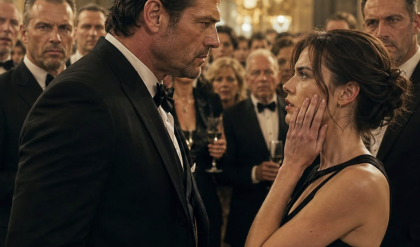
A husband handed his wife divorce papers in front of 300 guesTS. His mistress stood beside him in a silver gown
PART 1 — THE NAME THEY NEVER LEARNED
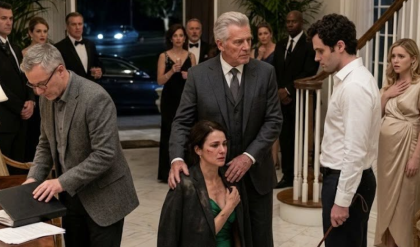
My husband handed me divorce papers in front of three hundred guests while his mistress stood beside him wearing my diamonds.
Not borrowed diamonds.
Not family diamonds.
Mine.
The emerald necklace at Vanessa Vale’s throat had belonged to my grandmother, though Charles Whitaker had once told me it was “too severe” for a woman like me.
Apparently it looked less severe on a twenty-nine-year-old in a silver gown who smiled as if she had already taken my chair, my house, my future, and the last seven years of my life.
The ballroom of the Grand Meridian glittered around us.
Chandeliers.
Champagne.
Cameras.
Old money pretending not to enjoy cruelty.
Every table held people who had kissed my cheek at Christmas, called me darling at fundraisers, and accepted my handwritten thank-you notes after I hosted their daughters, their widowed sisters, their sick husbands, and their political ambitions.
Now they watched me the way people watch a glass falling.
Waiting for the break.
Charles stood on the small stage near the orchestra with one hand on the microphone and the other resting lightly against Vanessa’s back.
He looked handsome.
He always did when he was hurting someone in public.
His tuxedo fit like power.
His silver hair touched his temples just enough to make women call him distinguished and men forgive him everything.
“My friends,” he said softly, “this is not the announcement I expected to make tonight.”
Liar.
He had rehearsed it.
His mother, Margaret Whitaker, sat at the front table with her arms folded and her pearls glowing against her black dress.
She had planned the seating chart herself.
She had placed me where every camera could catch my face.
She wanted tears.
She wanted proof.
She wanted the world to see that Caroline Whitaker had finally been removed from the family like an unsuitable stain.
Charles lowered his voice.
“Caroline and I have reached the difficult decision to end our marriage.”
The room inhaled.
I did not.
Beside him, Vanessa lowered her eyes and pressed two fingers delicately beneath one eyelash.
A performance.
A poor one.
Charles turned toward her.
“And after years of private unhappiness, I have finally found peace with someone who understands the life I was born to lead.”
That was when the room turned toward me.
Not slowly.
Not subtly.
All at once.
Three hundred faces.
Three hundred judgmenTS.
Three hundred hungry little silences.
I sat alone at table seven beneath a tower of white roses, wearing a dark blue gown Charles had not noticed when I came downstairs.
My hands rested in my lap.
My wedding ring felt cold around my finger.
For seven years, I had sat quietly beside him.
Quietly.
That was the word everyone used.
Caroline is quiet.
Caroline is graceful.
Caroline is lucky.
They never understood that quiet women hear everything.
I heard Margaret tell Charles I was too old to give him a child.
I heard Charles laugh when Vanessa called me “the museum piece.”
I heard the family attorney warn them that humiliating me publicly might look distasteful.
I heard Margaret answer, “Good.
Distasteful is memorable.”
So when Charles lifted the black leather folder, I was not surprised.
“The documents have been prepared,” he said.
“Fairly.
Respectfully.
Privately, until now.”
Privately.
I almost smiled.
A waiter beside me looked as if he might faint.
I touched his sleeve.
“My coat, please.”
The poor young man blinked.
“Ma’am?”
“My coat.”
The room grew strangely still.
I stood.
Not quickly.
Not dramatically.
I stood the way my mother had taught me to stand in church, with my shoulders straight and my grief between myself and God.
Then I walked to the stage.
Charles watched me with a flicker of satisfaction.
He mistook composure for surrender.
Men like Charles always did.
He offered the folder.
“I know this is difficult.”
“No,” I said.
“You don’t.”
The microphone caught it.
A few guests shifted in their chairs.
Vanessa’s smile tightened.
I opened the folder.
The agreement was exactly what I expected.
The house would remain in the Whitaker family.
The foundation seat would return to Margaret.
My access to trust properties would end within thirty days.
I would accept a generous settlement.
I would keep confidentiality.
I would disappear politely.
They had built the document like a coffin.
They forgot to check who owned the cemetery.
I flipped to the final page.
The signature line waited.
Caroline Whitaker.
That was the name they knew.
The name they had used on invitations and place cards and donation plaques.
The name they had allowed me to borrow.
I took the pen.
Then I signed the name they had never bothered learning.
Caroline Elise Harrow Ashford.
The moment my pen left the paper, Charles frowned.
Just slightly.
It was beautiful.
He knew something had moved, though he did not yet know what.
Vanessa leaned closer to see.
Margaret leaned forward.
I closed the folder and handed it back.
“Congratulations,” I said.
Then I turned and walked toward the ballroom doors.
No one spoke.
The waiter stood there with my coat, white-faced and trembling.
“Thank you,” I whispered.
He helped me into it as if I were royalty fleeing a burning palace.
Behind me, Charles’ phone rang.
He ignored it.
It rang again.
Then Margaret’s phone lit up.
Then his uncle Preston’s.
Then the family attorney’s.
Then the phones of three board members seated near the stage.
One ringtone became five.
Five became twelve.
The sound spread through the ballroom like birds startled from a tree.
I kept walking.
Margaret answered first.
“What?”
Her voice sliced through the room.
Then she stood.
“What do you mean frozen?”
I reached the doors.
I did not turn around.
A black car waited outside beneath the hotel awning.
Snow fell in thin silver threads through the city lighTS. My driver, Henry, opened the door.
Inside sat Jonathan Reeves.
Eighty-four years old.
Trustee.
Family ghost.
The only man in Boston who had waited longer than I had.
His cane rested across his knees.
His white hair was combed neatly back.
In his lap sat an old red folder sealed with wax.
He looked at me.
“Did you sign?”
“Yes.”
“With the full name?”
“Yes.”
He closed his eyes once.
Not relief.
Recognition.
“Then they triggered it themselves.”
I looked back at the hotel.
Through the glass, I could see movement.
Panic.
People standing.
Charles searching for someone to blame.
Vanessa no longer smiling.
Margaret shouting into her phone.
For the first time that evening, I felt something close to sadness.
Not for them.
For the woman I had been.
The woman who once believed being patient meant being kind.
“What happens now?” I asked.
Jonathan opened the red folder.
“Now, Mrs. Ashford, we find out who still remembers your father.”
I turned to him.
“My father?”
He did not answer.
That was the first small cliffhanger.
And the first time that night my hands began to shake.
PART 2 — THE FROZEN ACCOUNTS
By midnight, the Whitakers arrived at the trust offices looking less like a dynasty and more like survivors of a shipwreck.
Margaret came first.
Pearls still perfect.
Face not.
Charles followed with Vanessa attached to his arm, though she looked as if she wanted to be anywhere else.
Her silver gown caught the fluorescent lights and turned cheap in the hallway.
Behind them came Preston Whitaker, two board members, the family attorney, and a financial officer who had sweated through his collar.
They stopped at the conference room door.
Because I was already inside.
At the head of the table.
Jonathan sat on my right.
My attorney, Ruth Bellamy, sat on my left.
In front of us were documents the Whitakers had spent decades pretending were ceremonial.
Old trust papers.
Property deeds.
Foundation charters.
Succession amendmenTS.
The bones of the empire.
Charles looked at me as if I had broken into his house.
“What is this?”
Ruth answered before I could.
“A trust compliance review.”
Margaret laughed once.
It sounded like a glass cracking.
“You think you can frighten us with paperwork?”
Jonathan lifted his eyes.
“No, Margaret.
Paperwork is what frightened your banker, your auditor, your insurance carrier, and three members of your board in the last forty-eight minutes.”
No one sat.
So I did not invite them again.
Charles tossed the leather divorce folder onto the table.
“You signed.”
“I did.”
“You accepted the agreement.”
“I accepted the dissolution of the marriage.”
His eyes narrowed.
“Do not play word games with me.”
“Then stop playing empire games with me.”
The room went quiet.
Vanessa looked from him to me, suddenly unsure which woman had been foolish.
The family attorney cleared his throat.
His name was Gerald Moss.
He had been old when I married Charles and ancient now.
His hand shook as he removed a folded document from his briefcase.
“I received this from the archive vault at 11:08 tonight.”
Margaret turned on him.
“You received what?”
Gerald unfolded the document.
“A trust amendment executed by Theodore Whitaker in 1986.”
Charles frowned.
“My grandfather?”
Jonathan nodded.
“The founder of the modern Whitaker Trust.”
Gerald’s mouth had gone dry.
“The amendment states that if a marital dissolution involving a registered Ashford descendant occurs by coercion, public humiliation, reputational force, or prearranged financial displacement, all Whitaker-controlled assets connected to the Ashford-Harrow acquisition are to be frozen pending ownership review.”
Vanessa whispered, “Ashford?”
Margaret’s face changed.
Not much.
Enough.
Charles noticed.
“Mother?”
She did not answer him.
I did.
“My full name is Caroline Elise Harrow Ashford.”
Charles stared.
“That means nothing.”
Jonathan leaned forward.
“It means everything.”
Ruth opened a second folder.
“In 1989, Whitaker Holdings absorbed Harrow House Hotels after the death of Caroline’s grandfather, Walter Harrow Ashford.
That acquisition provided the real estate base for the Grand Meridian, the Atlantic properties, and the trust collateral your family has borrowed against for nearly thirty-seven years.”
Charles shook his head.
“No.”
“Yes,” I said quietly.
He looked at me with disgust.
“You knew?”
“For three weeks.”
That was not entirely true.
I had suspected for years.
But suspicion is smoke.
Documents are fire.
Three weeks earlier, I had found the first clue in a box of my mother’s things: a letter from a man named Theodore Whitaker, apologizing for “what was taken under grief.” I had brought it to Jonathan because my mother had written his name on the back.
Ask Jonathan when you are ready.
I had not been ready.
Then I found Vanessa’s earring in Charles’ car.
Readiness became less important.
Margaret placed one hand on the table.
“You have no claim.”
Ruth slid a copy toward her.
“She may have the strongest claim in the room.”
“No court will entertain this.”
“Then why are the accounts frozen?” I asked.
Margaret’s eyes cut into mine.
For seven years, she had looked at me as if I were temporary.
Now she looked at me as if I were an old debt.
Charles turned toward her.
“Mother.
What is she talking about?”
Margaret said nothing.
That silence did more damage than any confession.
Vanessa stepped away from Charles by half an inch.
Small movement.
Large meaning.
I saw it.
So did Margaret.
Ruth continued.
“The public divorce event, the prepared settlement, the reassignment of Foundation authority, and the attempted displacement of Mrs. Ashford from trust-controlled property activated the protective clause.”
Gerald whispered, “It was automatic.”
Charles slammed his hand on the table.
“Automatic? My accounts are frozen because of her maiden name?”
Jonathan’s voice went cold.
“Because your family built wealth on hers and then tried to humiliate her out of the legal structure that protected it.”
For the first time, Charles looked at me with something beneath anger.
Fear.
Not enough.
But a beginning.
Margaret finally spoke.
“What do you want?”
The question did not surprise me.
It disappointed me.
Even now, she thought this was a negotiation.
“I want the truth.”
She smiled bitterly.
“Truth is expensive.”
“So was silence.”
The room breathed around us.
Then Vanessa’s phone buzzed.
She looked down.
Her face drained.
Charles snapped, “Not now.”
But she did not look at him.
She looked at me.
For the first time all night, the mistress seemed truly afraid.
Not embarrassed.
Not jealous.
Afraid.
She slipped the phone into her purse with trembling fingers.
Margaret noticed.
“What is it?”
“Nothing.”
Charles grabbed her wrist.
“What is it?”
Vanessa pulled away.
The motion was sharp.
Instinctive.
Practiced.
A bruise beneath the bracelet flashed purple under the lighTS.
I saw it.
So did Ruth.
So did Margaret.
Nobody spoke.
Vanessa looked at me, and something passed between us that I did not want.
Recognition.
Women know certain silences.
Charles leaned down.
“Vanessa.”
She flinched.
That told me more than her text.
Ruth stood.
“This meeting is suspended until morning.
No trust assets will be released.
No properties may be transferred.
No family officer may remove or destroy documenTS.”
Margaret laughed.
“You are ordering us?”
“No,” Ruth said.
“The court order will arrive at 8:00.”
Charles turned toward me.
“You think this makes you powerful?”
“No,” I said.
“I think it makes you visible.”
His face hardened.
There was the man beneath the tuxedo.
The man I had lived with.
The man who apologized in public and punished in private.
He leaned close enough that only I could hear.
“You should have taken the money.”
I looked at him.
“I never needed it.”
Something shattered in his expression.
Not love.
Possession.
As they left, Vanessa lingered near the door.
Margaret called her name, but she stayed one second longer.
Her hand slipped into the pocket of my coat hanging near the chair.
Then she walked out.
I waited until the elevator doors closed.
Inside my pocket was a hotel keycard.
And on the back, written in shaky black ink:
Room 1217.
He lied about the child.
I stared at it.
The child.
Charles and I had no children.
Vanessa was not showing.
Yet.
Jonathan saw my face.
“What is it?”
I closed my hand around the card.
“The larger lie.”
PART 3 — THE CHILD WHO COULD NOT EXIST
I went to Room 1217 at 2:40 in the morning.
Ruth told me not to.
Jonathan told me to bring security.
I brought neither.
There are moments in a woman’s life when caution feels like another word for obedience.
I had obeyed enough.
The hotel hallway was silent.
Thick carpet swallowed my footsteps.
Somewhere behind one door, someone laughed too loudly.
Somewhere behind another, a shower ran.
The world had continued being ordinary after my life split open.
Room 1217 was at the end of the hall.
The keycard worked.
Vanessa stood inside wearing a hotel robe and no makeup.
Without diamonds, without silver silk, without Charles’ hand at her back, she looked younger.
And older.
Fear does that.
“You came,” she said.
“You left me a key.”
“I wasn’t sure you would.”
“I wasn’t sure either.”
She stepped aside.
The room smelled of roses and panic.
On the desk sat a half-packed suitcase, two bottles of water, a legal envelope, and a pregnancy test wrapped in tissue like evidence.
I looked at it.
She looked away.
“How far along?” I asked.
“Eleven weeks.”
The words struck differently than I expected.
For years, Margaret had measured me by absence.
No son.
No daughter.
No heir.
No continuation.
I had endured polite questions, cruel suggestions, doctors I did not choose, prayers I did not request.
Charles had stood beside me in clinics with a face full of boredom and called himself supportive.
Now his mistress carried a child.
I waited for jealousy.
What came instead was suspicion.
“Is it Charles’?”
Vanessa sat on the edge of the bed.
“No.”
There it was.
The first truth from her mouth.
“Then whose?”
She looked at the legal envelope.
“Preston’s.”
I went very still.
Preston Whitaker.
Charles’ uncle.
Margaret’s younger brother.
The charming one.
The family fixer.
The man who had toasted my marriage and kissed my forehead at Christmas.
Vanessa swallowed.
“He told me he was divorced.”
“He is.”
“He told me Charles knew.”
“He probably did.”
She looked up sharply.
That was when I understood.
The affair with Charles had not begun as an affair.
It had been arranged.
A younger woman.
A pregnant woman.
A useful woman.
A woman who could be presented as Charles’ future and Preston’s mistake erased.
“Charles planned to claim the baby,” I said.
Vanessa nodded.
“Why?”
Her laugh was small and broken.
“Because Preston’s trust has a bloodline clause.
If he has another child, half his voting shares move into a protected inheritance trust.
Charles needs those shares before the annual board election.”
The room seemed to tilt.
Of course.
Not romance.
Control.
Not desire.
Voting shares.
My marriage had not been ended for love.
It had been sacrificed for corporate mathematics.
“Did Preston know you were pregnant?”
“Yes.”
“Where is he?”
Vanessa’s eyes filled.
“I don’t know.”
The answer chilled me.
“He disappeared yesterday morning.
Charles said he went to Maine.
Preston never goes to Maine in winter.”
 PART 3 — THE MESSAGE THAT DESTROYED HIS LAST LIE
She handed me the envelope.
Inside were texts, medical records, and a photo of Preston holding Vanessa’s hand outside a clinic.
I wanted to despise her.
Part of me still did.
But disgust has limits when fear enters the room wearing bruises.
“What did Charles do to your wrist?” I asked.
Her hand covered the bruise.
“He grabbed me.”
“Only once?”
She did not answer.
Women know certain answers too.
A soft knock sounded at the door.
Three times.
Vanessa froze.
I did not move.
The knock came again.
A voice followed.
“Caroline.”
Margaret.
Vanessa whispered, “Don’t open it.”
I opened it anyway.
Margaret stood alone in the hallway wrapped in a black cashmere coat over her evening dress.
Her pearls were gone.
Without them, she looked less like a queen and more like an old woman trying not to bleed.
“How did you know I was here?” I asked.
“I have known where women hide in this family for forty years.”
I let her in.
Vanessa backed toward the window.
Margaret looked at the suitcase, then the documents, then the pregnancy test on the desk.
Her face did not change.
But her hand moved to the back of a chair for balance.
“So it is true.”
“You knew?” I asked.
“I suspected.”
“About Preston?”
“Yes.”
“About Charles claiming the child?”
Her mouth tightened.
“No.”
For once, I believed her.
Margaret turned toward Vanessa.
“Did Preston give you anything?”
Vanessa hesitated.
Margaret’s voice sharpened.
“Think carefully, girl.
If my son is doing what I believe he is doing, sentiment will not save you.”
Vanessa reached into her suitcase and removed a small velvet box.
Inside was not jewelry.
It was a brass key.
Old.
Heavy.
Stamped with the letters H.H.A.
My initials.
Or almost.
Harrow House Ashford.
Margaret exhaled.
“Oh God.”
“What is that?” I asked.
She looked at me, and for the first time in seven years, Margaret Whitaker looked ashamed.
“It opens the west archive beneath the original Harrow hotel.”
“The Grand Meridian?”
“Yes.”
“What is in it?”
Margaret closed the box.
“The documents your family died trying to protect.”
I felt the room go cold.
“My family?”
She looked at the floor.
“Your grandfather did not simply lose the company, Caroline.”
I waited.
The snow tapped softly against the window.
Margaret lifted her eyes.
“He was murdered before he could stop the sale.”
PART 4 — THE ARCHIVE BENEATH THE HOTEL
The Grand Meridian had a basement no guest ever saw.
Below the kitchens.
Below the laundry.
Below the wine storage and staff corridors.
There was an old iron door hidden behind a wall of shelves where banquet linens were stored in plastic-wrapped stacks.
Margaret led us there before dawn with the key in her gloved hand and a face like stone.
Vanessa came because she refused to be left alone.
I came because my life had become a locked room.
Ruth met us at the service entrance with a private investigator named Leo Marston, a retired federal prosecutor with sad eyes and a limp.
Jonathan arrived last, leaning heavily on his cane.
When he saw the key, he whispered, “Walter kept it.”
Margaret looked at him.
“You knew?”
“I knew there was an archive.
I did not know who still had access.”
We stood in the narrow storage corridor with steam pipes hissing above us.
The hotel pulsed overhead with sleeping guests, blinking cameras, and the remains of a ruined gala.
Margaret pushed aside the linen racks.
The iron door waited behind them.
H.H.A.
Harrow House Ashford.
My grandfather’s mark.
The key turned with a sound like a throat clearing after decades of silence.
Inside was a room built to outlive betrayal.
Metal cabinets lined the walls.
Old ledgers filled the shelves.
Boxes were labeled by year, property, trustee, and family name.
The air smelled of dust, paper, iron, and something faintly sweet.
Decay, maybe.
Or old perfume.
Jonathan reached for a cabinet marked 1989.
His hand trembled.
“Walter called me two days before he died,” he said.
“He said Theodore Whitaker had betrayed the agreement.”
Margaret flinched at her father’s name.
“He said he had proof the acquisition was fraudulent,” Jonathan continued.
“The next morning, Walter fell from the north balcony.”
My grandfather’s death had always been described as an accident.
A winter slip.
A tragedy.
A wealthy old man alone with grief.
I had been eight.
I remembered my mother receiving the call and folding in half at the kitchen table without making a sound.
Now I stood under the hotel he built and realized childhood grief had been edited.
Ruth opened the first file.
Then the second.
Then the third.
Her expression changed with each page.
“Caroline,” she said.
I joined her.
There were transfer documenTS.
Board minutes.
Medical records.
Police reporTS.
Life insurance communications.
And a letter from my grandfather addressed to my mother.
Eleanor, if anything happens to me, do not trust the Whitakers.
Theodore has discovered the blood clause.
They will try to take the hotels through debt, grief, and marriage if they must.
Marriage.
The word seemed to rise off the page.
I read further.
The Harrow-Ashford estate was protected by a descendant clause.
If control was ever transferred under fraud, duress, or concealment, ownership could revert through the nearest living Ashford descendant upon proof of coercion.
I was the nearest living descendant.
Charles had married me after learning it.
Not because he loved me.
Not because I was quiet and graceful and useful.
Because I was legal exposure.
The realization did not stab.
It emptied.
Seven years of birthdays.
Seven anniversaries.
Christmas mornings.
Shared beds.
His hand on my back in public.
His voice in the dark saying, “You’re safe with me.”
All strategy.
All containment.
Margaret covered her mouth.
“He knew before the wedding,” I said.
Jonathan closed his eyes.
“I am sorry.”
I turned to Margaret.
“Did you?”
She did not speak.
That was answer enough.
The room shrank around me.
“You let him marry me to control my claim.”
Margaret’s eyes filled.
“I thought it would protect the family.”
“From what?”
“From ruin.”
“No,” I said.
“From truth.”
Vanessa began to cry quietly behind us.
I almost hated her for witnessing it.
Then Leo Marston opened a sealed envelope.
“Everyone needs to see this.”
Inside was a videotape converted to a digital drive.
Ruth plugged it into her laptop with hands that had stopped pretending calm.
The screen flickered.
A man appeared.
White-haired.
Thin.
Sitting in what looked like a hospital room.
My breath stopped.
“Grandfather,” I whispered.
But Walter Harrow Ashford had died thirty-seven years ago.
The date stamp on the video was eighteen months old.
The old man looked directly into the camera.
“Caroline,” he said.
My knees nearly gave way.
Jonathan caught my arm.
The dead man continued.
“If you are seeing this, then Theodore’s house has finally turned on you.”
Margaret made a sound like prayer breaking.
The video played on.
“I did not fall from the balcony.
I survived.
Theodore hid me first, then Charles found out years later and kept me hidden because my death preserved the transfer.
Jonathan was told only what he needed to protect you.
Your mother believed I died.
I allowed that lie because I was told your lives depended on it.”
The room blurred.
My grandfather was alive.
Alive.
And Charles had known.
Walter leaned closer to the camera.
“The final ownership clause requires three things.
My living testimony.
Your full legal signature.
And evidence that a Whitaker attempted to remove you from the marriage under coercive public terms.”
A bitter laugh escaped me.
The ballroom.
The cameras.
The divorce papers.
Charles had triggered the very proof he had tried to avoid.
Walter’s voice weakened.
“There is one more truth.
Charles is not Theodore’s true heir.
Margaret’s firstborn son died at birth.
Charles was adopted privately from a woman Theodore paid to disappear.
The family hid it to preserve control.
He has no blood claim to the Whitaker Trust.”
Margaret collapsed into a chair.
Vanessa gasped.
I stared at the screen.
The largest secret was not mine.
It was his.
Charles Whitaker had spent his life worshiping bloodlines he did not belong to.
Walter looked tired now.
But his eyes were clear.
“Caroline, if you choose to sign the restoration order, the hotels return to you, the illegal trust transfers collapse, and the victim compensation fund activates.
But understand this.
You will not inherit an empire.
You will inherit the duty to dismantle one.”
The video ended.
No one moved.
Above us, footsteps thundered in the corridor.
Leo lifted his head.
The iron door flew open.
Charles stood there in his tuxedo, ruined and pale, with Gerald Moss behind him and two private security men blocking the exit.
His eyes went first to the laptop.
Then to me.
“You opened it,” he said.
I closed the computer.
“No, Charles.
You did.”
PART 5 — THE WOMAN WHO ENDED THE EMPIRE
Charles looked less handsome with fear on his face.
For years, I had watched rooms lean toward him.
Bankers smiled before he finished sentences.
Women softened their voices.
Men laughed too quickly.
His mother corrected the world around him so he never had to feel ordinary.
Now he stood in the archive beneath a hotel his family had stolen, staring at proof that he was not the prince of anything.
“You have no idea what you’re doing,” he said.
It was almost tender, how familiar the words were.
He had said them when I questioned a foundation budget.
When I changed the household staff schedule.
When I refused one of Margaret’s doctors.
When I asked why our marriage had more locked rooms than conversations.
You have no idea what you’re doing.
I looked at the cabineTS.
The files.
The frightened mistress.
The broken mother.
The trustee who had carried guilt longer than I had carried a name.
“I think I finally do.”
Charles stepped forward.
Leo moved between us.
One of Charles’ security men reached inside his jacket.
Ruth said calmly, “Federal agents are upstairs.”
Charles laughed.
“No, they are not.”
Then the elevator bell sounded in the service corridor.
Once.
Twice.
The sound was small.
The effect was not.
Leo smiled without warmth.
“Yes,” he said.
“They are.”
Charles turned toward Gerald Moss.
The old attorney would not meet his eyes.
That betrayal hit him harder than mine.
“You called them?” Charles whispered.
Gerald’s voice broke.
“I should have called them thirty years ago.”
Federal agents entered through the linen corridor moments later.
Quiet.
Efficient.
Unimpressed by chandeliers, family names, or tuxedos at dawn.
Charles did not run.
Men like Charles do not imagine consequences quickly enough.
They arrested him for obstruction, financial fraud, witness concealment, and conspiracy related to the Harrow acquisition.
More charges would come later.
Many more.
As they took him past me, he stopped.
“You loved me.”
It was the cruelest thing he could have chosen to say.
Because it was true.
I had loved him.
Not wisely.
Not safely.
But truly.
And that truth deserved more respect than his betrayal had given it.
“Yes,” I said.
“I did.”
His face shifted.
For one second, I saw panic.
Not about prison.
About being unloved.
Then I finished.
“That was never your power.
It was my gift.”
They led him away.
Margaret sat in the archive long after the agents left.
Vanessa wrapped both arms around herself and stared at the floor.
Ruth began organizing documents with the sacred aggression of a woman who had waited her whole career for a case like this.
I went upstairs alone.
The ballroom was empty now.
Staff had cleared the champagne glasses.
The flowers looked tired.
One overturned chair remained near the stage.
A smear of Vanessa’s silver makeup marked the black leather divorce folder where Charles had dropped it.
I stood where he had handed me the papers.
Morning light pressed against the tall windows.
The city was waking.
So was I.
By noon, Walter Harrow Ashford was moved under federal protection from a private medical facility in Vermont to Boston.
He was ninety-one, fragile, and very much alive.
When I entered his room, I expected rage to carry me.
Instead, I found an old man with my mother’s eyes.
That nearly broke me.
“Caroline,” he said.
I stood at the foot of the bed.
“You let us mourn you.”
Tears filled his eyes.
“Yes.”
“You let my mother die believing she was alone.”
His face crumpled.
“Yes.”
“You let me marry into the family that stole from us.”
“I tried to stop it.”
“No,” I said.
“You tried to manage it.”
Silence.
Good.
Old men build empires out of decisions they call sacrifices.
Women are left to live inside the ruins.
Walter reached toward me with one shaking hand.
I did not take it.
Not yet.
“I am sorry,” he whispered.
It was not enough.
But it was true.
And truth was the first clean thing anyone had handed me in years.
Weeks passed.
Then monThS.
The Whitaker empire did not collapse all at once.
It cracked in hearings, court filings, resignation letters, frozen transfers, surrendered emails, and late-night news reporTS. Preston was found alive in a coastal house in Maine, drugged but breathing.
He testified.
Vanessa testified.
Gerald testified.
Margaret testified last.
She looked smaller on the witness stand.
But not weak.
When the prosecutor asked why she had allowed Charles to marry me, Margaret closed her eyes.
“Because I mistook family preservation for love.”
It was the only honest thing I had ever heard her say.
Vanessa gave birth seven months later to a son.
Preston claimed him publicly, then placed his voting shares into an independent trust for the child, just as the original clause required.
Vanessa did not become a Whitaker wife.
She became something better.
Free.
We were not friends.
Not then.
Maybe never fully.
But when she sent me a photograph of the baby wrapped in a blue blanket, I sent back one sentence.
May he inherit kindness instead of power.
She replied:
That is the plan.
As for Charles, he wrote to me from federal custody three times.
I opened none of the letters.
Then one came with no return address.
Inside was a single page.
You destroyed everything.
I read it once.
Then I turned it over and wrote:
No.
I signed where you told me to.
I mailed it back.
One year after the gala, the Grand Meridian reopened under its original name.
Harrow House.
Not as a monument to wealth.
As a foundation-owned hotel, shelter network, legal aid center, and transitional housing fund for women over fifty leaving financially abusive marriages.
That was Ruth’s idea.
And mine.
And, quietly, Margaret’s.
She donated her pearls.
We auctioned them for enough money to fund the first twenty-seven apartmenTS.
On opening night, I stood in the restored ballroom beneath the same chandeliers.
But the room felt different.
No cameras waiting for humiliation.
No mistress in stolen diamonds.
No husband rehearsing my disappearance.
On the walls hung photographs of women beginning again.
Widows.
Grandmothers.
Retired nurses.
Teachers.
Women with silver hair and new keys in their hands.
Women who had been told they were too old to start over.
They were not.
Margaret approached me near the stage.
She wore a plain black dress and no jewelry.
“I was cruel to you,” she said.
“Yes.”
“I was afraid of losing the family.”
“You did lose it.”
She nodded.
Then I looked around the room.
Children laughing near the dessert table.
Women signing housing applications.
Volunteers carrying flowers.
Walter in a wheelchair near the window, weeping silently as a choir sang an old hymn my mother used to love.
“No,” I said.
“We changed what family means.”
Margaret covered her mouth.
For the first time, I touched her arm.
Not forgiveness.
Not yet.
But something less sharp.
Later, when the music began, Vanessa arrived quietly with the baby.
Preston walked beside her, older and humbler than I remembered.
She wore a simple green dress.
No silver.
No diamonds.
She paused when she saw me.
“I almost didn’t come.”
“I know.”
She looked at the ballroom.
“I thought I was entering an empire.”
“So did I.”
Her eyes filled.
“What was it really?”
I looked at the stage where Charles had tried to erase me.
Then at the women waiting in line for keys.
“A locked house,” I said.
“And we found the door.”
Near midnight, I stepped outside onto the terrace.
Snow was falling again.
Soft.
Silver.
The same as the night Charles handed me the papers.
Walter’s nurse pushed his wheelchair beside me.
He asked for a few minutes alone.
I almost refused.
Then I remembered that healing does not always arrive because someone deserves it.
Sometimes it arrives because you are tired of guarding the wound.
He looked out over the city.
“Your mother would be proud.”
I let the words enter slowly.
“She deserved to know you lived.”
“Yes.”
“So did I.”
“Yes.”
He did not defend himself.
That helped.
After a long while, he handed me an envelope.
“I wrote this years ago.
But you may decide whether to read it.”
I looked at the envelope.
My name was written in my mother’s handwriting.
Not his.
My breath caught.
“She left it with me before everything happened,” Walter said.
“She said you would know when you were ready.”
I almost opened it there.
I did not.
Some truths deserve morning light.
Inside the ballroom, applause rose.
Another woman had received keys to an apartment.
Another life had shifted.
Another door had opened.
I tucked my mother’s letter against my heart.
Then my phone buzzed.
Unknown number.
For a moment, I felt the old fear.
The message read:
You will always be my wife.
Charles.
I stared at it.
Then I smiled.
Not kindly.
Not cruelly.
Freely.
I typed back:
No, Charles.
I was your evidence.
Then I blocked the number.
When I returned to the ballroom, the orchestra had begun a slow waltz.
No one asked me to dance.
No one needed to.
I walked alone to the center of the floor where three hundred guests had once waited to see me break.
This time, three hundred people watched me stand.
Not as Mrs. Whitaker.
Not as a discarded wife.
Not as a hidden Ashford.
As Caroline.
The woman who signed a divorce paper and unlocked a buried empire.
The woman who learned that patience was not weakness.
The woman who did not keep the power.
She returned it.
And that was the twist Charles never understood.
I had not wanted his throne.
I had wanted the doors opened for every woman he would have locked outside.