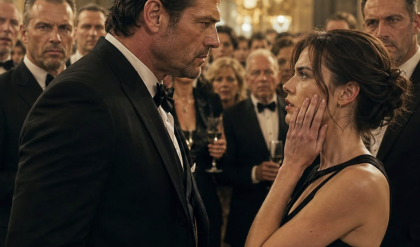
Gloating as they publicly mocked his wife, the cheating husband and his mistress instantly panicked when her billionaire royal father entered, making the world’s most powerful CEOs bow in deep, trembling submission.
Loading ad…
Continuing with part 3 of the story.
“That’s impossible.”
“It was expensive.
Not impossible.”
“You can’t call it in.”
Arthur’s cane tapped once.
“I already did.”
The first gasp came from a hedge fund manager near the bar.
Then another.
Then a cluster of men near the front row began typing frantically.
Sterling Industries shares halted after after-hours collapse.
Debt recall sends company into crisis.
Kensington Holdings takes control position.
Sebastian looked at his phone.
His color drained.
“No,” he whispered.
Arthur walked toward the stage.
“You built your empire on leverage, Mr. Sterling.
The penthouse.
The yacht.
The cars.
Even that foundation gala.
All collateral.
All borrowed against stock whose value depends on confidence.
And confidence, as you just demonstrated, is fragile.”
Sebastian gripped the podium.
“I’ll sue you.”
“With what money?”
The room inhaled.
Sebastian looked toward his board.
“Tell him,” he demanded.
“Tell him who I am.”
No one spoke.
The CEO of Chase looked down at his champagne.
Senator Wilcox turned his face away.
Preston Hale, Sebastian’s CFO, suddenly seemed fascinated by his cuff links.
That is something people rarely admit about power.
It is not loyalty.
It is proximity to advantage.
When advantage moves, so do the loyal.
Arthur stopped beside Isabelle.
“My daughter,” he said, “entered your life without name, fortune, or guards because she wanted to be loved for herself.
You had the rarest privilege a man can receive: the love of a woman who asked nothing from you but decency.”
His voice hardened.
“And you failed the easiest test in the world.”
Sebastian came down from the stage, his mask collapsing.
“Belle,” he said.
Isabelle almost flinched at the old nickname.
Almost.
“Please,” he whispered.
“Call him off.”
“You called me a maid.”
“I was angry.”
“You gave my necklace to Tiffany.”
“I was stupid.”
“You stood on that stage and called me dead weight.”
“I didn’t mean—”
“You meant every word when you thought I was poor.”
That stopped him.
Good.
Let it.
Isabelle turned toward Tiffany.
“Tiffany.”
The blonde froze near the exit.
“That necklace belongs to the Sterling estate,” Tiffany said quickly.
“Sebastian gave it to me.”
“The Sterling estate,” Isabelle said, “is now under creditor seizure.
That necklace belongs to Kensington Holdings until ownership is settled.”
Tiffany’s hand flew to her throat.
Arthur’s voice boomed from behind Isabelle.
“Remove it.”
Tiffany’s eyes filled with tears.
“It’s stuck.”
“Then security will remove it.”
Her trembling fingers fumbled at the clasp.
The whole room watched.
The humiliation was slow, precise, and deserved.
Finally, the sapphire fell into Tiffany’s hand.
She dropped it into Isabelle’s palm.
Isabelle did not put it on.
She turned toward the woman who ran the orphanage charity.
A small woman in a gray suit near the back raised her hand uncertainly.
“Catch,” Isabelle said.
The room gasped as she tossed the three-million-dollar sapphire necklace through the air.
The charity director caught it against her chest like a bomb.
“Sell it,” Isabelle said.
“Build the children a library.
At least something good can come from the Sterling name.”
The applause began in the back.
Then spread.
Then roared.
Arthur offered Isabelle his arm.
“Ready, my little lion?”
“One more thing.”
She looked at Sebastian.
“You said the prenup means I leave with what I came with.”
His eyes were red.
“Yes?”
She smiled for the first time all evening.
“I came with the Kensington fortune.
You came with nothing.
Now we are both returning to our original positions.”
Then she walked out while every CEO in the room bowed his head—not to her husband, not to Arthur, but to Isabelle Kensington.
Part 4 — The king outside his own tower
The gala emptied quickly after Isabelle left.
Rich people know when a sinking ship becomes contagious.
By midnight, Sebastian sat alone at the edge of the stage while a janitor swept confetti, broken glass, and the remains of his reputation into a dustpan.
“Sebastian?”
He looked up fast.
Tiffany stood near the exit in her red coat, purse clutched under one arm.
Hope rose in him.
Pathetic, but real.
“Tiffany.
Thank God.”
He stood, smoothing his ruined tuxedo.
“This is temporary.
We can go to the Caymans tonight.
I have accounTS. I’ll rebuild.”
“We?”
Her voice was flat.
He stopped.
“There is no we, Sebastian.”
“Tiff, don’t be dramatic.”
She laughed once.
“I wanted the CEO of Sterling Industries.
Not a broke fraudster hiding from creditors.”
“I made you.”
“And now you’re toxic.”
She pulled out her phone.
“I gave Page Six an exclusive.
How I was manipulated by a narcissistic billionaire.
I’m the victim now.”
He stared.
“You sold me out?”
“In this city, you are either the hero or the victim.
I’m not going down as the villain with you.”
The door closed behind her.
Sebastian walked forty blocks in the rain to 432 Park Avenue after discovering his limousine had vanished.
The driver had seen the news and decided unpaid invoices were no longer worth loyalty.
By the time Sebastian reached the lobby, his tuxedo was soaked, his Italian shoes ruined, his hair plastered to his forehead.
He pushed toward the elevators.
A large hand stopped him.
“Mr. Sterling.”
It was Henry, the night doorman.
Sebastian had walked past Henry for three years without learning his name.
He knew it only because Isabelle used to ask about Henry’s wife, his daughter’s college applications, his knee surgery.
“Move,” Sebastian snapped.
“I’m going upstairs.”
“You don’t have access anymore, sir.”
“Excuse me?”
“The penthouse deed was collateralized through a Kensington-held note.
The locks have been changed.”
“That’s my home.”
Henry’s face remained calm.
“Not according to the legal notice.”
Sebastian’s hands curled.
“My things are up there.”
“They will be boxed and sent to storage in Queens.”
Henry reached under the desk and produced a white envelope.
“Ms.
Kensington left this.”
Sebastian tore it open.
Inside was a cheap brass key and a note in Isabelle’s handwriting.
I kept the lease on your old studio in the Bronx.
Rent is paid for one month.
Consider it severance.
After that, you are on your own.
— Isabelle
His first apartment.
The rat-infested one above a liquor store, where he had once told Isabelle he would never go back.
“Is this a joke?” he whispered.
Henry looked through the glass doors at the growing cluster of paparazzi outside.
“I suggest you leave before they get their shot, sir.”
Sebastian did leave.
Not because he wanted to.
Because for the first time in years, nobody was afraid of him.
The Bronx studio smelled of old paint, radiator heat, and memory.
There was a mattress on the floor.
A metal chair.
A sink that dripped.
No skyline view.
No staff.
No Tiffany.
No Isabelle.
He slept badly.
At dawn, he woke and checked his phone.
Account frozen.
Trading halted.
Board emergency meeting.
SEC inquiry.
Tiffany Banks exclusive: “I escaped a toxic billionaire.”
He threw the phone across the room.
It hit the wall and cracked.
Three months later, after selling his watch, two suitcases of remaining clothes, and a signed baseball he once pretended to care about, Sebastian flew to Paris with a coach ticket and a desperate plan.
Isabelle had an office on Avenue Montaigne now.
The Kensington name opened doors that had once opened for him.
He had to wait three hours in reception.
When she finally allowed him in, he nearly did not recognize her.
Cream suit.
Loose dark hair.
No fear anywhere.
“Hello, Sebastian.”
“You look incredible,” he said.
“I know.
What do you want?”
The bluntness made him wince.
“I lost everything.”
 The Maid Put Her Hand Over the Mafia Boss’s Mouth… Until the Grieving Wife on Live TV Realized the Dead Man Was Watching
“I heard.”
“Your father scorched the earth.”
“You lit the match.”
“I’m living in a motel in Queens.”
“I gave you an apartment.”
“I lost it.”
“That was careless.”
His face twisted.
“Isabelle, please.
I’m sorry.
I see it now.
I see you now.”
No, he didn’t.
She knew it in that instant.
He saw the money.
The safety.
The connection.
The rescue rope.
Not her.
He moved closer.
“We were a team once.
Give me a seed investment.
A small loan.
I have ideas.
We can rule Paris together.”
He reached across the desk.
“I still love you, Belle.”
She looked at his shaking hand and felt nothing.
That was the freedom.
Not rage.
Not revenge.
Nothing.
She opened a drawer and wrote a check.
His eyes lit.
Then he read it.
“Five hundred dollars?”
“Plane ticket.
And a haircut.”
“You have billions!”
“And you once told me five hundred dollars was more than I deserved to spend on a dress.”
His face reddened.
“You’re heartless.”
She stood.
“No.
I’m finished.”
Security entered.
As they escorted him out, he looked back once.
“You’ll regret this.”
Isabelle turned toward the window, Paris glowing beyond the glass.
“I already regret enough.
You are not getting any more.”
The doors closed.
And for the first time in three years, no ghost followed her into the room.
Part 5 — What remained after the fall
One year later, Sebastian Sterling was pouring ice water for a man half his age at Le Bernardin in Midtown Manhattan.
The polyester vest itched.
The shoes hurt.
His hands, once soft and manicured, were red from dish trays and polish.
He had begged for the job after six months of rejections, one motel eviction, and a week sleeping in a shelter where nobody cared he used to be on the cover of Forbes.
“More ice,” the young man at table four snapped without looking up from his phone.
Sebastian froze.
The tone was familiar.
Cruel without effort.
His own voice, returned to him from another mouth.
“Yes, sir,” he said.
He walked back toward the service station, stomach tight.
Above the bar, the television switched to a live press conference outside the United Nations.
Isabelle stood at the podium in a white dress beside Arthur Kensington.
The restaurant quieted.
“The Kensington Sterling Initiative,” Isabelle said, “is pledging one billion dollars to vocational training and youth housing programs.
We believe a person’s beginning should not define the limits of their life.”
A reporter asked why she kept the name Sterling in the initiative.
Sebastian gripped the water pitcher.
Isabelle smiled slightly.
“Because wealth without character is poverty.
The name reminds me what I survived, and what I refuse to become.”
People in the restaurant murmured approval.
“Class act,” someone said.
“To think her ex threw her away,” another replied.
Sebastian set the pitcher down before he dropped it.
Then the front door opened.
Tiffany walked in on the arm of a much older man with a famous temper and three famous divorces.
She wore fur in the wrong season and too much makeup.
The man gripped her arm tightly.
“Smile,” he hissed.
Tiffany’s eyes met Sebastian’s.
For a moment, neither of them moved.
She saw the waiter’s vest.
He saw the hand on her arm.
The two people who once thought they had won stood across a room full of people who would never understand the symmetry.
Tiffany looked away first.
Sebastian felt no joy.
That surprised him.
He felt only exhaustion.
The manager snapped from the kitchen.
“Sterling.
Service.”
Sebastian turned away from the television, from Tiffany, from the ghost of the man he had been.
“Coming.”
In Paris, Isabelle watched the same press conference replay later that night with Arthur in his study.
“You did well,” he said.
“I didn’t want to say his name.”
“You didn’t.
You used it.”
She looked at her father.
For years, she had thought power meant money.
Then she thought power meant revenge.
Now she was learning power could mean choosing what pain became after it passed through you.
Sterling Industries factories had been repurposed to produce low-cost medical equipment.
The headquarters had become a community training center.
The sapphire funded libraries.
The foundation funded shelters.
The name that once humiliated her now fed children.
That felt right.
Not clean.
Right.
Healing is rarely clean.
There were still mornings when Isabelle remembered Sebastian’s voice in the penthouse.
You can’t breed out poverty.
You look like a maid.
You’re convenient.
Those words had rooTS. They did not disappear just because a private jet landed and cameras flashed.
Cruelty lives in the body.
It takes time to evict it.
Some nights, Arthur found her on the balcony staring over Paris.
“I should have come sooner,” he said once.
“I told you not to.”
“I should have ignored you.”
She smiled sadly.
“Yes.
Probably.”
They were learning each other again.
Father and daughter, both older, both guilty in different ways.
Arthur had protected too much.
Isabelle had hidden too long.
Love survived, but it needed new rules.
Two years later, Isabelle visited New York quietly.
No gala.
No cameras.
She went to the old diner in Ohio first, the one where Sebastian had met her.
It had new owners now.
The cook was gone.
The booth was still there.
She sat alone and ordered coffee and pie.
A waitress about twenty-two came over, tired and polite.
“You passing through?”
“Something like that.”
The girl smiled.
“Pie’s good.”
“I remember.”
Outside, trucks passed on the interstate.
Ordinary people ate dinner.
A child spilled ketchup.
A man paid with quarters.
Life went on without diamonds.
Isabelle left a thousand-dollar tip.
Not because she wanted to perform generosity.
Because once, a waitress in that same diner had been trying to understand whether love could exist without money.
The answer was yes.
But not with everyone.
On her final night in New York, Isabelle drove past the Metropolitan Museum.
Another gala was underway.
Flashbulbs.
Gowns.
Men pretending they owned the future.
She did not go inside.
She went instead to the youth center built from Sterling’s old Manhattan office lease.
Teenagers were learning coding in one room, culinary basics in another.
A boy in a stained apron asked if she wanted to taste his soup.
She did.
It was too salty.
She told him kindly.
He laughed and said, “That’s what my grandma said.”
That made her happy in a way no gala ever had.
Years later, when people asked if Sebastian deserved what happened to him, Isabelle always paused.
“I think,” she would say, “he deserved the truth.
The truth was simply expensive.”
She never called herself a victim.
Never called herself a queen either, though the media loved that word.
She was a woman who learned the hardest lesson: if someone only treats you well when they think you have value, they never treated you well at all.
The last time she saw Sebastian was not dramatic.
No rain.
No stage.
No microphones.
He was leaving a recovery meeting in Queens, older, thinner, carrying a paper coffee cup.
She was in a car stopped at a red light.
He looked up.
Saw her.
For one second, the past stood between them.
Then he nodded once.
Not arrogantly.
Not pleading.
Just a small acknowledgment.
She nodded back.
The light changed.
Her car moved forward.
That was enough.
Some stories do not end with forgiveness.
Some end with distance.
Clean, quiet distance.
The kind where you finally stop looking back to see whether the person who hurt you is watching.
Isabelle Kensington had arrived at the gala as a mocked wife in navy Dior.
She left as the daughter of Arthur Kensington, yes.
But more importantly, she left as herself.
And that was the inheritance no man could take.