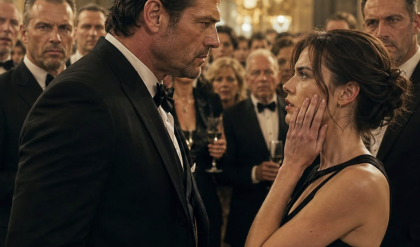
“You’re dead when we get home.” “Bradley Hayes said it so softly that Alice almost smiled, because men like him always believed the quietest threats were the smartest.”,.013
“You’re dead when we get home.” “Bradley Hayes said it so softly that Alice almost smiled, because men like him always believed the quietest threats were the smartest.”
The restaurant did not gasp.
It did something worse.
It went still.
Not silent in the empty sense.
Silent in the way a room becomes silent when everyone has heard violence before and is pretending not to notice it now.
Alice Fitzgerald kept her eyes on the pale swirl of cream in her untouched risotto.
The truffle smell rose from the plate in a warm, expensive cloud, and for one dizzy second it made her think of birthdays, of anniversaries, of all the polished lies people served on white china.
Bradley’s hand stayed locked around her upper arm under the edge of the table, where only she could feel it.
His fingers were hard and efficient, as if her skin were something he had bought and could press into shape.
“Smile,” he murmured without moving his lips.
She did.
Preview
That was the worst part.
Her face obeyed before her pride could argue.
The muscles around her mouth lifted by habit, by training, by survival.
Bradley noticed the smile and mistook it for submission.
He loosened his grip just enough to let the pain bloom slowly instead of all at once.
He looked immaculate.
Gray Brioni suit.
White cuff peeking beneath the jacket sleeve.
Rolex catching the chandelier light in small cold flashes.
The kind of man women turned to look at twice when he entered a room and never thought to be afraid of until it was too late.
Across the aisle, at the next table, Dominic Castelli set down his wine glass with absolute care.
He was older than Bradley by a decade, maybe more, but there was nothing tired in him.
His stillness had weight.
Dark hair, silver at the temples.
A charcoal coat folded over the back of his chair.
Hands that looked calm and could probably ruin someone without rising from the table.
His companion, a lean man in his fifties with the watchful eyes of someone who never forgot a room, was speaking in a low voice about freight routes and union pressure.
Dominic wasn’t listening anymore.
He was looking at Alice.
Not in the way Bradley looked at her.
Not like ownership.
Not even like desire.
Like recognition.
Bradley lifted his glass and smiled without warmth.
“I just don’t understand how you can be so profoundly naive, Alice.”
Her throat tightened around the first response she wanted to give.
The one about the children.
The one about how second graders came into her art classroom carrying grief they did not know how to name, and how paint helped them survive themselves.
Instead she said nothing.
Bradley leaned back, pleased by her silence.
“You spend your afternoons covered in glue and finger paint and call it a profession.
It’s adorable, really.”
The man at the next table had stopped cutting his steak.
Alice heard the tiny drag of silver against porcelain, then nothing.
Bradley continued, enjoying the shape of his own voice.
“When we go to the Harrison gala next week, you’ll wear the black dress I bought you.
You’ll stand beside me.
You’ll thank me when I introduce you.
And you will not embarrass me with one of your little stories about the classroom.
Do you understand?”
“Yes,” she said.
The word tasted like rust.
Bradley’s thumb pressed into the tender underside of her arm.
The pressure was hidden from everyone but her.
A private wound, made public by the tablecloth.
“Louder.”
“Yes, Bradley.”
He let out a quiet breath that almost sounded satisfied.
Then, in a voice so low it barely carried, he said, “You’re dead when we get home.”
It was meant for her.
It landed somewhere else.
Dominic Castelli’s knife stopped halfway to the plate.
His eyes lifted.
Not fast.
Not dramatic.
Just enough.
And in that tiny movement, Alice felt the room change.
A waiter passing behind Dominic slowed without knowing why.
The older man across from him turned his head an inch, then another.
Even the couple at the far end of the room seemed to sense the air had been cut open.
Bradley didn’t notice any of it.
He had spent too long mistaking confidence for invisibility.
He reached for his glass again.
He was still smiling when Dominic spoke.
“Gentlemen,” Dominic said softly to his own table, “give us a minute.”
The companion went still.
A single nod.
No questions.
Dominic rose.
Not in haste.
That would have made it theatrical.
He simply stood, adjusted one cuff, and walked toward Bradley’s table with the kind of contained grace that made people instinctively lower their voices in his presence.
Alice had no time to think.
Only to feel.
The air seemed to thicken around her.
Bradley’s face lost a fraction of its color.
He recognized power when it approached.
He just hadn’t realized it had been seated three feet away.
Dominic stopped beside their table.
“Take your hand off her,” he said.
Bradley gave a short laugh, sharp and disbelieving, as if the world had briefly misbehaved for him.
“Excuse me?”
Dominic looked at Alice first, not Bradley.
“Are you hurt?”
The question hit her harder than the threat had.
No one asked that in Bradley’s presence.
No one.
She opened her mouth.
Nothing came out.
Bradley’s jaw tightened.
“This is private.”
Dominic’s gaze moved back to him.
“Not anymore.”
One of the men by the coat check had shifted closer.
Another was suddenly there too, as if he had stepped out of the wallpaper.
Quiet men.
Expensive suiTS. The kind of men who didn’t announce themselves because they didn’t have to.
Bradley felt it now.
He felt the room leaning away from him.
He released Alice’s arm at last, but too late.
The shape of his fingers remained on her skin, hot and humiliating.
Alice pulled her sleeve down over the bruising mark and wished she could disappear into the lacquered wood of the chair.
Bradley stood halfway.
“Do you know who I am?”
Dominic’s expression didn’t change.
“I know exactly who you are.”
Something in his tone made the neighboring tables pretend very hard to be fascinated by their own wine.
Bradley tried for laughter again, but it came out thin.
“Then you should know this doesn’t concern you.”
Dominic leaned in just enough for only Bradley to hear.
His voice lowered, but it did not soften.
“A man puts his hands on a woman in a room like this, it concerns everybody in it.”
For one breath, no one moved.
Then Bradley did something stupid, which was also predictable: he reached for dominance by forcing a smile.
“She’s my wife.”
The word wife hung in the air like a bruise.
Alice felt her stomach drop through the floor.
She had once believed that word meant shelter.
Now it only meant paperwork and permission and the long legal shadow that made escape feel like a crime.
Dominic’s eyes flicked to her face again.
He saw everything.
The fear.
The shame.
The practiced stillness.
Something ancient and dangerous stirred beneath his control.
“Not tonight,” he said.
Bradley’s nostrils flared.
“This is ridiculous.”
Dominic straightened.
“Call your driver.”
Bradley blinked.
“What?”
Dominic didn’t raise his voice.
He didn’t need to.
“You heard me.”
“Who the hell are you?”
Dominic looked almost amused, which was somehow more frightening than anger.
“A man who’s asking once.”
Bradley’s mouth opened, then closed.
Alice could see him recalculating, trying to salvage the room, the dinner, the illusion of command.
She knew that expression.
She had lived inside it for years.
Bradley always believed there was a version of reality he could still engineer if he spoke confidently enough.
Then Dominic’s companion stood too, just enough for Bradley to catch the outline of him in the mirror behind the bar.
A second shadow.
Bradley saw it and finally understood he was no longer in a private argument.
He was standing on a stage he had not agreed to enter.
He let go of his glass.
The sound of it touching the table was so small, but Alice flinched anyway.
Dominic spoke again, quieter now.
“You will walk out of here.
Alone.
You will not touch her again tonight.”
Bradley’s face had gone pale in a way that looked almost elegant if you didn’t know fear when you saw it.
And then, because he couldn’t help himself, because men like Bradley were addicted to the last word, he said, “You have no idea what she’s involved in.”
Dominic’s eyes sharpened.
Alice felt it before she understood it.
A tiny shift.
A recognition not of threat, but of timing.
“What did you say?” Dominic asked.
Bradley looked from one face to the other, suddenly sensing he had walked into something he could not see.
“You think she’s innocent? You think she hasn’t been lying to me?”
Alice went cold.
The room waited.
Dominic didn’t move, but the stillness around him deepened.
“Explain.”
Bradley’s mouth twitched.
He thought he had found leverage.
“Ask her about her father.”
Alice’s breath caught so hard it hurt.
For a second, the restaurant fell away.
The chandelier lights dimmed.
The clink of cutlery vanished.
There was only the pounding in her ears and the ridiculous, impossible, buried word: father.
She had not heard it attached to her life in years.
Dominic’s gaze cut to her.
And in that look, Alice saw something crack.
Not anger.
Not surprise.
Knowledge.
He knew.
Bradley saw it too and grinned, the ugly grin of a man reaching for a weapon he barely understood.
“Oh,” he said.
“You know her.”
Dominic’s hand moved.
Not fast enough to look panicked.
Fast enough to shut the door on Bradley’s next sentence.
He grabbed Bradley by the back of the jacket and drove him forward into the table with a single brutal motion.
Glasses jumped.
Wine splashed onto white linen.
A woman at the next table gasped into her hand.
Bradley made a sound that was half outrage, half pain, and then the two quiet men by the coat check were there, already taking his arms.
Not a brawl.
Not chaos.
A removal.
Bradley fought for one wild second, face twisted, cuff link scraping the table edge, but the men around him were too controlled, too practiced.
The struggle ended almost before it began.
Dominic didn’t even look winded.
He simply stood over Bradley and said, “You made a very bad mistake.”
Alice stared at the wreck of her dinner and couldn’t decide whether to cry or vomit.
Bradley was dragged away, still hissing threats, still trying to twist his head back toward her.
His eyes found hers one last time, and there it was: panic.
Real panic.
For the first time in years, he understood he might not be the biggest force in the room.
When he was gone, the restaurant remembered how to breathe.
Not normally.
Carefully.
No one clapped.
No one spoke.
Silverware resumed in frightened little taps.
A waiter appeared with a towel and vanished when he saw Dominic’s face.
Alice realized she was shaking only when she tried to stand and nearly didn’t manage it.
Dominic put a hand out, not touching, giving her the choice.
She took it.
 She Slapped the Quiet Woman in Business Class.
By Sunrise, Her Airline Was Bleeding Millions.
His palm was warm, steady, surprisingly human.
“Can you walk?” he asked.
She nodded, though she wasn’t sure it was true.
He led her through a narrow service corridor at the back of the restaurant, away from the staring windows and the polished mirrors and the last echo of Bradley’s voice.
The hallway smelled like onions, bleach, and hot grease.
It was such an ordinary smell that it almost made her cry.
They passed a swinging door, a stack of crates, a tired employee pretending not to see anything at all.
At the rear exit, cold Chicago air hit her face like a slap.
She inhaled and immediately coughed.
Dominic noticed.
“Easy.”
That was all.
One word.
Not calm down.
Not you’re safe now.
Just easy, as if her body were a frightened animal he knew better than to startle.
A black SUV waited by the curb.
The driver did not look up.
Alice stared at the vehicle.
“I’m not getting in that.”
Dominic nodded once, as if he had expected the refusal.
“Fair.”
The fact that he did not argue made her more uneasy than any argument could have.
“I want to go home,” she said, but the word home tasted rotten.
Bradley was there.
Or his things were.
Or the shape of him would be waiting in the dark room like a curse.
Dominic studied her for a second, then asked, “Do you have somewhere else to go?”
The question was so gentle it broke something loose in her chest.
Her sister Emma.
Evanston.
A key hidden under a ceramic frog by the back door.
A couch.
A dog that would bark at her before remembering her smell.
“Yes,” Alice said.
“Good,” Dominic said.
“Then we’ll go there first.”
We.
It was absurd, how much that word mattered.
He drove her himself, one hand on the wheel, the other resting relaxed and ready near the gearshift.
The city slid past in wet gold streaks.
Neon reflected on the windshield.
Traffic lights bled red into the dark.
Alice watched the streets she knew pass by like a life she had almost lived in.
For a long time neither of them spoke.
Then, somewhere near the river, Dominic said, “He hurt you.”
It wasn’t a question.
Alice laughed once, a tiny broken sound.
“That’s a generous word for it.”
He glanced at her, and in the dashboard glow his face looked older, harder, and somehow sadder than before.
“How long?”
She folded her hands in her lap so he wouldn’t see them shaking.
“Long enough that I stopped remembering when it began.”
His jaw worked once.
“Why didn’t you leave?”
She looked out the window at the black water moving beneath the bridge.
“Because every time I tried, he found a new way to remind me he could reach everything I loved.”
Dominic said nothing for a while after that.
When he finally spoke, his voice was rougher.
“Your father’s business.
That was Bradley.”
Alice turned slowly to look at him.
He kept his eyes on the road.
“The debt sale.
The supplier pressure.
The hospital bills that suddenly became impossible.
He made it look like a favor because men like that prefer their cruelty wrapped in paperwork.”
She swallowed.
“How do you know that?”
Dominic’s fingers tightened once on the wheel.
“Because I saw the name.”
He said nothing else.
Her pulse thundered.
The river’s reflection slid over his face and vanished.
The apartment in Evanston was dark when they arrived.
Emma was still at work, bless her stubborn heart.
Alice let herself in, kicked off her shoes, and stood in the hallway like she had forgotten the shape of a home.
Dominic remained by the door, not intruding, not leaving.
He looked wrong in the tiny apartment.
Too large.
Too controlled.
Like a storm trying to pretend it was a guest.
Alice turned on the kitchen light.
The yellow glow found the little signs of life Emma had left everywhere: a mug in the sink, a dish towel over the oven handle, a plant leaning toward the window.
All of it looked painfully tender.
She pressed a hand to her mouth.
Then, because her body had finally decided to stop holding itself together, she slid down the side of the counter and sat on the tile floor.
Dominic crouched at a respectful distance.
“Alice.”
She laughed again, and this time it turned into a sob.
“I don’t know what to do with this,” she whispered.
“I don’t know what happens now.”
His face changed.
Not much.
Just enough.
“Now,” he said carefully, “you breathe.”
She stared at him through tears she had fought for years and lost in one night.
“That’s all?”
“No.” His gaze held hers.
“But it’s the first thing.”
She cried then, quietly and with shame, like someone who had forgotten how much grief a body could carry.
Her knees, her wrists, the ache in her arm, the old bruise she had been pretending was gone, the years of being made smaller until even her hope had learned to whisper.
Dominic didn’t touch her.
He stayed there in the kitchen while she cried like a man guarding a door he had no right to enter.
When the tears finally thinned, he reached into his coat and removed a small envelope.
Alice frowned.
“What’s that?”
For a moment, he looked almost unwilling to give it to her.
“Something your father gave me.”
The words hit like a cold glass of water.
Her father.
The one who had disappeared from the edges of her life after the debt, after the hospital, after the money problems Bradley had promised to solve and then weaponized.
The one whose voice she had not heard in seven years.
The one she had mourned without being allowed to call it mourning.
“He’s alive?” she whispered.
Dominic did not answer immediately.
That pause was answer enough.
She took the envelope with trembling hands and opened it.
Inside was a photograph, old and worn at the edges.
Her mother standing in a summer yard, laughing into the sun.
Beside her, much younger but unmistakable, was Dominic Castelli, holding a little girl in a red cardigan.
The little girl had Alice’s face.
Her breath left her body all at once.
No sound came out.
None at all.
Dominic watched her with a stillness that felt almost sacred and almost cruel.
“Your mother didn’t tell you,” he said softly.
“She wanted you far away from all of this.”
Alice stared at the photograph until the room blurred.
“That’s impossible.”
“No,” he said.
“It’s overdue.”
The world tipped.
She looked up at him, heart hammering so violently it made her vision pulse.
“Who are you?”
His mouth tightened, and for the first time since she had met him, something fragile showed beneath the steel.
“I’m the man who should have come sooner.”
It was not an answer.
It was worse.
He let the silence stretch until it became unbearable, then said, “Your mother asked me to keep you safe if anything happened to her.
I failed.
Your father asked me to wait until you were old enough to decide what you wanted.
I waited too long.
Bradley found you before I did.”
Alice’s fingers clenched around the photograph.
The edge cut her palm.
She barely felt it.
“Why didn’t he tell me?” she asked, meaning her father, meaning the whole ruined chain of men and decisions and secrets that had shaped her life without her consent.
Dominic’s eyes lowered briefly.
“Because he thought keeping you ignorant was the same as keeping you safe.”
Alice laughed through fresh tears, horrified by the sound.
“And you?”
He looked at her then with a kind of brutal honesty that was almost tender.
“I thought watching was enough.”
The sentence landed and kept landing.
Not because it was romantic.
Not because it was simple.
Because it meant he had known.
Maybe not every bruise.
Maybe not every lie.
But enough.
He had been near.
He had seen pieces.
And still she had walked into Bradley’s hands alone.
Her stomach turned.
Not just rescued.
Watched.
The happy relief that had started to settle in her chest cracked immediately, split by something colder.
She had a father.
Maybe.
A father who had not disappeared after all, only stepped into the shadows and left her there.
“Was Bradley lying about me?” she asked, her voice thin.
Dominic held her gaze.
“No.
He was lying about himself.”
She thought of Bradley’s final look in the restaurant.
The fear.
The sudden knowledge that he had miscalculated.
She thought of his threat and the way it had made the room turn.
Then she thought of Dominic’s hand on the steering wheel, calm as a blade.
Thought of the envelope.
The photograph.
The years he had spent close enough to know her name, far enough to let her bleed.
“Did you use him?” she whispered.
He did not flinch.
That was the worst answer of all.
“I used his greed,” Dominic said.
“I did not expect him to find you first.”
Alice stood up so fast the chair legs scraped the tile.
“You don’t get to say that like it makes it better.”
“No,” he said, and for the first time all night, his voice broke around the edges.
“I don’t.”
They stared at each other in the kitchen light, the photograph between them like a relic from a life neither of them had earned.
Outside, somewhere beyond the apartment windows, sirens moved through the city and kept moving.
Emma’s key clinked softly in the lock downstairs.
A door opened.
A familiar voice in the hall.
Life, small and ordinary, pushing its way back in.
Alice looked at the picture again.
Her mother’s laugh.
The child in the red cardigan.
Dominic’s hand, young and protective and impossible.
Then, very softly, she asked, “If I go with you, do I become a secret too?”
For the first time, Dominic looked afraid.
Not of her.
For her.
And that was the final twist of the knife, the thing that made the whole night rearrange itself in her mind: he had not come to claim her.
He had come to ask permission to finally stop hiding her.
He took one slow step forward.
“Only if that’s what you choose.”
Alice looked at the photograph one last time, at the little girl she had been, held by a man who had let her grow up without him, and understood with a sick, clear certainty that the rescue had never been the miracle.
It was the inheritance.
Her hand trembled over the envelope.
Then, from somewhere deep inside all the fear and fury and grief, she lifted her chin.
And in the kitchen light, with her father waiting like a confession and the city breathing outside the glass, Alice smiled for the first time like someone who had decided to survive on purpose.