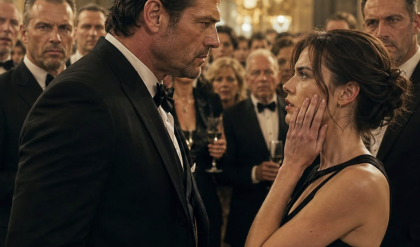
HE KISSED HIS MISTRESS IN FRONT OF EVERYONE—SO HIS PREGNANT WIFE LEFT DIVORCE PAPERS ON HIS DESK AND VANISHED ON A PRIVATE JET..
HE KISSED HIS MISTRESS IN FRONT OF EVERYONE—SO HIS PREGNANT WIFE LEFT DIVORCE PAPERS ON HIS DESK AND VANISHED ON A PRIVATE JET.
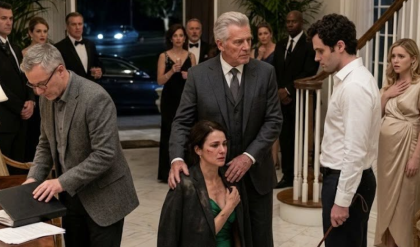
By the time Andrew Weston walked into the ballroom with his mistress on his arm, every camera in Manhattan had already turned toward him.
The Bright Horizons Charity Ball glittered the way expensive things always did when they were trying too hard not to look hollow.
Crystal chandeliers poured warm gold over polished marble, over gowns that cost more than most people’s cars, over faces lifted for photographs and reputations.
The orchestra played something soft and elegant and useless.
Somewhere in the room, ice clicked against crystal.
Somewhere else, a woman laughed too sharply, the sound brittle as broken sugar.
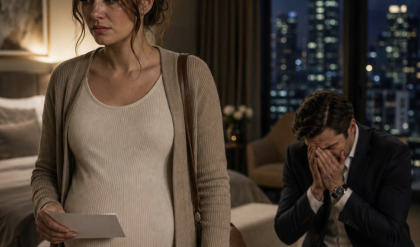
Emma Weston stood near a white column with one hand resting lightly on the curve of her pregnancy.
Six monThS. A visible life.
A visible mistake, if you asked the people who never said it out loud.
She had not come to make a scene.
She had come to watch her marriage die in public.
Andrew crossed the ballroom as if the room had been built to receive him.
Tall, handsome, sharp in a tuxedo cut so well it looked like arrogance tailored into cloth.
His smile was polished and empty and familiar in the way a scar is familiar.
On his arm was Lila Summers, twenty-three, red-haired, radiant, a body made for flashbulbs and headlines.
Her crimson gown clung to her like a dare.
Lila glanced at the room, then up at Andrew, as if every camera in Manhattan were a mirror placed there just for her.
Emma saw the look.
She saw the way Andrew’s hand rested at Lila’s waist too confidently, too intimately, like a man arriving with a prize rather than a date.
She saw the little tightening in the mouths of the people nearest them, the subtle pivot of heads, the private delight of witnesses who loved a ruin as long as it belonged to someone else.
No one spoke to Emma.
A senator’s wife looked at her belly, then away.
A columnist lifted her glass and pretended not to stare.
One of Andrew’s investors gave Emma a sympathetic half-smile that died before it became real.
Andrew laughed at something Lila whispered into his ear.
He tilted his head toward her, indulgent, pleased, as if he were already half somewhere else.
Emma knew that laugh.
Once, she had believed it belonged to her.
Once, it had sounded warm.
Now it sounded like a door locking.
Her phone vibrated inside her clutch.
She didn’t look down.
Across the room, a photographer raised his camera and shouted, “Mr. Weston, over here!”
Andrew turned.
Lila turned with him.
And in the hard white burst of camera flashes, in front of donors, investors, gossip columnists, social climbers, and all the people who would feast on this for weeks, Andrew Weston kissed his mistress on the mouth.
The ballroom went still.
Not silent.
Still.
The kind of stillness that happens when a room understands something has been shattered but hasn’t yet decided how loudly to react.
A fork slipped from someone’s hand and hit the floor.
A woman sucked in a breath through her teeth.
A man near the bar muttered, “Jesus.” The orchestra stumbled, then kept playing as if a faster violin could cover humiliation.
Emma felt her baby move under her palm.
A tiny roll.
A living throb.
It was such a small thing against the violence of the moment that it nearly made her laugh.
Her child, as if answering the room, as if reminding her that life inside her had no interest in spectacle.
Andrew broke the kiss and looked across the room.
Their eyes met.
For one brief second, he seemed almost annoyed to find her there.
Not guilty.
Not ashamed.
Annoyed.
As though she had interrupted something important by remaining visible.
That was the instant something in Emma closed so cleanly it felt surgical.
Not heartbreak.
Not rage.
Something colder, cleaner, and more final.
That was the moment she stopped loving him.
Not after the cheating.
Not after the lies.
Not after the silence that had stretched between them for months like a rope pulled tight enough to cut skin.
This was the moment.
Emma lowered her hand from her stomach and turned away before the room could see what her face did next.
Her heels clicked against the marble, even, measured, unhurried.
She would not give them shaking.
She would not give them tears.
She would not give them the satisfaction of collapse.
Behind her, someone started clapping too early, too nervously, as if applause could turn humiliation into a social accident.
The sound died instantly.
Emma moved through the ballroom with her chin lifted, her body straight, the white silk of her gown whispering around her knees.
She could feel the eyes tracking her, each one a pin prick.
She did not slow.
She did not accelerate.
She kept the same steady pace a woman uses when she has already decided the fire will not get her.
And the memories came anyway, because the body remembers what the heart tried to forgive.
Andrew on a terrace in summer, a glass in one hand, telling her she looked “calm” the way rich men compliment paintings.
Andrew in their penthouse kitchen, rubbing her shoulders with one hand while scrolling his phone with the other, asking if she wanted scrambled eggs like he was being generous.
Andrew, months earlier, pressing his palm to her stomach and smiling at the baby as if it were an acquisition.
“My kid is going to have everything,” he had said then, voice soft with ownership.
Emma had mistaken possession for tenderness.
She had learned better.
At the ballroom doors she paused only long enough to hear the room behind her bloom into whispered chaos.
She heard her name.
She heard Andrew’s.
She heard Lila say something high and breathless, defensive now, not triumphant.
Then the doors closed behind Emma, and the sound cut off as if someone had severed a wire.
The Manhattan rain had started while she was inside.
Thin silver lines fell through the night over the hotel’s limestone facade, turning the city into a glossy blur of headlights and reflections.
A chauffeur waited under the awning with an umbrella already open.
He started toward her, then hesitated when he saw her face.
“Ma’am?”
“Car,” Emma said.
Her voice sounded steady to her, and that frightened her more than tears would have.
The driver nodded immediately and led her to the black sedan idling at the curb.
The moment the door shut behind her, the shell of the ballroom vanished.
The rain tapped softly against the glass.
Traffic hissed on wet pavement.
Somewhere behind her, through several stories of marble and glass, the charity gala continued pretending it was not the end of something.
Her phone buzzed again.
She looked down this time.
Unknown number.
Mrs. Weston, your jet is ready.
Private terminal.
Gate 4.
Everything you need is waiting.
Emma stared at the message until the words blurred.
Her jet.
The phrase should have felt absurd.
Instead it felt like a hand closing around a pulse she had almost forgotten she still had.
The driver glanced in the rearview mirror.
“Where to, ma’am?”
Emma looked out at the wet city.
At the tower lights vanishing into mist.
At the taxis slicing through puddles.
At the people under umbrellas hurrying from one life to the next without knowing how close one of theirs had just ended.
She should have said Lancaster.
Her parents’ house.
The farmhouse with blue shutters.
The kitchen that always smelled like coffee and cinnamon.
She should have said home.
But home was a word that had begun to feel complicated the day Andrew started sleeping with lies.
“Gate Four,” she said.
The driver nodded as if he had been expecting that answer.
He pulled away from the curb, and Emma pressed her hand to her stomach again, this time not to hide the baby but to hold on to the fact that there was still something real inside her.
Something that had no idea how badly the world outside intended to bruise it.
Three hours earlier, before the ballroom, before the kiss, before the cameras and the shame, she had stood in Andrew’s penthouse office with a manila envelope balanced in her hand.
She had been calm then too.
Too calm, maybe.
The office had smelled faintly of cedar and expensive paper.
His desk had been spotless except for the framed magazine covers, the awards, the polished silver pen set he never used.
Emma had placed the envelope dead center on the desk, her fingers steady despite the baby turning low in her belly.
Inside were the divorce papers.
Signed.
Dated.
Final.
No note.
No plea.
Just her name and the end of a sentence Andrew had once believed he would write for her.
Two weeks before that, she had discovered the first crack.
A charge on a hotel bill that did not match Andrew’s calendar.
Then a perfume note on the shoulder of a jacket hanging in the closet.
Then a message from Lila Summers on a screen that Andrew had forgotten to lock before stepping into the shower.
Not a love declaration.
Not even a threat.
Just: He told me you’d understand.
Emma had sat down on the bathroom floor with that message open in her hand and watched the shower steam curl beneath the door.
She had not cried then either.
She had looked around their marble bathroom, at the gold fixtures, the orchid arrangement she replaced every week, the photograph of them at the Met Gala smiling so beautifully nobody would have guessed one of them was already learning how to leave, and she had thought, with a terrible clarity, that her life had become a room she no longer recognized.
So she had begun.
Quietly.
She called a lawyer recommended by her mother, not Andrew’s, because she was done being polite about where to seek mercy.
She emptied the separate account her parents had insisted she keep when she married, the account Andrew had mocked as “an old-fashioned precaution.” She changed passwords.
She copied statemenTS. She photographed the texTS. She saved receipTS. She asked questions that sounded harmless and made answers impossible.
Then, in one long afternoon that tasted like rain and fear, she sat across from her lawyer and learned that Andrew had already been moving money through shell companies.
That he had used her name on a property loan.
That the prenup he treated like a joke had a fidelity clause buried in three pages of legal language he had never bothered to read.
Emma had stared at the document and felt her grief harden into something usable.
Her lawyer had looked up at her over reading glasses and said, very softly, “He won’t see this coming.”
Emma had almost smiled.

Now, in the car, the city streamed by in streaks of white and red.
The driver took the FDR south, then turned toward the private terminal where jets waited behind fences and floodlights, where the rich left New York without touching the same doors as everyone else.
A message came through again.
This time, from her mother.
I’m on the field.
Don’t let him follow you.
Emma closed her eyes.
Her mother should have been a farmer’s wife in Lancaster County, yes.
Blue shutters.
Coffee and cinnamon.
But there were things her mother had never told her about the life before Emma’s father died—things about trust funds and old family money, about a grandfather who had made a fortune in aircraft parts and left it to the women in his line because men, in his opinion, were bad at protecting what mattered.
Emma had only learned some of it in the last month, as the old structures she had never understood began quietly moving into place around her.
A private jet did not appear out of nowhere.
Neither did rescue.
It was built in advance by people who loved you enough to think ahead.
At the terminal, rain streaked the windows into silver threads.
A uniformed attendant took one look at Emma’s face and said nothing.
He simply guided her through security and down a quiet corridor where the carpet muffled every footstep.
The world beyond the glass was all wet tarmac and white lights, the nose of a sleek jet gleaming under floodlamps like a promise she didn’t trust yet.
Her suitcase waited near the stairs.
A silver hard shell.
Small.
Packed.
Exactly as she had asked.
So he knew.
The thought came uninvited, sharp as broken glass.
Not Andrew.
Not at first.
The person who had answered the call.
The person who had made the room for her at the end of the runway.
The person who had packed her things with such care that even her favorite sweater was folded on top.
Emma stopped at the foot of the stairs.
For one dangerous second, she wanted to turn around.
Not because she wanted to go back to Andrew.
Because leaving was its own kind of grief.
You do not walk away from a marriage without hearing the bones of it crack under your feet.
Even a bad one.
Even one that has already been dying for monThS. You leave behind the version of yourself who kept trying.
You leave behind the woman who ironed his shirts and smiled for photographers and believed silence could be mended if she just became quieter.
The attendant touched his cap.
“Mrs. Weston.”
The surname sounded foreign now.
Emma looked up the stairs and saw the cabin lit in warm amber.
No crowd.
No ballroom.
No cameras.
Just a clean, private world suspended above the wet dark of the runway.
She climbed.
The cabin smelled of leather and coffee and something faintly floral, the kind of smell money buys only when it has learned to imitate comfort.
On the seat facing hers lay a cream envelope with her name written in her mother’s hand.
Beside it was a folded cashmere blanket and a bottle of water she suddenly, absurdly wanted to cry over.
The door closed behind her with a soft final sound.
The engine began to hum.
Then her phone rang.
Andrew.
She stared at his name as though it belonged to a man she had once dreamed rather than married.
It rang again.
She answered.
For a second there was only his breathing, rough and disordered, stripped of the ballroom polish.
Then his voice, stripped too.
“Emma.”
She said nothing.
“Where are you?”
The question was so ridiculous she almost laughed.
“Not at your feet.”
“Did you leave?” he asked, and the outrage in his tone lit something bright and cold inside her.
As if her departure were the offense.
As if the public kiss had been a minor scheduling error and not a surgical cut to the throat of everything they’d built.
“You really shouldn’t have made it so easy,” she said.
There was a beat of silence.
Then: “Emma, listen to me.”
“No.”
It came out quiet.
Flat.
Final.
She could hear the room behind him now—noise, distant and confused, someone speaking too fast, someone else asking what happened, and beneath it all the terrible vacancy of a man who had never believed the floor could open under his own feet.
“Lila means nothing,” he said.
Emma closed her eyes.
That was the line, of course.
The old line.
The lazy one.
The line men used when they wanted a woman to swallow her dignity and call it understanding.
“Then you should have kissed nothing,” she said.
“Please,” he said, and there it was at last.
Not love.
Not remorse.
Fear.
“Don’t do this tonight.
Come home.”
Come home.
The words hit her harder than the kiss.
He still thought he could name the place she belonged.
She looked down at the envelope on the seat beside her and opened it with fingers that did not shake until the paper unfolded.
Her mother’s note was inside, and beneath it, another set of documents clipped neatly together.
Emma read the first line, then the second, then sat back so slowly it felt like surrender.
It was not just the divorce filing.
It was the transfer package.
The trust had been activated.
The holdings attached to Andrew’s leveraged venture—his hidden loans, his overextended shares, the accounts he had used to pad his image of invincibility—were now under emergency review with Emma’s signature as the controlling protective measure.
Her grandmother, who had died three years before and who Andrew had dismissed as “sweet but irrelevant,” had anticipated exactly this kind of man.
She had built a failsafe into the family aviation trust because, in her words, “a woman should never have to ask a liar for permission to survive.”
Emma read the final page three times before the meaning landed fully.
The private jet was not a luxury escape.
It was a legal fortress.
Andrew had spent the last year borrowing against pieces of her future without knowing he had already been standing on a trapdoor.
She laughed once—small, disbelieving—and then the laugh broke in her throat and became something else entirely.
Not joy.
Not yet.
But relief with teeth in it.
On the other end of the line, Andrew was still talking, words rushing now, pleading and angry and confused.
“Emma, I made a mistake.
I can fix this.
I can—”
“You can’t fix being seen,” she said.
Silence.
The engines deepened beneath her, a low animal sound.
She turned toward the window and watched the runway lights blur in the rain.
The jet had begun to roll.
And suddenly, with brutal clarity, she understood why the message had come from an unknown number.
Why her mother had sounded so calm.
Why the suitcase had already been packed.
Why no one had asked her to explain anything.
Because they had all known the real end was never the kiss.
It was this.
The moment Andrew realized the woman he had treated like a quiet decoration had already moved the pieces around him without raising her voice once.
“Emma,” he said again, smaller now.
She could hear the room behind him in ruins.
Cameras still flashing.
People asking questions.
Lila speaking too fast.
Someone maybe telling him the hotel accountant had just been on the phone.
Someone else maybe telling him that the trust had frozen the bridge financing.
That his board was calling.
That the room was full of witnesses.
He was drowning in consequences and she was already airborne.
The jet lifted through the rain.
The city dropped away beneath her in a field of lights, glittering and helpless.
Emma pressed a hand to her stomach as the cabin tilted gently into the dark, and for the first time all night, she let herself breathe all the way in.
Not because she was healed.
Not because she had won.
Because she had left while it still mattered.
Her mother’s note trembled in her lap as the aircraft climbed above the clouds.
At the bottom, in the same neat handwriting, was one final sentence Emma had somehow missed the first time.
Your father was right: the sky is the only place a woman can see who was lying to her.
Emma stared at the words, then looked out into the black glass of the window, where the reflection of her face hovered over the dark like a ghost finally learning to go.
Below her, Manhattan glittered like a wound.
Above it, the jet carried her forward into the night, and in the silence between one heartbeat and the next, she realized the baby was going to keep her mother’s name